Foods of the World Forum Homepage
Forum Home Forum Home > The US and Canada > The Midwest and Great Plains
  New Posts New Posts RSS Feed - Basque Sheepherders' Bread
  FAQ FAQ  Forum Search   Events   Register Register  Login Login

This site is completely supported by donations; there are no corporate sponsors. We would be honoured if you would consider a small donation, to be used exclusively for forum expenses.


Thank you, from the Foods of the World Forums!

Basque Sheepherders' Bread

 Post Reply Post Reply
Author
Message
TasunkaWitko View Drop Down
Admin Group
Admin Group
Avatar

Joined: 25 January 2010
Location: Chinook, MT
Status: Offline
Points: 9389
Post Options Post Options   Thanks (0) Thanks(0)   Quote TasunkaWitko Quote  Post ReplyReply Direct Link To This Post Topic: Basque Sheepherders' Bread
    Posted: 24 January 2013 at 11:20
Idaho, Wyoming and Colorado have inherited a rich heritage from the Basque country by way of 19th and early 20th Century sheepherders, who brought their ways with them and adapted them to the Rocky Mountain region.
 

Quote Baking your own Sheepherder’s Bread
My wife’s grandmother’s cookbook had this clipping from a newspaper, probably from Salmon, Idaho....

Quote Many Basques still enjoy baking the dome-shaped loaves of sheepherder’s bread at home, like Anita Mitchell. She gave us her recipe that won the bread-baking championship at the National Basque Festival last year. Her updated method for baking in a conventional oven is more reliable than the old way of baking in a pit....

You’ll need a 10-inch cast iron or cast aluminum covered Dutch oven (5-quart size); for pit-baking, it should have a bale (wire handle) and be well seasoned.

Sheepherder’s Bread

3 cups very hot tap water
1/2 cup butter, margarine, or shortening
1/2 cup sugar
2 1/2 teaspoons salt
2 packages active dry yeast
About 9 1/2 cups all purpose flour, unsifted
Oil

In a bowl, combine the hot water, butter, sugar, and salt. Stir until butter melts; let cool to warm (110 to 115 degrees). Stir in yeast, cover, and set in a warm place until bubbly, about 15 minutes.

Add 5 cups of the flour and beat with a heavy-duty mixer or wooden spoon to form a thick batter. With a spoon, stir in enough of the remaining flour (about 3 1/2 cups) to form a stiff dough. Turn dough out onto a floured board and knead until smooth, about 10 minutes, adding flour as needed to prevent sticking. Turn dough over in a greased bowl, cover, and let rise in a a warm place until doubled, about 1 1/2 hours.

Punch down dough and knead on a floured board to form a smooth ball. Cut a circle of foil to cover the bottom of the Dutch oven. Grease the inside of the Dutch oven and the underside of the lid with...oil.

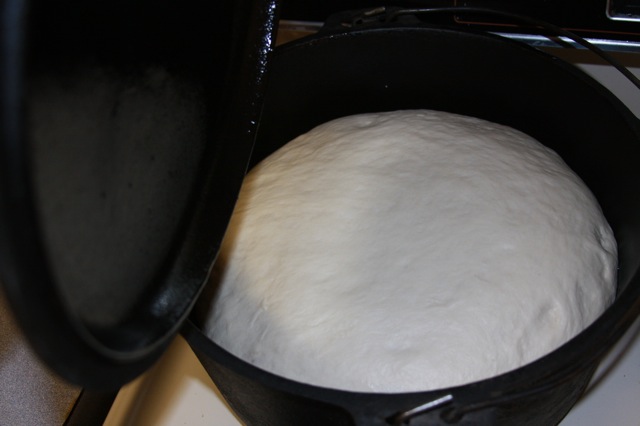
Place dough in the pot and cover with the lid. Let rise in a warm place until dough pushes up the lid by about 1/2 inch, about 1 hour (watch closely).

Bake, covered with lid, in a 375 degree oven for 12 minutes. Remove lid and bake for another 30 to 35 minutes, or until loaf is golden brown and sounds hollow when tapped. Remove from oven and turn loaf out (you’ll need a helper) onto a rack to cool. Makes 1 very large loaf.

A poignant camp custom: Before serving, a herder would slash the sign of the cross on top of the loaf, then serve the first piece to his invaluable dog.

 
Here's another, more traditional-looking recipe from the same source:
 
Quote
 
IMG_0688
 
S]eemingly once I left home for school, my dad began making his own jamon and chorizo. Another tradition my dad has revived recently is making sheepherder’s bread.  Actually, the whole gang in Homedale has gotten back to their roots, so to speak, and they hold competitions for the best bread. It gets pretty intense, with guys speculating about whether this loaf will turn out or not. My dad is no exception. He treated us to the full experience over break.

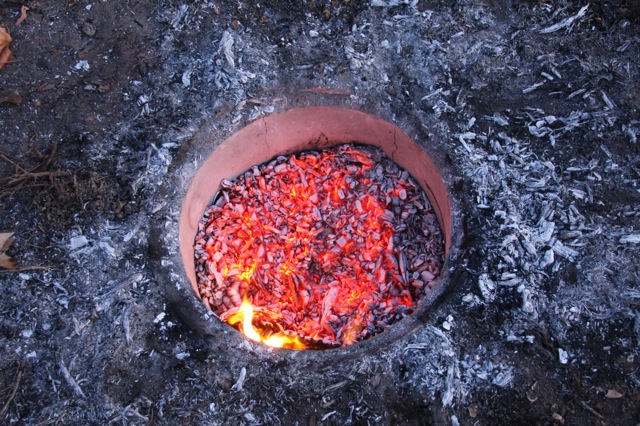
Out in the hills, he would dig a pit in which to bake the bread.  At his home, however, he has a permanent pit, lined with a big concrete pipe. Most of the time, it’s covered with a board and it’s only rarely that the lid comes off and he makes a loaf, mostly because it does take some effort. He’s collected a large pile of sagebrush from the hills that he slowly is chipping away at.

I’ve had a recipe for sheepherder’s bread [that I've used] for some time now (above), and from what I’ve been told and experienced from my wife’s own hand, it makes a very good loaf.  But Dad’s (txitxi to my daughter) recipe is slightly different:

IMG_0874


Quote Txitxi Bread for a #10 Dutch Oven 1.5 packets active dry yeast (he uses Red Star) 1 quart + "a bit" lukewarm water 1 heaping Tbsp + 1/4 tsp sugar Combine and let yeast proof. Add 3/4 tsp salt and all purpose flour until you reach desired consistency. Knead until smooth. Let rise until doubled in bulk, twice. Put in greased dutch oven (preferably with bacon grease) and let rise until lid is pushed up. If baking in oven, 350 degrees Fahrenheit for approximately 60 minutes. Keep covered with lid or tented with foil.

However, if you want to be authentic, you’ve got to cook it in the pit.

IMG_0773

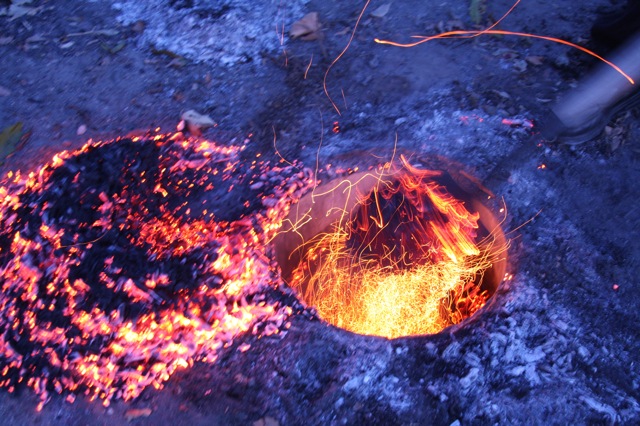
First, we burned quite a bit of the sagebrush, just to get some ashes to use later.  These we dug out and let cool. We then burned another batch. These were for the hot ashes, the ones to cook the bread. Once the sagebrush had burned down such that we had maybe 5 inches of hot coals, we lowered the Dutch oven into the pit. This is where the cool ashes come in.  We covered the Dutch oven with cool ashes to act as an insulating blanket and to keep the heat in.  We further covered it with a little dirt. This seems to be the trickiest part: you want enough insulation to keep the heat in but not so much that you smother the fire. Dad said that you should be able to just barely feel the heat coming off when putting your hand near the top.

A critical step is to make sure the handle of the Dutch oven is up when you start burying it, as otherwise you won’t have anything to grab when you pull it out.

We left our bread in the pit for something on the order of 1 and a half hours. It was getting late and we needed to eat dinner, so we pulled it out, maybe a little early. The center wasn’t quite cooked.  Dad threw it in the conventional oven for a while longer to eat the next day. He claimed we had smothered the fire, put too much ash on top. In any case, the bread looked great and, the next day, the bread tasted great too.

IMG_0794

While we were burning all of that sagebrush and the wind picked up some embers and blew them around, I asked dad if he ever had a fire get away from him in the hills. He said once, a fire started to get away, but he was able to put it out, so nothing really happened.  But he had a tale of another sheepherder who did have one get completely out of control. It burned quite a few acres, getting big enough that a fire crew had to be called in to put it out.  I don’t know how much it ended up burning or exactly where this was, but dad said that this sheepherder somehow became part of the fire crew, helped put it out, and got paid to do it!

This is a very simple recipe, with only 5 ingredients. I imagine it was important for a young sheepherder, cooking in a strange environment with limited ingredients while also trying to herd sheep, to keep things as simple as possible. I’m not sure how much these guys would have cooked back in the old country, but I imagine it was very little. I also imagine that the bread isn’t too sensitive to how it’s cooked as things aren’t precisely controlled in this process.  But, it sure does produce some very tasty bread!


If you are a visitor and like what you see, please click here and join the discussions in our community!
Back to Top
Sponsored Links


Back to Top
Margi Cintrano View Drop Down
Master Chef
Master Chef
Avatar

Joined: 03 February 2012
Location: Spain
Status: Offline
Points: 6362
Post Options Post Options   Thanks (0) Thanks(0)   Quote Margi Cintrano Quote  Post ReplyReply Direct Link To This Post Posted: 24 January 2013 at 13:06
Tas. I believe I had once told you that a former friend of mine ( we lost contact when I moved to Europe) and she gave me an article called The Lost Tribes; and there is a large Basque Community in Boise, Idaho with a fine documented Library & Basque shops ... Susan was born & raised in Boise. She had moved to Miami Beach for a job oppty. She was a VP in a well known Insurance Corp.   Sounds like u are learning about The Basques ! ! I have had numerous breads in Alava, Vitoria & in the cities of San sebastian, Guipuzcoa and Bilbao, Vizcaya. This is a very rural bread ... It is prepared with pork fat not butter in Pais Vasco !
Volamos a Mediterraneo, un paraiso que conquista su gente u su cocina.
Back to Top
 Post Reply Post Reply
  Share Topic   

Forum Jump Forum Permissions View Drop Down


This page was generated in 0.114 seconds.