
|
Thank you, from the Foods of the World Forums! |
Egypt: Ful mudammas (fava beans) |
Post Reply 
|
| Author | |
Marissa 
Cook 

Joined: 28 February 2012 Location: Austin TX Status: Offline Points: 160 |
 Post Options Post Options
 Thanks(0) Thanks(0)
 Quote Reply Quote Reply
 Topic: Egypt: Ful mudammas (fava beans) Topic: Egypt: Ful mudammas (fava beans)Posted: 30 April 2012 at 11:53 |
|
We grew a bunch of fava beans for the first time at the farm this year and I really haven't done much with them in the past, so I've been exploring new recipes. I'm also on a weird breakfast kick - it's the only meal of the day that my pregnant body really wants so I've been trying all sorts of new things. So when I came across a fava bean breakfast, I just had to try it!
This is based on a recipe in Mediterranean the Beautiful Cookbook but I took a bit of liberty with it as it's not much of a recipe and it called for dry beans anyway. Basically, you simmer fava beans until done, then add garlic, salt, parsley and cumin until you like the way it tastes and drizzle with olive oil! By the way, I've seen this spelled a dozen ways, this is just the way it was in the cookbook. Here's the ingredients. For some reason, I didn't think I was going to use the cumin. The recipe said it was optional and I just wasn't sure it was going to go with the flavors, but I wound up adding it in later. 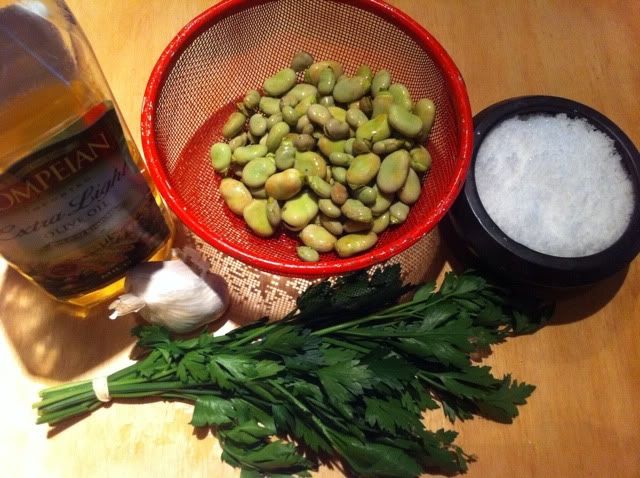 The fava beans and parsley are homegrown. I used about 1.5 cups of fresh fava beans and simmered in vegetable stock (just enough to cover) until they were done, about 15 minutes. You can either leave the beans whole or mash them. There was nothing about draining them before mashing in the recipe but it seemed I had too much liquid, so I did drain them but reserved the stock. I stuck them in the food processor with 2 cloves of garlic, about 2 tablespoons of parsley, a teaspoon of cumin and enough stock to make a paste. The stock was salty enough that I didn't need to add much more than a little pinch. I then served with a sprinkling of parsley on top, a drizzle of olive oil and some salted yogurt, hard boiled eggs and the Texas version of pita bread (homemade tortillas). 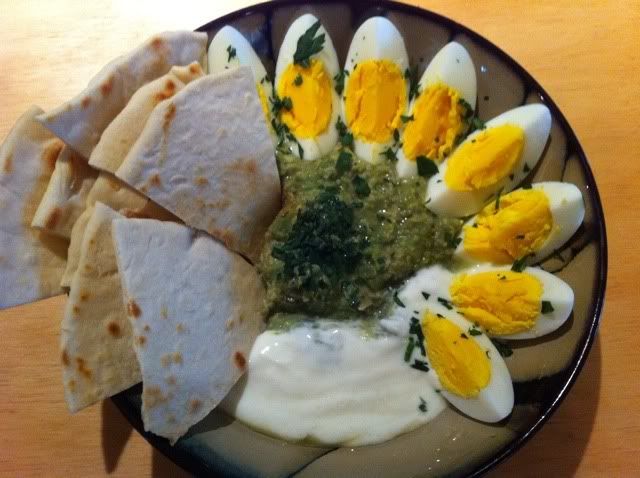 Absolutely delicious. My husband loved it too. My toddler scraped her tongue with her spoon after trying it to make sure she got every little particle out of her mouth. Sigh, can't win them all! Hubby thinks it's the garlic she doesn't like so I may try some without in the future. Not much of a recipe, more of an idea of how to do it! But it's a simple dish!
|
|
 |
|
| Sponsored Links | |
|
|
|
TasunkaWitko
Admin Group 

Joined: 25 January 2010 Location: Chinook, MT Status: Offline Points: 9389 |
Post Options
Thanks(0)
Quote Reply
Posted: 30 April 2012 at 12:08 |
|
looks pretty good to me, and i love that presentation ~
|
|
|
If you are a visitor and like what you see, please click here and join the discussions in our community!
|
|
|
|
|
Margi Cintrano
Master Chef

Joined: 03 February 2012 Location: Spain Status: Offline Points: 6362 |
Post Options
Thanks(0)
Quote Reply
Posted: 30 April 2012 at 12:34 |
|
Marissa,
Lovely post. Thanks for idea.
Fava beans are also very popular in Italia and Greece. I make a Hummus with them too.
You certainly have a green thumb !
Margi.
|
|
|
Volamos a Mediterraneo, un paraiso que conquista su gente u su cocina.
|
|
|
|
|
ChrisFlanders
Chef's Apprentice 

Joined: 01 March 2012 Location: Flanders Status: Offline Points: 343 |
Post Options
Thanks(0)
Quote Reply
Posted: 01 May 2012 at 03:51 |
|
Very nice mediterranean dish and beautiful pictures, Marissa! Fave are most popular in many south-European countries. There's not only used fresh but also dried. There's a big difference in taste between dry and fresh ones. Maroccans love to make soup from the dried ones. I buy "fresh" frozen but only Maroccan foodshops seem to have them around here. You will find these beans on many gastronomic dishes too in springtime. It's not clear in your post but I have to guess you boiled them and ate them as they were? I know it's a lot of extra work but mostly they also remove the peel from the beans themselves after they are cooked, these peels don't seem to digest too easy and they're not very agreable to eat neither. It's known that fresh fave in their pods produce more waste than food! What is left after peeling the cooked bean itself is a very bright green 2 halves. Even when using frozen ones, I still remove the peel after boiling them. It could well be that your toddler will like them peeled...? |
|
|
|
|
HistoricFoodie
Admin Group
Joined: 21 February 2012 Location: Kentucky Status: Offline Points: 4945 |
Post Options
Thanks(0)
Quote Reply
Posted: 01 May 2012 at 05:29 |
|
Really nice presentation, Marissa, for a dish that often looks pretty blah.
Favas used to be much more popular in America than they are now. Loss of fashion stems from our emphasis on convenience over taste. For most people, prepping them consists of: shucking the beans, blanching them to loosen the skins, peeling each individual bean, then cooking.
Let's face it. If Birdseye didn't shuck 'em for us, most of us wouldn't even eat English peas!
I'm glad to see you're growing them, as they're a great addition to many cuisines.
|
|
|
|
|
Margi Cintrano
Master Chef
Joined: 03 February 2012 Location: Spain Status: Offline Points: 6362 |
Post Options
Thanks(0)
Quote Reply
Posted: 01 May 2012 at 05:37 |
|
FAVA BEANS are called HABAS in Spanish, and they are more popular on the Mediterranean Coast in Catalonia than in the interior of the Iberian Peninsula. They are commonly soaked overnight in salted water and then, rinsed and boiled with a Ham Hock. They are slow cooked for 2 1/2 hours, until tender yet firm to bite --- and served with tiritas = little slim matchbook size pieces of local Ham with EVOO and lemon drizzled.
Thanks for posting the Hummus style.
Margi.
|
|
|
Volamos a Mediterraneo, un paraiso que conquista su gente u su cocina.
|
|
|
|
|
Marissa
Cook
Joined: 28 February 2012 Location: Austin TX Status: Offline Points: 160 |
Post Options
Thanks(0)
Quote Reply
Posted: 01 May 2012 at 09:30 |
|
Chris, I've seen countless recipes that talk about blanching and then peeling the beans. After just a few minutes of boiling, I pulled some out and tried the bean, tried the skin and tried the bean and skin. Maybe because these are so fresh, or even because they weren't fully mature (you can see lots of the little ones in the uncooked batch), the skin was absolutely not offensive. So I left them on!
By the way, Giada said on one of her shows you don't have to peel if you cook them long enough. I know what a fan some of you are of her 'cooking' so thought that might be a point in favor of leaving them on! Next time I may just try peeling and see what a taste/texture difference there is. EDIT: Interesting article about peeling. Apparently it's country specific... |
|
|
|
|
HistoricFoodie
Admin Group
Joined: 21 February 2012 Location: Kentucky Status: Offline Points: 4945 |
Post Options
Thanks(0)
Quote Reply
Posted: 01 May 2012 at 10:00 |
|
Marissa, depending on how big your crop is, you might be interested in knowing that one of the two most common forms of falafal uses half chickpeas and half favas.
|
|
|
|
|
africanmeat
Chef 

Joined: 20 January 2012 Location: south africa Status: Offline Points: 910 |
Post Options
Thanks(0)
Quote Reply
Posted: 01 May 2012 at 10:10 |
|
It looks great very nice presentation. love full mudammas at my house we eat it with hummus, boiled eggs ,falafel made out of ful (not Chickpeas ) and some chili paste.
like your one i do it with garlic ,cumin ,olive oil,lemon juice.salt and pepper. thanks for the post.
|
|
|
Ahron
|
|
|
|
|
ChrisFlanders
Chef's Apprentice
Joined: 01 March 2012 Location: Flanders Status: Offline Points: 343 |
Post Options
Thanks(0)
Quote Reply
Posted: 02 May 2012 at 06:01 |
|
Marissa, indeed, your fresh from the garden beans should have a much softer peel. It's not a "must" to remove the peel at all, but it is in restaurant dishes. I'm not familiar with that Gaida person but her suggestion to cook them "long enough so you don't have to peel them" is very odd imo. I would rather suggest to have a spoon at hand when cooking these, regularly fish out a bean and bite on it or press between a thumb and indexfinger, that's the perfect way to check how these fresh beans are cooking. I like to add a few to savory dishes. They're boiled, peeled and sauteed for a moment in a little butter. Another addition to savory dishes is to make a purée of them like you did in your first post. I boil them in water, drain, add a little chickenstock plus a dash of cream and mix them finely, then push through a fine sieve where the bits of peel are removed. The result is a silky lightgreen purée. I was also wondering, does anyone use the name "broadbeans" for these? |
|
|
|
|
Marissa
Cook
Joined: 28 February 2012 Location: Austin TX Status: Offline Points: 160 |
Post Options
Thanks(0)
Quote Reply
Posted: 02 May 2012 at 09:48 |
I used to. It was the standard American name for them until they went out of favor and now with recent re-interest, they are going by fava beans. The reason I always called the broad beans was because the majority of homesteading books I read were published in England and that's the name they use! I *think* most people in the US know they are the same thing...if they know what one is at all! Here's all you need to know about Giada: http://foodsoftheworld.activeboards.net/television-cooking-personalities_topic969.html :)
|
|
|
|
|
ChrisFlanders
Chef's Apprentice
Joined: 01 March 2012 Location: Flanders Status: Offline Points: 343 |
Post Options
Thanks(0)
Quote Reply
Posted: 02 May 2012 at 10:43 |
|
I called you twice "Melissa" instead of Marissa
 , sorry for that, could be a getting old thing I suppose! I corrected the two errors. , sorry for that, could be a getting old thing I suppose! I corrected the two errors.
|
|
|
|
|
Marissa
Cook
Joined: 28 February 2012 Location: Austin TX Status: Offline Points: 160 |
Post Options
Thanks(0)
Quote Reply
Posted: 02 May 2012 at 11:11 |
|
Ha! I don't even notice that anymore. I've gotten it my whole life and readily respond to 'Melissa' when someone says that name. People are always laughing at me when I turn my head because some one has said 'Melissa' but seriously, EVERYONE makes that mistake when I first meet them and sometimes for a long time after!
|
|
|
|
|
HistoricFoodie
Admin Group
Joined: 21 February 2012 Location: Kentucky Status: Offline Points: 4945 |
Post Options
Thanks(0)
Quote Reply
Posted: 02 May 2012 at 13:27 |
|
But don't forget, Chris, that we also have a Melissa who is a member. Don't go getting them mixed up, now.
Broad beans are, indeed, how they were most known in the U.S. as well as the UK. The oldest variety still around are the Windsor Broad Beans, and many only know them by that name, or simply as Windsor Beans, as well.
Near as I can determine, they are the only one of the Old World beans still regularly eaten.
|
|
|
|
|
Post Reply
|
|
 Tweet
Tweet
|
| Forum Jump | Forum Permissions You cannot post new topics in this forum You cannot reply to topics in this forum You cannot delete your posts in this forum You cannot edit your posts in this forum You cannot create polls in this forum You cannot vote in polls in this forum |


 Topic Options
 ChrisBelgium wrote: