
|
Thank you, from the Foods of the World Forums! |
Erwtensoep |
Post Reply 
|
| Author | |||
TasunkaWitko 
Admin Group 

Joined: 25 January 2010 Location: Chinook, MT Status: Offline Points: 9389 |
 Post Options Post Options
 Thanks(0) Thanks(0)
 Quote Reply Quote Reply
 Topic: Erwtensoep Topic: ErwtensoepPosted: 14 October 2011 at 11:54 |
||
|
Wikipedia provides some interesting information on this uniquely Dutch soup, how it is made and served - and it's place in everyday Dutch life:
Wiki's section on Dutch Cuisine offered a little more information:
Here's the recipe, from Time-Life's Foods of the World - A Quintet of Cuisines (1970):
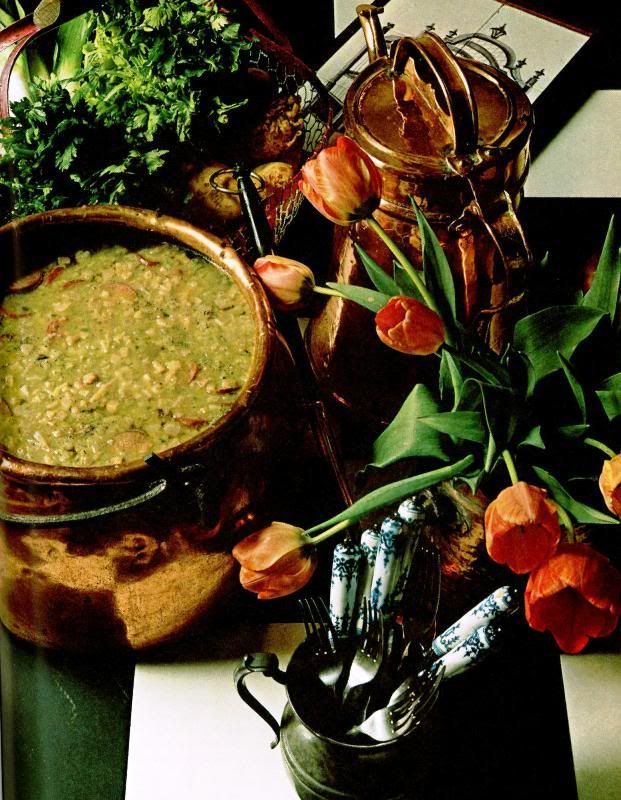
Here's a picture from the Time-Life volume:
 |
|||
|
If you are a visitor and like what you see, please click here and join the discussions in our community!
|
|||
 |
|||
| Sponsored Links | |||
|
|||
|
TasunkaWitko
Admin Group
Joined: 25 January 2010 Location: Chinook, MT Status: Offline Points: 9389 |
Post Options
Thanks(0)
Quote Reply
Posted: 14 October 2011 at 14:18 |
||
|
in shopping for this, i ran into a couple of snags. one is the celeriac, which our local grocery carried up until just a couple of months ago, but then quit carrying because no one ever bought it. i'll check in a few places, but i will probably end up using one of the substitutes from the food thesaurus at www.foodsubs.com:
the second problem was tracking down the herb, savory ~ ironically, i've grown it the last 3 years, but it hasn't grown too well, just a few leaves, and so i didn't plant it this year. to heighten the irony, the few herbs i DID plant this year did really, really well - i guess i will start planting it again next year ~ in the meantime, i eventually found a supply of dried summer savory at a great price by calling the local health food store. if you can't find any where you are, www.foodsubs.com lists the following for substitution:
|
|||
|
If you are a visitor and like what you see, please click here and join the discussions in our community!
|
|||
|
|||
|
pitrow
Master Chef

Joined: 22 November 2010 Location: Newberg, Oregon Status: Offline Points: 1087 |
Post Options
Thanks(0)
Quote Reply
Posted: 20 October 2011 at 11:11 |
||
|
Pretty similar to my Oma's (Grandma) recipe.
I love that stuff. It's my comfort food. Reminds me I need to make some.... |
|||
|
|||
|
TasunkaWitko
Admin Group
Joined: 25 January 2010 Location: Chinook, MT Status: Offline Points: 9389 |
Post Options
Thanks(0)
Quote Reply
Posted: 20 October 2011 at 11:38 |
||
|
Hey, pitrow ~ good to see you posting on this! If you make this, please make a post with your recipe and some pictures. It would be great to see this made by someone who grew up with it!
Take a look at this passage, and see if it might bring up any memories for you:
From Time-Life's Foods of the World - A Quintet of Cuisines (1970):
I started this recipe out at my parent's house, since most of that day was consumed with pickling beets and canning tomatoes. Since the first stage of making the soup involves simmering the peas, trotters and salt pork for three hours, I figured I might as well do it there, and then bring the operation back home to finish for supper.
Here's a shot of the ingredients I needed to get started:
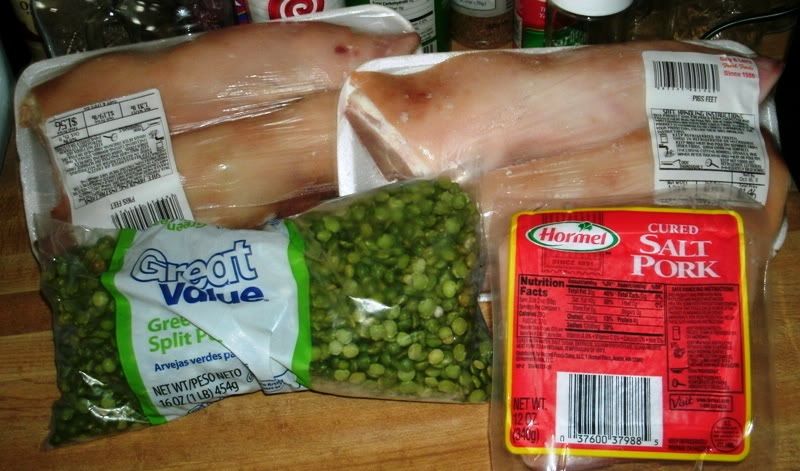 As with most of the dishes I prefer to make, the ingredients are simple, humble, economical and close to the land, and this is no exception.
A note on the pig's feet: these were split, so i bought four halves (2 pig's feet). as it turned out, they didn't have much meat on them, but it was ok. They also serve a purpose in that they are full of melty gelatinous goodness that will be released while simmering.
A note on the salt pork: You want to choose salt pork that is cured and as "meaty" as possible. I searched an entire bin to find the one that had the most meat versus fat, and it paid off pretty well. The salt pork will probably come with a rind of skin. Per the instructions, I trimmed it off, providing a wonderful square of rind and fat, which worked beautifully in a dish that i did a couple of nights later, when i rendered it out and fried onions and lean beef in the fat.
You want to use the proscribed amount of water (four quarts) because the peas will require it, and so will the feet and salt pork, in order to soak up the moisture that they need. There is no need to add any salt to this recipe, as plenty will come from the salt pork and, later, from the sausage.
I added the components to the water in the kettle:
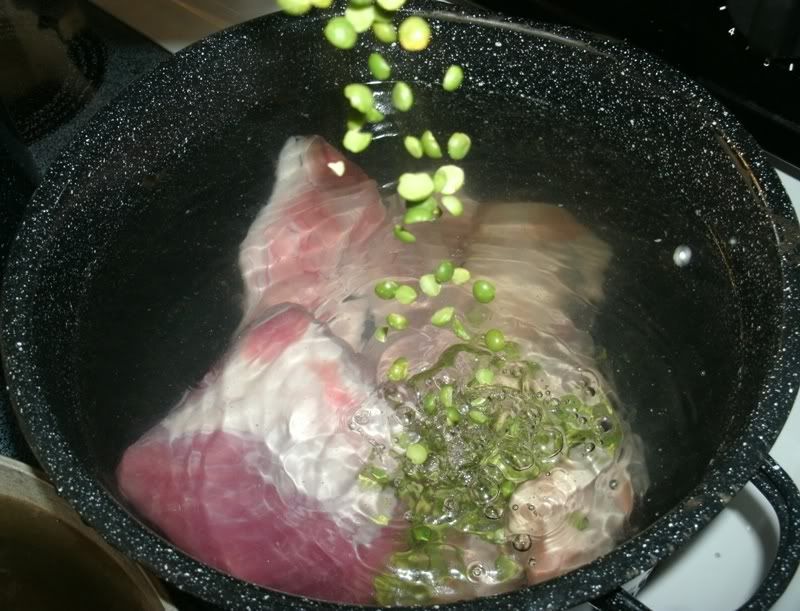 Then brought it to a boil and reduced the heat so that it could simmer, bubbling contently, for three hours. This allowed time for the peas to absorb the water, the salt pork to release it's wonderful flavour and the trotters to melt into rich goodness!
When that was done, I was also finished with my canning for the day, so I packed everything back home and turned my attention to the remainder of the preparation. I had asked #3 son Billy to get a shot of the rest of the goods with his iPhone or iPod or some electronic gizmo, but he wasn't able to get the pictures to save, so we're missing out on that ~ no worries, though, because he prepped them for me and did a great job of it.
The three-hour-boiling finished, I then consulted the recipe and added the next ingredients:
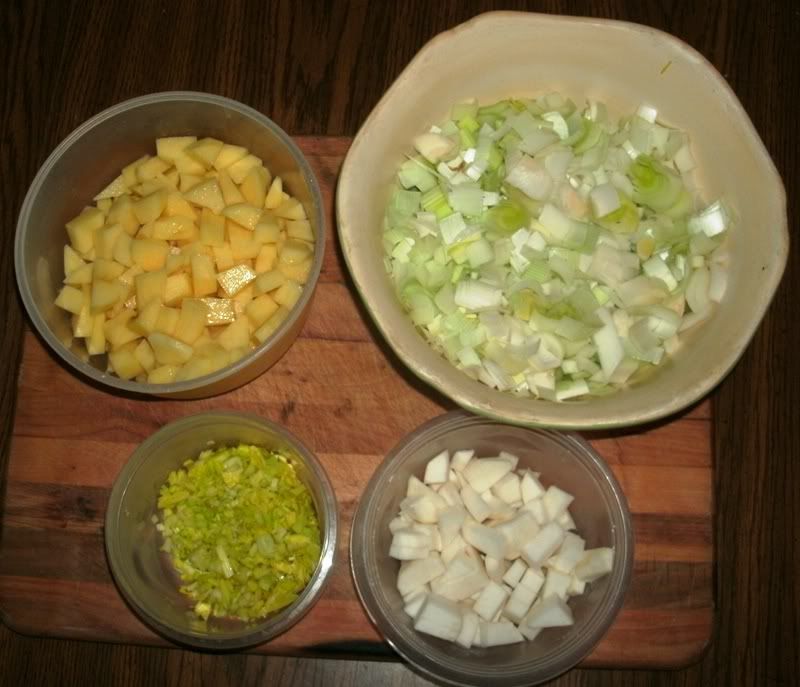 Clockwise from upper-left: potatoes, leeks, 1 large turnip (substituted for celeriac) and chopped celery leaves.
Normally, the celery I buy has beautiful, big, very green celery leaves - but this time, they were a little pale. for the best flavour, you want to use the best ones you can find. There is something about celery leaves that make any good soup much, much better, with an aroma and subtle flavour that really brings things up a notch.
When I added these ingredients, the soup, which had been a thin, pale green so far, immediately transformed into a thick, delightful, verdant treasure:
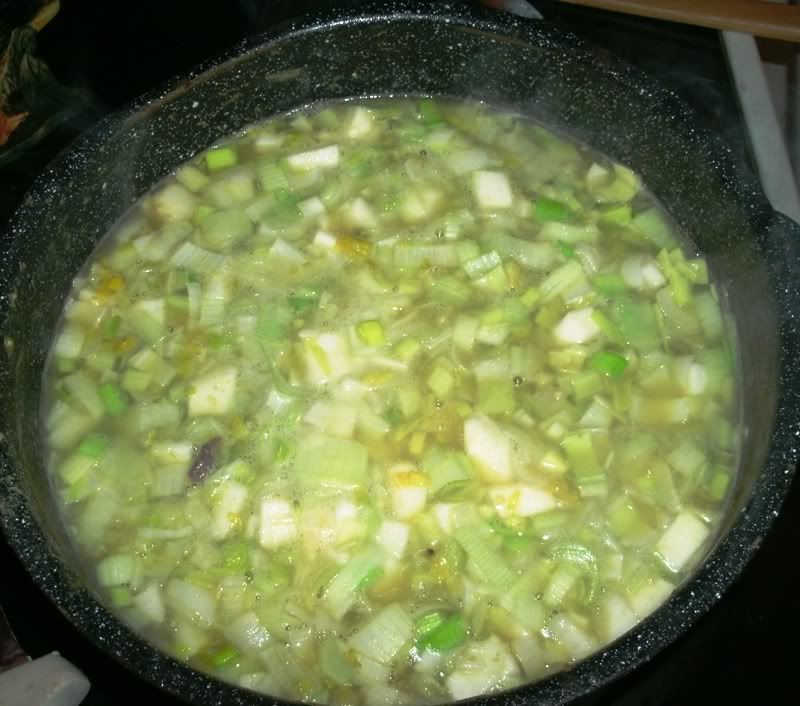 The aroma was wonderful and completely full of the rich, bountiful earth, and I was suitably impressed with the way things were going. The recipe dictates that the soup (which was on the verge of being a stew now) simmer another half hour, so we brought it to the bare beginnings of a boil again and then reduced heat to a slow, thick bubble.
30 mintues later, I lifted the lid and saw some beautiful stuff:
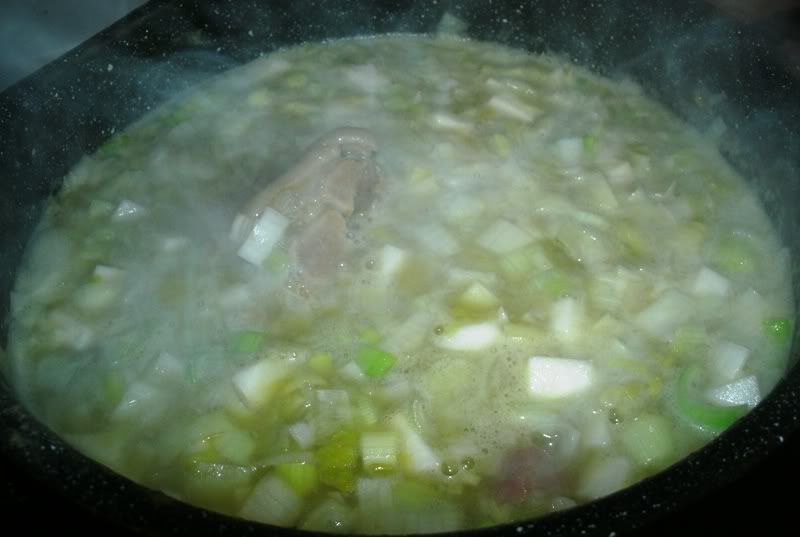 The peas had pretty much incorporated themselves into the stew, the leeks and celery leaves were starting to break down, and the potatoes and turnip were tender. Everything looked just about right and ready for the next stage.
I removed the salt pork and the feet from the soup and left it to simmer while I prepared the meat:
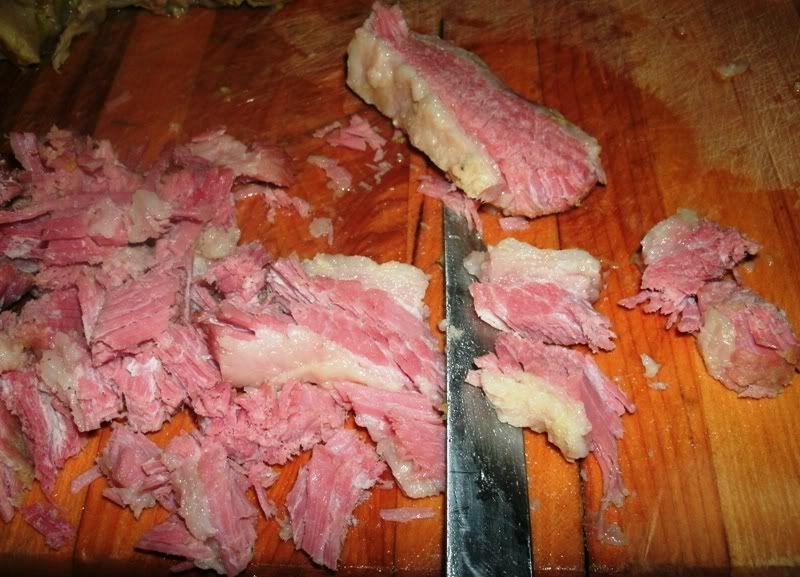
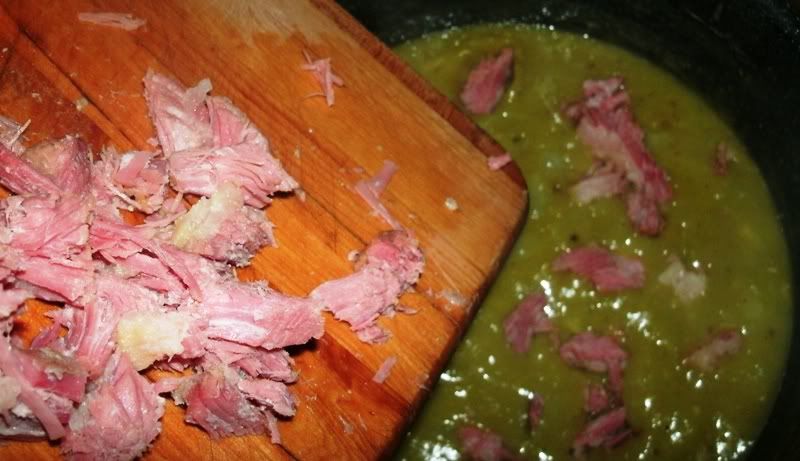
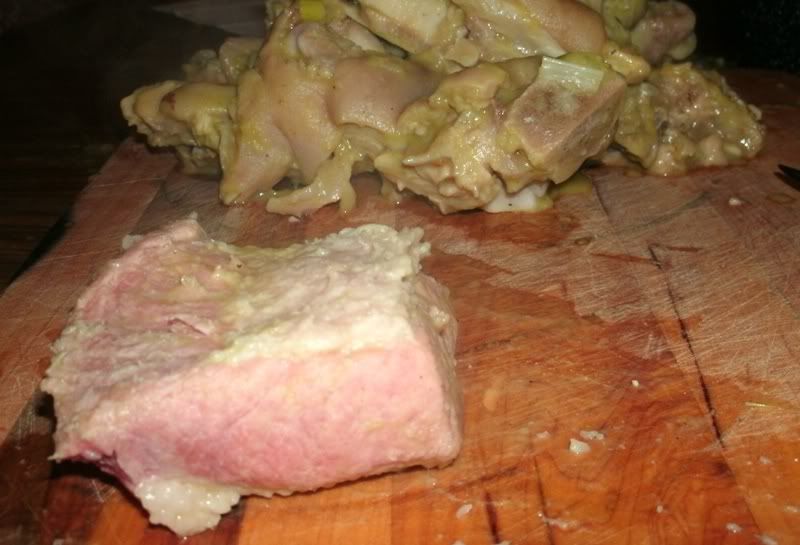 The trotters had broken down very well - the skin was sloughing off and the bones were very loose. They really didn't have much meat on them, so we got what little we could and then I diced the salt pork:
 And added the meats to the bubbling, thickening stew:
 At this point, tradition dictates that Dutch rookworst, sliced into thin coins, be added to the stew, but rookworst is a little hard to come by in this part of the country. Kielbasa or some other similar smoked sausage is a perfectly acceptable substitute:
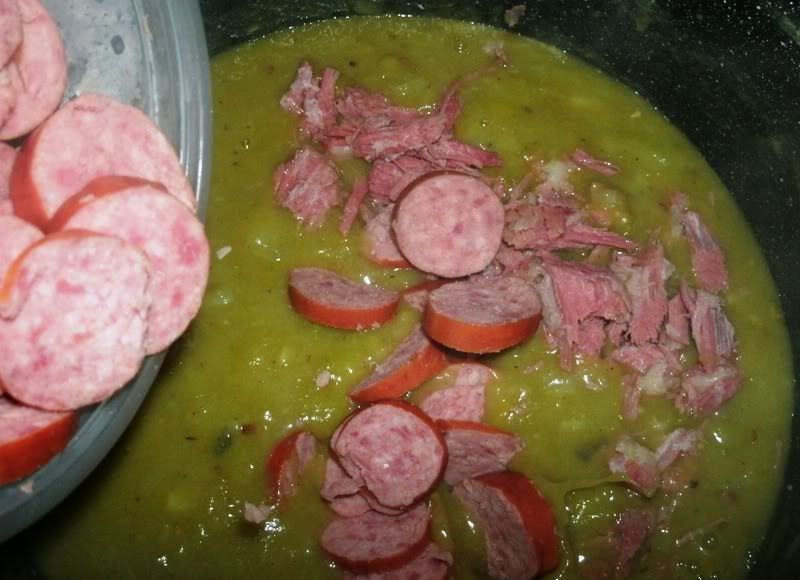 After adding the sausage, I stirred in a moderate dose of black pepper and the summer savory, and then let the erwtensoep simmer for about 10 minutes in order to heat everything though.
By this time, the vegetables had broken down very well and we were left with a rich, thick, bubbling joy, with a few bits of potato and turnip to provide some texture along with the meats:
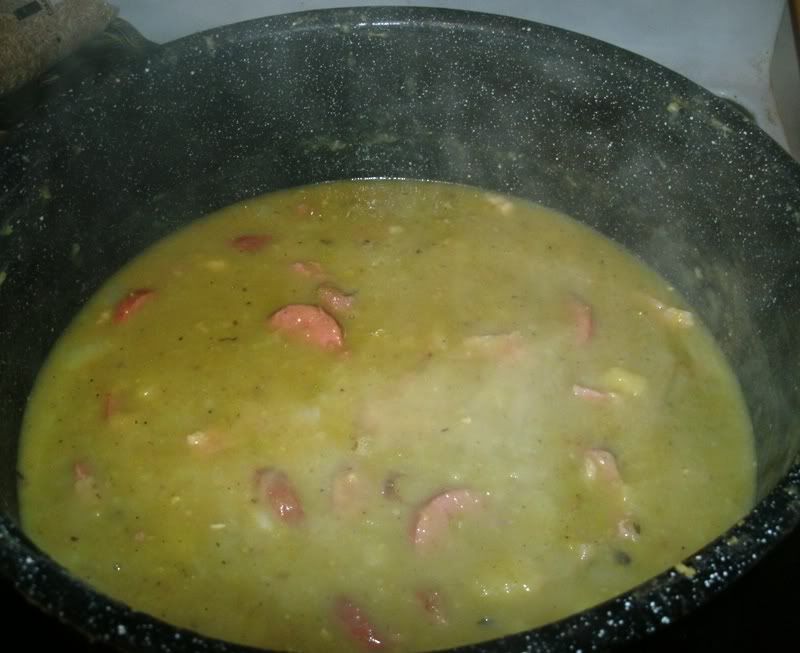 When the erwtensoep was ready, I served it up:
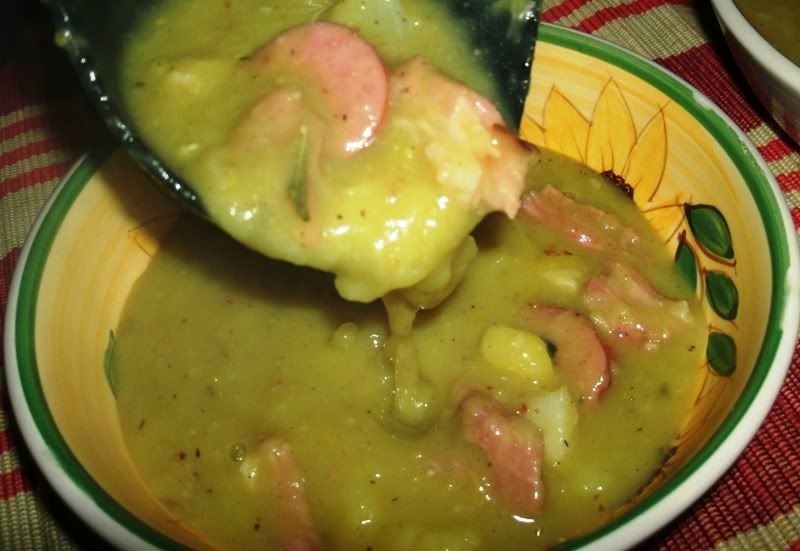 Normally, this soup/stew/"stewp" is served with roggebrood, a Dutch rye bread, but we didn't have any handy, so we buttered some slices of humble, whole wheat bread, it it worked just as well.
I really enjoyed this soup and all of the deep, earthy flavours. It is amazingly clear why it is associated in Holland with winter days in the countryside, as it contains everything that could be found on a family farm there. When simple ingredients are brought together and given slow, gentle cooking, the result is always much more than the sum of its parts, and this was no exception. Every component was evident, but in between were flavours that simply wouldn't have been possible without the combination. The only thing I could see doing differently was to perhaps add a few diced carrots for colour, which would be in keeping with Dutch versions of this recipe.
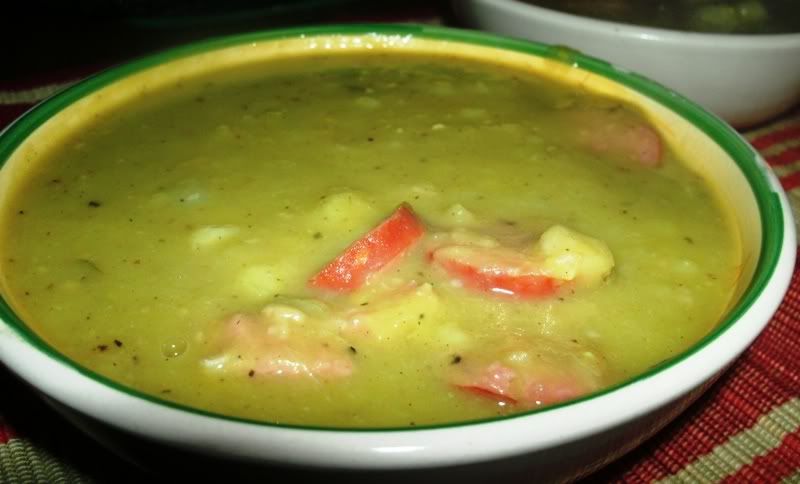 The entire family really liked this dish - but the kids, who had been enjoying seconds to the point where I had none for lunch the next day, seemed to change their minds the later on when they found out there were pigs' feet in it. Suddenly, for that reason alone, the soup went from "wonderful" to "yucky."
Thanks for taking a look at this - it was a real treat and one that will definitely be made again for a humble, satisfying supper on a cold winter's day. I hope that some of you are able to give this a try ~ especially those of you who live in the rural areas of the north - it's a perfect dish for such a setting! |
|||
|
If you are a visitor and like what you see, please click here and join the discussions in our community!
|
|||
|
|||
|
pitrow
Master Chef
Joined: 22 November 2010 Location: Newberg, Oregon Status: Offline Points: 1087 |
Post Options
Thanks(0)
Quote Reply
Posted: 20 October 2011 at 13:17 |
||
|
Damn man, you're makin' me drool all over my keyboard.
|
|||
|
|||
|
TasunkaWitko
Admin Group
Joined: 25 January 2010 Location: Chinook, MT Status: Offline Points: 9389 |
Post Options
Thanks(0)
Quote Reply
Posted: 20 October 2011 at 14:00 |
||
|
that's the idea ~

|
|||
|
If you are a visitor and like what you see, please click here and join the discussions in our community!
|
|||
|
|||
|
Bill/Oregon
Scullery Servant 
Joined: 30 October 2011 Location: Southern Oregon Status: Offline Points: 2 |
Post Options
Thanks(0)
Quote Reply
Posted: 30 October 2011 at 11:47 |
||
|
Tasunka: I followed your recipe over here from AR, and registered. I'm going to give it a go today or tomorrow. I think I can find celeriac.
Update: Found the celeriac, but the store we was out of pigs' feet and leeks. So I'm using the pork chops, and grabbed my leeks from another shop. It's all simmering now ... |
|||
|
|||
|
TasunkaWitko
Admin Group
Joined: 25 January 2010 Location: Chinook, MT Status: Offline Points: 9389 |
Post Options
Thanks(0)
Quote Reply
Posted: 30 October 2011 at 14:50 |
||
|
sounds like you've got a plan, bill! hocks and/or a hambone worke well, too!
good to see you over here - thanks for joining! hope to see a picture of the finished erwtensoep!
|
|||
|
If you are a visitor and like what you see, please click here and join the discussions in our community!
|
|||
|
|||
|
TasunkaWitko
Admin Group
Joined: 25 January 2010 Location: Chinook, MT Status: Offline Points: 9389 |
Post Options
Thanks(0)
Quote Reply
Posted: 04 April 2012 at 13:23 |
||
|
for those of you preparing ham for easter, this might be a great use for the ham bone!
|
|||
|
If you are a visitor and like what you see, please click here and join the discussions in our community!
|
|||
|
|||
|
Hoser
Admin Group

Joined: 06 February 2010 Location: Cumberland, RI Status: Offline Points: 3454 |
Post Options
Thanks(0)
Quote Reply
Posted: 05 April 2012 at 03:52 |
||
|
Outstanding job Ron!
A thick, sludgy bowl of pure belly-warming goodness
 |
|||
|
Go ahead...play with your food!
|
|||
|
|||
|
Margi Cintrano
Master Chef

Joined: 03 February 2012 Location: Spain Status: Offline Points: 6362 |
Post Options
Thanks(0)
Quote Reply
Posted: 05 April 2012 at 05:40 |
||
|
Good Morning,
Celery Turnip:
The dish looks very delicious ... crusty warm bread, a glass of wine ... it works as a whole lunch for me ...
Thanks for posting.
Margi.
|
|||
|
Volamos a Mediterraneo, un paraiso que conquista su gente u su cocina.
|
|||
|
|||
|
Post Reply
|
|
 Tweet
Tweet
|
| Forum Jump | Forum Permissions You cannot post new topics in this forum You cannot reply to topics in this forum You cannot delete your posts in this forum You cannot edit your posts in this forum You cannot create polls in this forum You cannot vote in polls in this forum |


 Topic Options
 Erwtensoep, also called "snert", is the
