
|
Thank you, from the Foods of the World Forums! |
Old Tinned Copper Cookware? |
Post Reply 
|
Page 12> |
| Author | |
Karl 
Chef's Apprentice 
Joined: 23 January 2012 Location: Juneau Status: Offline Points: 251 |
 Post Options Post Options
 Thanks(0) Thanks(0)
 Quote Reply Quote Reply
 Topic: Old Tinned Copper Cookware? Topic: Old Tinned Copper Cookware?Posted: 24 January 2012 at 18:41 |
|
First off, I enjoy reenacting a few historic time periods and I love cast iron but cast iron cookware seems to have "magically" appeared fully formed in 1607 (but that is a long story too.) In an attempt to create a more historically authentic camp kitchen I am experimenting with earthenware and tinned copper cookware.
Copper can be a bit pricey to collect and much smaller than the cast iron that I have gotten used to using. I am researching how to safely re-tin the insides of various copper items like:  The more I read about copper toxicity the more concerned that I am getting. The conflicting information is even more disturbing. OK, I understand cooking tomatoes in unlined copper is bad. What else is bad to cook in unlined copper? Are there things that are not even safe to cook in tinned copper? I see a few sources that say no food should be left to cool in any copper or tin(?) I understand that tin melts at a relatively low 450F so there goes some styles of cooking and that wooden spoons are best to avoid scratching the soft tin. Copper cookware owners - how all do you use your copper to best effect? What are your tips? Why does most copper cookware not seem to use lids? What foods does copper cook best? I enjoy the challenge of trying to prepare old foods as authentically as possible to experience how our grandcestors lived but I am not anxious to join them. I do not recall having to worry about my cast iron poisoning me. |
|
 |
|
| Sponsored Links | |
|
|
|
TasunkaWitko
Admin Group 

Joined: 25 January 2010 Location: Chinook, MT Status: Offline Points: 9389 |
Post Options
Thanks(0)
Quote Reply
Posted: 25 January 2012 at 09:04 |
|
karl - i really, really like your sense of authenticity and research! i don't own any copper cookware, but am interested in learning more about it.
you mention the reaction that it has with tomatoes - perhaps that's where the early notion that they are poisonous came from, if they were using copper before 1607? possibly....
i'm afraid i don't know much on the subject, but i will be reading it with interest. thank you for introducing this new aspect to historical cooking here. this is exactly what this site is about!
|
|
|
If you are a visitor and like what you see, please click here and join the discussions in our community!
|
|
|
|
|
Karl
Chef's Apprentice
Joined: 23 January 2012 Location: Juneau Status: Offline Points: 251 |
Post Options
Thanks(0)
Quote Reply
Posted: 25 January 2012 at 11:03 |
 My goal is to have a painfully period 16th century camp kitchen. I have been picking other folks' brains for years now like on Landsknecht.org or http://forums.armourarchive.org/phpBB3/viewtopic.php?f=4&t=139098&hilit=cast+iron http://api.ning.com/files/kUPB6lcJi-6dT33B*kcEyTu0XKbadI6PuvMH--eij9OEJdRQu48QWB*VhtKsImDH75SAPuhht*XHSxXnQiiIUWdGhkhHpe9K/PotsandPansHistory.pdf For now I would like to hear from die hard copper cookware fans. |
|
|
|
|
Rod Franklin
Chef 

Joined: 17 February 2010 Location: USA Status: Offline Points: 921 |
Post Options
Thanks(0)
Quote Reply
Posted: 25 January 2012 at 18:42 |
|
Hungry
|
|
|
|
|
Karl
Chef's Apprentice
Joined: 23 January 2012 Location: Juneau Status: Offline Points: 251 |
Post Options
Thanks(0)
Quote Reply
Posted: 27 January 2012 at 08:16 |
|
No gloves when he tins the copper pot? It looks like he may have done this more than once.
 This does give me a better idea what I am getting into. I need to gather the materials and tools (tin, flux, "brush", propane) and get all of my pots ready at once. All of the smoke from the flux means that I need to do it outside when the snow goes away here. Thanks! This does give me a better idea what I am getting into. I need to gather the materials and tools (tin, flux, "brush", propane) and get all of my pots ready at once. All of the smoke from the flux means that I need to do it outside when the snow goes away here. Thanks!
|
|
|
|
|
TasunkaWitko
Admin Group
Joined: 25 January 2010 Location: Chinook, MT Status: Offline Points: 9389 |
Post Options
Thanks(0)
Quote Reply
Posted: 27 January 2012 at 08:57 |
|
i've got a buddy who might have some information on this. i'll pass this link to him and see if we can pick his brain a little ~
|
|
|
If you are a visitor and like what you see, please click here and join the discussions in our community!
|
|
|
|
|
Karl
Chef's Apprentice
Joined: 23 January 2012 Location: Juneau Status: Offline Points: 251 |
Post Options
Thanks(0)
Quote Reply
Posted: 27 January 2012 at 10:30 |
|
What I would like to know the most about retinning is what the rag/brush is actually made out of. I have seen the expression "moleskin" brush but then they mention it being denim and linen(?)
Are there any foods that react dangerously even with a good tinned copper pot? |
|
|
|
|
Rod Franklin
Chef
Joined: 17 February 2010 Location: USA Status: Offline Points: 921 |
Post Options
Thanks(0)
Quote Reply
Posted: 27 January 2012 at 17:12 |
|
I think any thick, no fuzz, cotton or linen cloth would work fine. Old pair of jeans and the like. I think you're just trying to smear the molten metal smoothly and without burning yourself. The rag itself won't burn. I've brazed plenty and a smooth, thick natural material rag folded several times worked fine for any wiping that needed to be done. As the rag browned from the heat and wiping, it would become smooth, almost shiny. It also seemed to pick up flux, so I'm guessing in this application the rag would get better the more pots you did. To a point, because it would eventually burn through.
In reference tot the video, it looks as if the guy would check for the proper heat with the powdered rosin, then throw a little rosin in the pot, throw a little tin in the pot and wipe it on with the rag that was dipped in the powdered rosin. As it seemed that the heat suited him, he threw enough tin in there to do the job and would add rosin as seemed necessary. You can see the molten tin rolling along in the bottom crease of the pot. Heat and wipe, rosin, heat, wipe. Then he let it cool a little then did it again to get a little thicker tin surface. Oh yeah, it a cinch he's done it before. He's also got the added complication of the charcoal fire. The following taken from a website for a company that re-tins pots: What is Tin Tin (Sn) is a soft, malleable, silver-color metal. It is generally used
to coat other metals and to make alloys. Tin is a silvery metal when new, however it becomes darker with
cooking. This is normal and in no way interferes with the properties of the
metal. How to Use Tin-Lined Cookware Stove top cooking generates higher temperatures than tin's
melting point (about 450°F or 230°C), however liquid being heated in a
tin-lined pan will absorb a lot of excess heat and help keep the tin intact.
The majority of oven-baked recipes call for temperatures that will not harm
a tin lined utensil that is properly used. How to Care for Tin-Lined Cookware Tin is a soft metal and should be cleaned with a dishcloth or sponge.
Never use abrasive cleaning materials, such as metal scouring pads or metal
scrapers. Re-Tinning Metal Cooking Utensils Most tin coated pans will require re-lining at some point, to make them
like new again. In the case of copper, the tin prevents reaction with acidic
foods. If you're not cooking acidic foods, then it's not necessary to have a
tin lining. Also, if the copper pot is going to be subjected to very high
temperatures, such as for making hard candy, the copper needs to be bare in
order to support the high temperatures. And bare copper is desirable in
making meringues, because of its reaction to egg whites, which makes them
peak faster and longer.
How to Renew Rusted Tinned Steel Cutters Use fine sandpaper to remove the surface rust, hand wash with hot sudsy
water, dry thoroughly, and use. |
|
|
Hungry
|
|
|
|
|
Karl
Chef's Apprentice
Joined: 23 January 2012 Location: Juneau Status: Offline Points: 251 |
Post Options
Thanks(0)
Quote Reply
Posted: 28 January 2012 at 18:40 |
|
Rod - Thank you for the information! I also see some references to cooking milk in unlined copper too:
http://en.wikipedia.org/wiki/Copper_toxicity It is not very clear whether cooking milk in unlined copper pots is only a danger to certain people or not(?) It would seem to me that copper's conductivity and lower heats would otherwise be good for cooking milk. Tin seems to be a very safe metal: http://en.wikipedia.org/wiki/Tin_poisoning Bronze is a mixture of about 90% copper and 10% tin (while modern food safe pewter is about 90% tin and 10% copper) so how much safer for cooking is it then unlined copper? I notice that this maker offers his bronze cauldrons with tin lining: http://thadenarmory.com/sell/cookware/cookware.htm I do not own any bronze cookware yet (I am cheap) but it seems very appropriate to the time period(s) that I am trying to recreate. 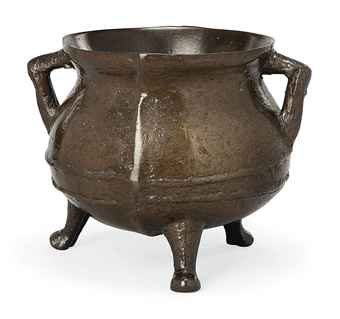 16th Cent. "leaded-bronze" cauldron. I know a fellow in Alabama who is doing some backyard bronze and iron casting. If I understand him correctly, he is carving items out of BlueBoard, packing them in dry sand, then just pouring the molten metal in(?) Apparently the molten metal evaporates the foam. Unfortunately my little kiln would not hold a crucible much bigger than a beer can.  Does anyone here know if a rivet forge could get hot enough to melt copper/bronze? Does anyone here know if a rivet forge could get hot enough to melt copper/bronze?  |
|
|
|
|
Rod Franklin
Chef
Joined: 17 February 2010 Location: USA Status: Offline Points: 921 |
Post Options
Thanks(0)
Quote Reply
Posted: 28 January 2012 at 20:08 |
|
Oh yeah, that'll get hot enough. What will you use for a crucible?
|
|
|
Hungry
|
|
|
|
|
Karl
Chef's Apprentice
Joined: 23 January 2012 Location: Juneau Status: Offline Points: 251 |
Post Options
Thanks(0)
Quote Reply
Posted: 30 January 2012 at 13:39 |
http://www.backyardmetalcasting.com/ http://codesmiths.com/shed/things/smithing/casting/ I am getting a few suggestions for what to use as a crucible. This project will need to wait a while so the weather can clear up a bit here. We are not getting hit as hard as Cordova this winter but we still have too much snow to get much done outside. I also won a nice looking footed copper cauldron on Ebay but it has not had time to arrive yet. It is supposed to be a usable 2+ quarts size. I probably need to just take pictures of what all I have so far. |
|
|
|
|
Rod Franklin
Chef
Joined: 17 February 2010 Location: USA Status: Offline Points: 921 |
Post Options
Thanks(0)
Quote Reply
Posted: 30 January 2012 at 17:30 |
|
You are an ambitious individual. Go for it, have fun and take pictures!
|
|
|
Hungry
|
|
|
|
|
TasunkaWitko
Admin Group
Joined: 25 January 2010 Location: Chinook, MT Status: Offline Points: 9389 |
Post Options
Thanks(0)
Quote Reply
Posted: 01 February 2012 at 09:13 |
|
this is an interesting discussion, guys - please keep us updated!
|
|
|
If you are a visitor and like what you see, please click here and join the discussions in our community!
|
|
|
|
|
Rod Franklin
Chef
Joined: 17 February 2010 Location: USA Status: Offline Points: 921 |
Post Options
Thanks(0)
Quote Reply
Posted: 01 February 2012 at 11:07 |
|
After watching a couple of other vids and another video of the same old timer doing a colander, I will update my opinion of the cloth used to 100% cotton cheese cloth, wadded up into a round pad.
http://www.youtube.com/watch?v=mXZGsosR-1E&list=PLA25D9C130344C427&index=2&feature=plpp_video Notice how this time he actually mixes flux and tin together in the hot colander before wiping it around, and how this time he picks up bits of tin with the rag from his pan off the heat and melts it on the hot colander as he wipes it around. |
|
|
Hungry
|
|
|
|
|
Rod Franklin
Chef
Joined: 17 February 2010 Location: USA Status: Offline Points: 921 |
Post Options
Thanks(0)
Quote Reply
Posted: 01 February 2012 at 11:30 |
|
Then there's the git-r-dun method...
http://www.youtube.com/watch?v=I4VB3uGIQL0&feature=related She might be using paper towels to wipe with and towards the end it appears that some sort of hot acid is being used to prep the pots before starting. No care given to the hole burned in the roadway... Or what type of wood is used. Maybe the finish wouldn't be very smooth or of even thickness either. I think I would rather pay the old timer in the first few videos to re-tin any cookware I might have. |
|
|
Hungry
|
|
|
|
|
Karl
Chef's Apprentice
Joined: 23 January 2012 Location: Juneau Status: Offline Points: 251 |
Post Options
Thanks(0)
Quote Reply
Posted: 06 February 2012 at 08:24 |
|
Thank you for these videos. They are helping me feel more confident about trying this (when the weather warms up a little).
Here is a site for a coppersmith: http://www.stumpblufftradingpost.com/ and his more detailed FB page: http://www.facebook.com/pages/Stump-Bluff-Trading-Post/200681260448 |
|
|
|
|
Karl
Chef's Apprentice
Joined: 23 January 2012 Location: Juneau Status: Offline Points: 251 |
Post Options
Thanks(0)
Quote Reply
Posted: 16 February 2012 at 17:25 |
|
I just received a copper cauldron (and not quite mated copper double boiler) that I won on Ebay. It seems to be 2+ qts and is similar to this one:
 It is not tinned (the double boiler top is tinned) and will take some cleaning but is fairly heavy copper and a nice usable size. I'll try and post real pictures when I have cleaned it up. So what all food is absolutely safe to cook in unlined copper? Candy? Egg whites? Corn mush? Boil water? Nothing really? |
|
|
|
|
TasunkaWitko
Admin Group
Joined: 25 January 2010 Location: Chinook, MT Status: Offline Points: 9389 |
Post Options
Thanks(0)
Quote Reply
Posted: 16 February 2012 at 21:06 |
|
nice-looking cauldron, larl! not sure what is safe and what isn't, but we should be able to find some answers ~
|
|
|
If you are a visitor and like what you see, please click here and join the discussions in our community!
|
|
|
|
|
Karl
Chef's Apprentice
Joined: 23 January 2012 Location: Juneau Status: Offline Points: 251 |
Post Options
Thanks(0)
Quote Reply
Posted: 20 February 2012 at 13:34 |
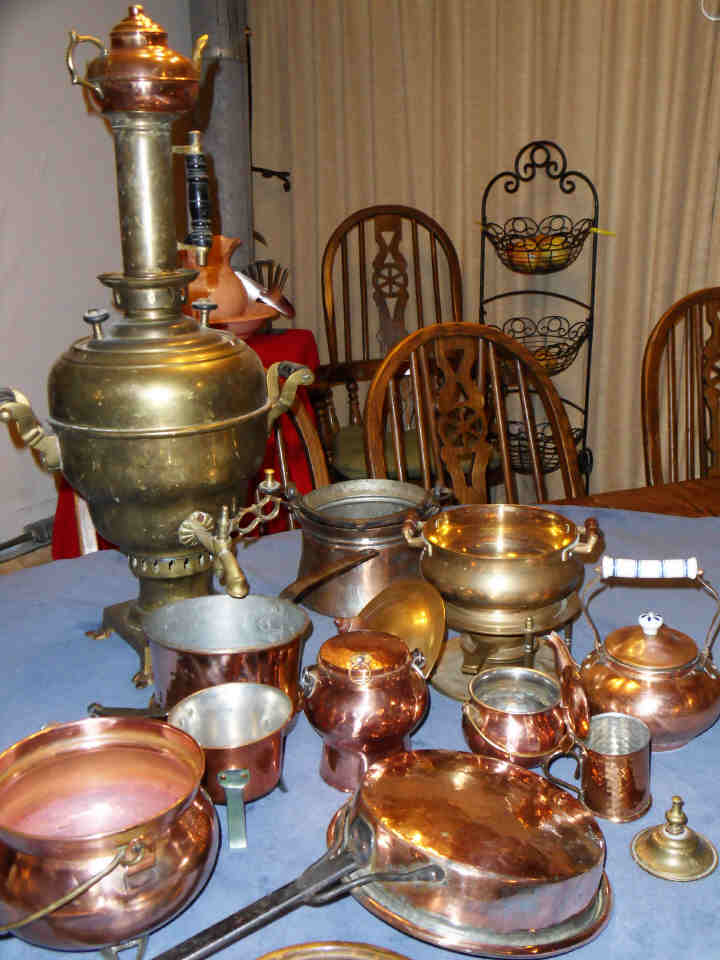 This is most of the copper that I have collected so far. The 2qt cauldron in the front left is the newest find. Is the funny tulip shaped pot in the center a "French potato steamer?" |
|
|
|
|
toomuch
Scullery Servant 
Joined: 20 February 2012 Status: Offline Points: 5 |
Post Options
Thanks(0)
Quote Reply
Posted: 20 February 2012 at 21:45 |
|
Hello all;
New to this list but not to antique copper cookware. Currently, I am working on a documented field kitchen based on Scappi's Opera field kitchen from 1570. Many of the pieces are antique, have been made for me or I have made myself, with a lot of help of course. I have tinned several pieces of cookware, it looks a lot easier than it actually is. It takes a lot of practice to wipe on a smooth coating of tin. I have made wattle fences for the kitchen and now making willow baskets for storage. If anyone is interested, I can post pictures of my kitchen, it isn't specific to any one country or time, just a lot of pieces I think are neat. Mostly to have the option to turn the kitchen from viking to 14th century England to Renaissance Spain depending on the theme of the dinner. There is cast iron cookware, but I try to find pieces that look like period iron cookware. uploads/213/59048_103603933036638_100001610940794_24304_1916435_n1.jpg |
|
|
|
|
Post Reply
|
Page 12> |
 Tweet
Tweet
|
| Forum Jump | Forum Permissions You cannot post new topics in this forum You cannot reply to topics in this forum You cannot delete your posts in this forum You cannot edit your posts in this forum You cannot create polls in this forum You cannot vote in polls in this forum |


 Topic Options
 Rod Franklin wrote: