
|
Thank you, from the Foods of the World Forums! |
cotolette di maiale alla milanese |
Post Reply 
|
| Author | |||
TasunkaWitko 
Admin Group 

Joined: 25 January 2010 Location: Chinook, MT Status: Offline Points: 9389 |
 Post Options Post Options
 Thanks(0) Thanks(0)
 Quote Reply Quote Reply
 Topic: cotolette di maiale alla milanese Topic: cotolette di maiale alla milanesePosted: 23 March 2011 at 11:45 |
||
|
from the recipe "pork milanese," in the book, everyday italian, by giada di laurentiis - 2005
as you can see, we are basically talking schnitzel here, with italian flavours. this is one of the most popular ways to cook cutlets in italy due to the ease of preparation as well as the versatility of the basic method.
coming up, some interesting notes on cutlets, translations, milanese cooking and even elephants, followed by my preparation of this dish with some (hopefully good) pix!
|
|||
|
If you are a visitor and like what you see, please click here and join the discussions in our community!
|
|||
 |
|||
| Sponsored Links | |||
|
|||
|
Hoser
Admin Group

Joined: 06 February 2010 Location: Cumberland, RI Status: Offline Points: 3454 |
Post Options
Thanks(0)
Quote Reply
Posted: 23 March 2011 at 12:09 |
||
|
Outstanding choice Ron...you know that I am a big fan of schnitzel, and you're absolutely correct (I think) in your translation. In Paris it would be pork or veal Francese sp?. It doesn't matter what border we may just have crossed...it's good old peasant food, comfort food for the soul...very much looking forward to the finished post.
|
|||
|
Go ahead...play with your food!
|
|||
|
|||
|
TasunkaWitko
Admin Group
Joined: 25 January 2010 Location: Chinook, MT Status: Offline Points: 9389 |
Post Options
Thanks(0)
Quote Reply
Posted: 24 March 2011 at 12:31 |
||
|
well, dave - the translations were certainly a challenge with this one. (WARNING! the following is some pretty interesting lexicological and historical information, but for those of you who simply want to see this get made, scroll down to the pix!)
giada's book listed the recipe simply as "pork milanese." being who i am, i wanted to translate this dish into it's italian name, and the given title is very generic and can cover a lot of ground; so i wanted to narrow it down a bit in order to be specific for the type of meat, preparation etc. the danger is that you can come up with words that are technically correct, but using them in the right CONTEXT or vernacular is a definite challenge. an incorrect colloquialism could be spotted a mile away by an expert or a person from italy, so it is important to try to find the most relevant translation possible. the subtleties are, well, subtle....but important! that was my lesson for today!
basically, this dish is nearly identical wiener schnitzel, except it is italian and uses pork loin cutlets rather than veal from the leg. i had no books to use as resources since i was at work, so i tried the old internet machine in-between tasks. messing around with the google translator, there are about 6 different words that COULD be used for a pork chop or cutlet, depending on the meat and how it is cut, how it is cooked and how it is served. i probably could have settled on any translation, but i wanted to be specific and contextual.
from what i could find, braciole refers to a pan-fried steak cutlet OR any cutlet that is rolled as in a roulade, so that was out. costalette refers to a bone-on pork chop. scallopine refers to a cutlet, but breading isn't mentioned and it is more associated with veal or chicken and also the sauce that it would be served with. cotolette is also a reference to a cutlet, with the bone removed and apparently can be derived from any cut of meat, though as usual, veal is the most often used. so that appeared to solve half the problem.
the alla milanese part was easy, as it generally refers to the place that gave birth to this method of cooking, and eventually down through time to the method itself.
then wiki threw me a curveball:
judging by what i did, this is pretty much exactly what i made. i considered making this the title of the topic, but once again i saw that cotoletta a orecchio di elefante is most commonly made with veal. when i tried to insert "pork" into the title, so as to be specific, i came up with clunky translations that were all over the place.
being half-north-dakotan, simple solutions don't always dawn on me until much later. as i type this, it occurs to me that i simply could have used the cotoletta a orecchio di elefante as the title and specified in the post that it can be made with veal, pork or whatever, but in the midst of trying to come up with THE translation for what i made, and my frustration at my limited resources, i didn't think of it. poor ol' john was deluged with PMs as i brainstormed my way through this process, and when i brought this new, elephant ear concept to the table, he threw up his hands in frustration (i could actually picture it in my mind's eye) and said, "unless the things are 9-inches across, don't worry about it!" the funny thing was, due to the pounding out with the mallet, they were about 9 inches across ~ lol ~
anyway, my ultimate solution was rather unique. since everything was so similar to a basic schnitzel, i attacked the problem from the other end, and ran my "pork cutlet" through the german translator, then converted from GERMAN to italian, which gave me cotolette di maiale, which when converted to english came to breaded pork cutlet. i finally settled on cotolette di maiale alla milanese, but holy smokes....
and then, the ultimate irony ~ last night, while i was aimlessly perusing my culinaria italy book, i turned a page and there it was, big as life (bold emphasis mine):
good grief! after all of the agnonizing and effort, i had managed after all to stumble on the "correct" colloquialism for this dish ~ i felt vindicated, but also at the same time, the value of a good, primary reference was once again underscored to me, an historian.
culinaria went on to provide some background and history, which is something i always find interesting:
As if i needed further proof, the recipe in culinaria italy was nearly identical to giada's except in that it used veal rather than pork, and the culinaria italy did NOT call for the addition of parmesan cheese. i briefly considered changing the title to lumbulos di maiale con panito, an homage to the original, historical derivation of this milanese classic, but in the end, i decided to let sleeping dogs lie.
so, without further ado, here is my preparation of this quintessential milanese specialty. first of course are the goods used:
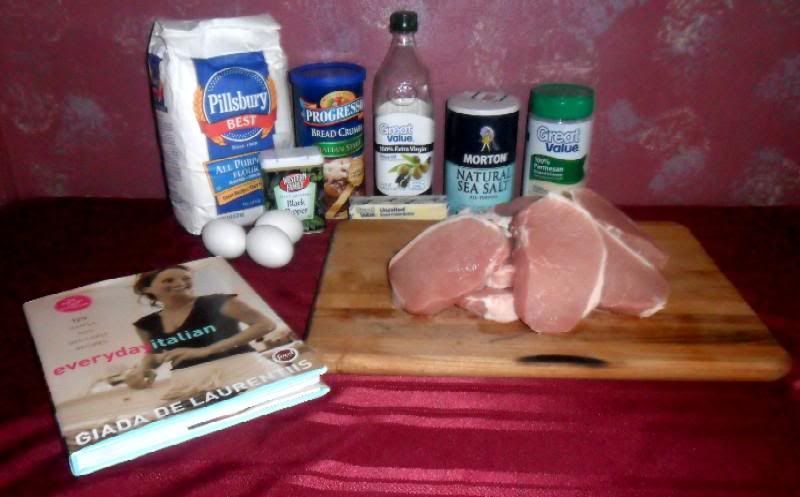 note that rather than the basil and thyme called for in the recipe (the beautiful mrs. tas is very hostile to those two particular herbs, and said she wasn't going to eat anything containing them), i used "italian flavoured" breadcrumbs, which most likely contain a healthy portion of basil and thyme anyway - except now progresso can get in trouble if she doesn't like it, rather than me!
 also, rather than the vegetable oil called for in the recipe, i used extra virgin olive oil - we are, after all, cooking italian, no? kidding aside, it is easy to see once again just how simple this meal is to prepare and the humble ingredients used, which can be found in any kitchen or pantry. also, rather than the vegetable oil called for in the recipe, i used extra virgin olive oil - we are, after all, cooking italian, no? kidding aside, it is easy to see once again just how simple this meal is to prepare and the humble ingredients used, which can be found in any kitchen or pantry.worthy of note is that due to the number of pork chops we had (11), i made a preparation for this recipe that amounted to about two-and-a-half times the given amounts, which are for 4 cutlets.
first order of business was dealing with the star of the meal, the boneless loin chops. as per the recipe, i began converting them from cotolette to orecchie di elefante, pounding them gently with the flat side of the meat mallet:
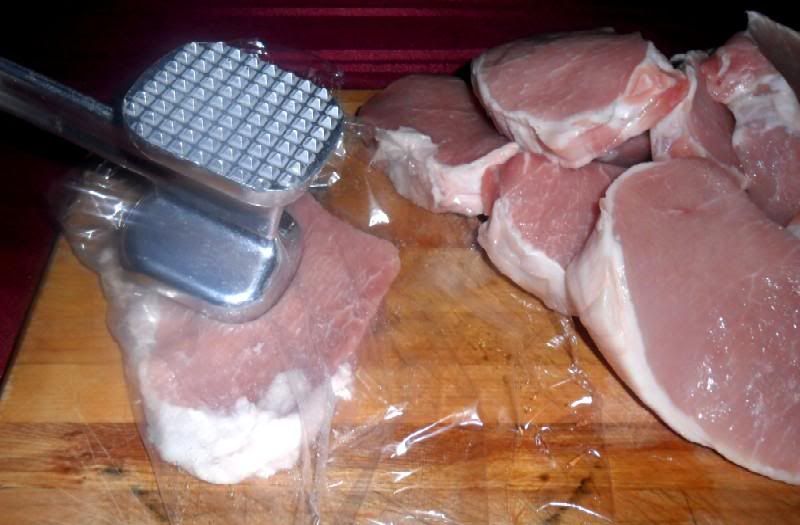 i found out right away that this process really does work better if the cotolette are between two sheets of saran wrap (wax paper would most likely work just as well). i have no explanation for why this is true, unless it has to do with air pressure or compression, but when i tried a couple of times without the saran wrap, it was very difficult. covering them, for whatever reason, made it easy to pound them all to a thickness between 1/4 and 1/2 inches.
in this next picture, you can really see the effects of the pounding, and how the term orecchie di elefante came about:
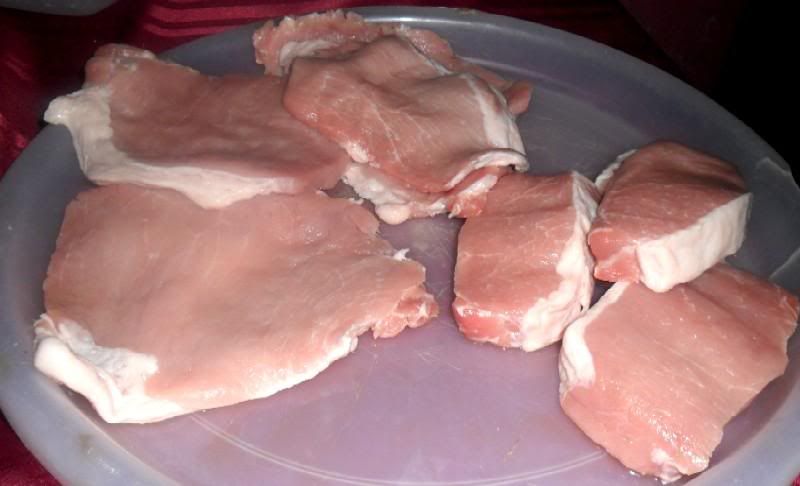 compared to the un-pounded chops, they really do look like elephant ears!
when that was finished, i mixed the parmesan into the breadcrumbs:
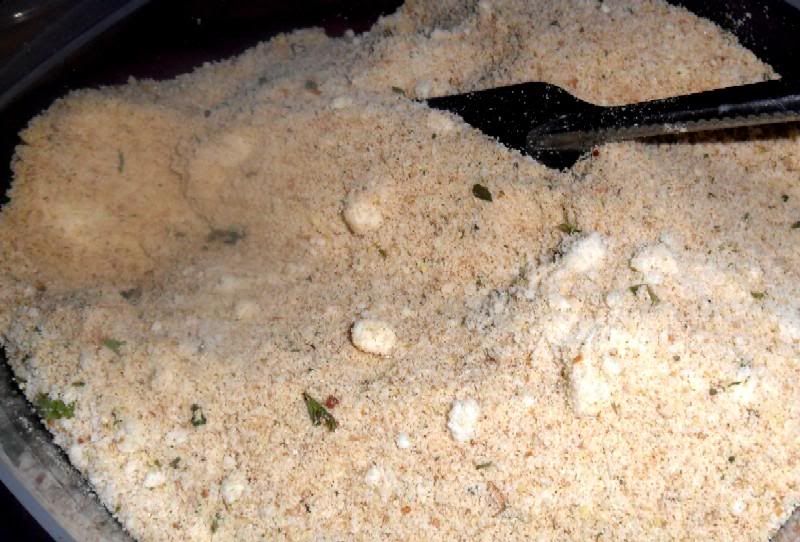 and set up my three stations - flour, then egg dip, then breadcrumb mixture - for preparing the cotolette:
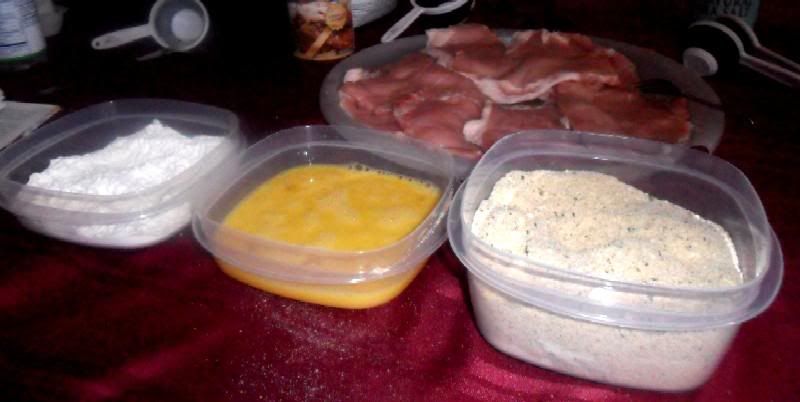 when i got the bowls prior to preparing the recipe, i had no idea how large the cotolette would become after pounding; hence, these bowls were a little small, which interfered slightly with the successive dipping.
after a light seasoning of the cotolette, consisting simply of salt and pepper:
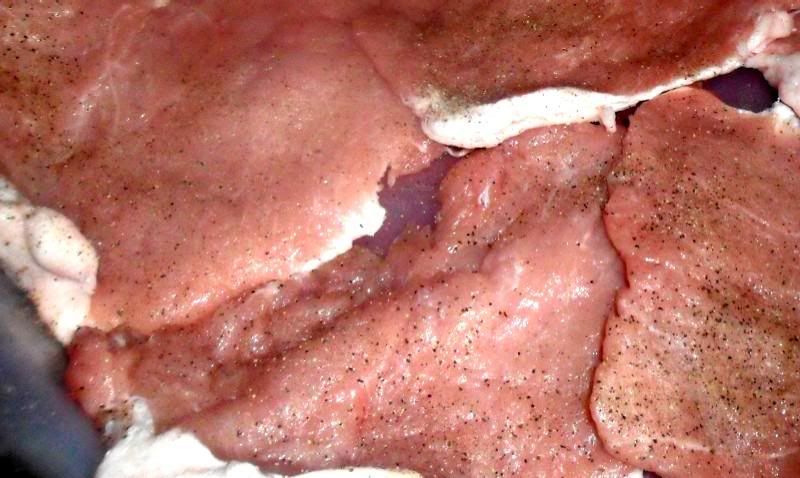 #3 son billy and i breaded them according to the recipe, dipping first in the flour:
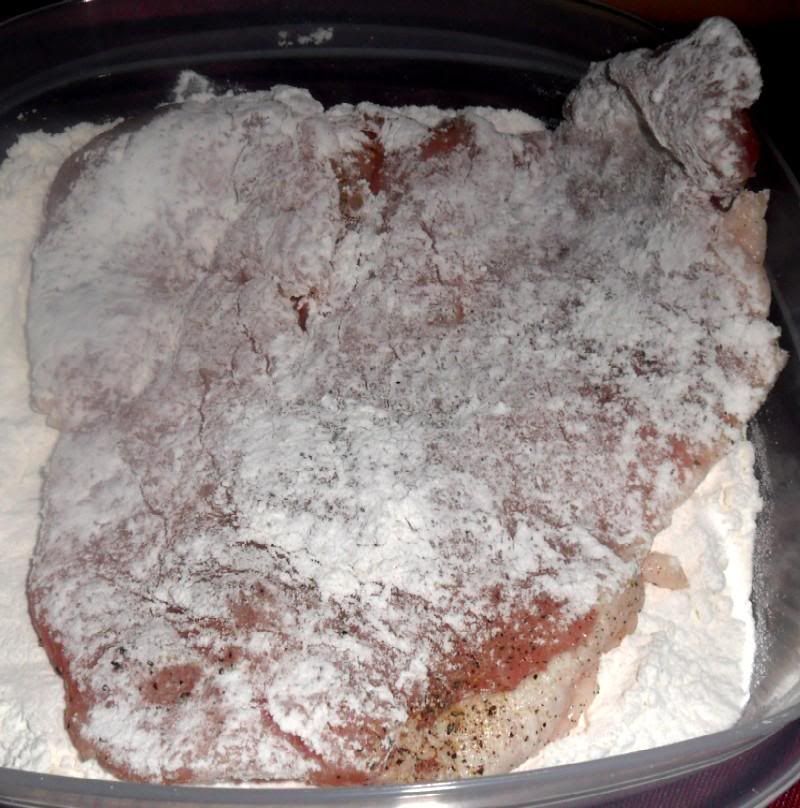 then in the egg:
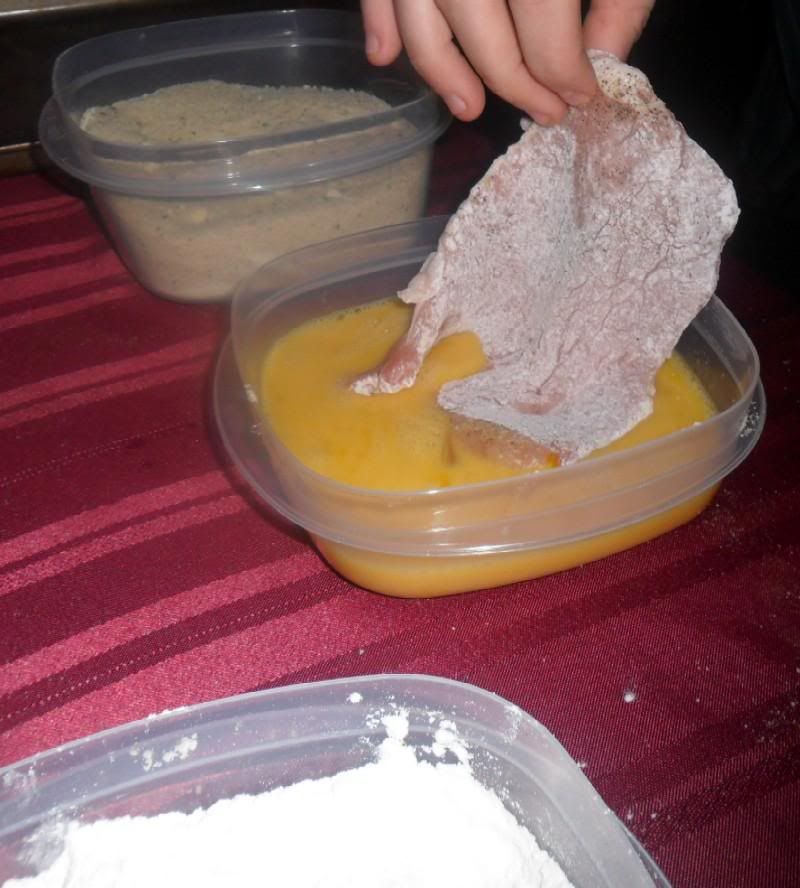 and then in the breadcrumbs:
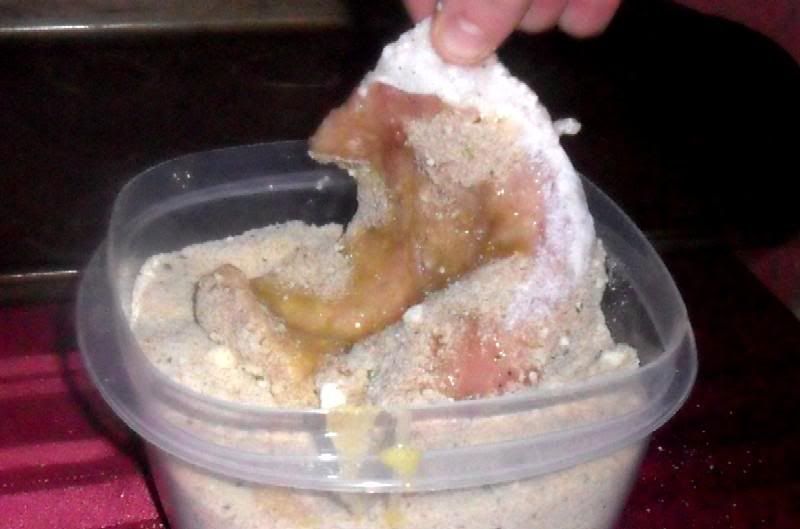 the picture above shows some of the challenge involved with the smaller bowls. we were able to do it, but wider bowls would have been more helpful. also, the recipe did not specify this, but i have learned from bitter experience with similar dishes that it is very important to shake off the excess flour before dipping in the egg, which will help prevent the final breading from becoming an ooey-gooey mess that slides off during cooking and also while trying to enjoy the meal.
as we prepared them, we laid out each cotoletta onto a baking sheet, for a total of 11 cotolette:
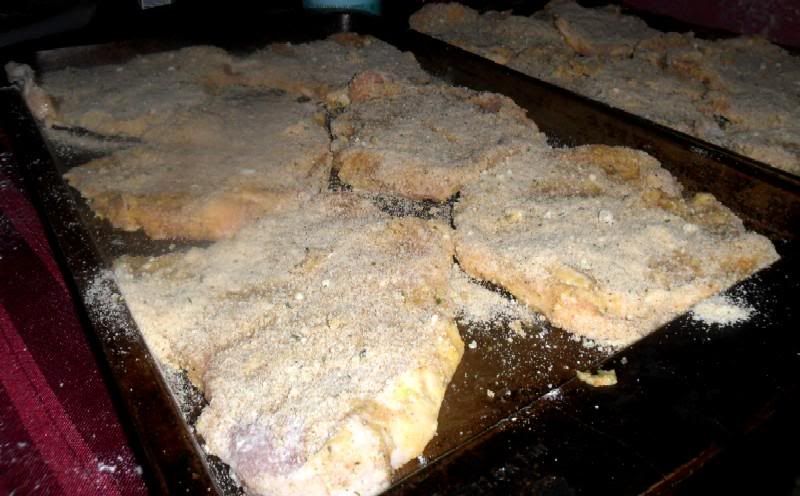 we also, as you can see, needed to apply a little extra breading into a few small bare spots, pressing it in to adhere.
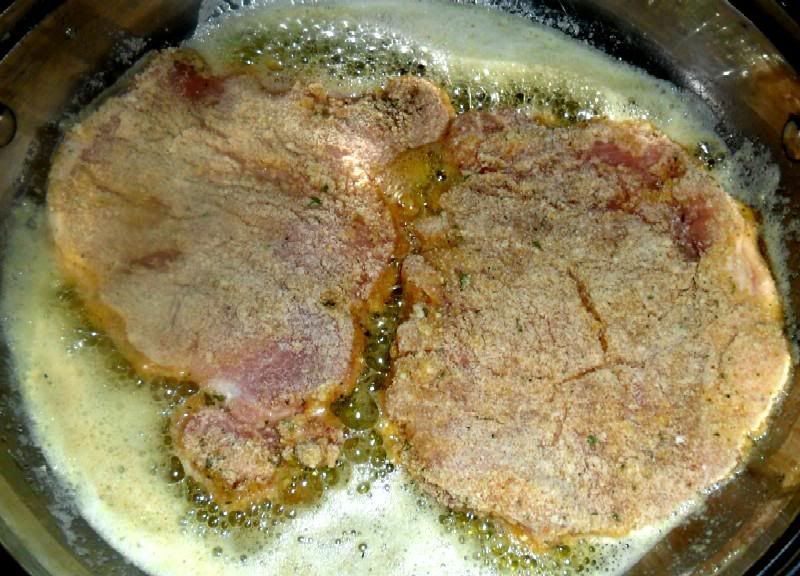
now comes the fun part: the actual cooking ~ after melting the butter into the olive oil over medium heat, i eventually judged the fat to be hot enough and began dropping the cotolette in, two at a time - after shaking off any excess breading. the actual cooking was easy - three minutes or so on the first side:
 and then on the other:
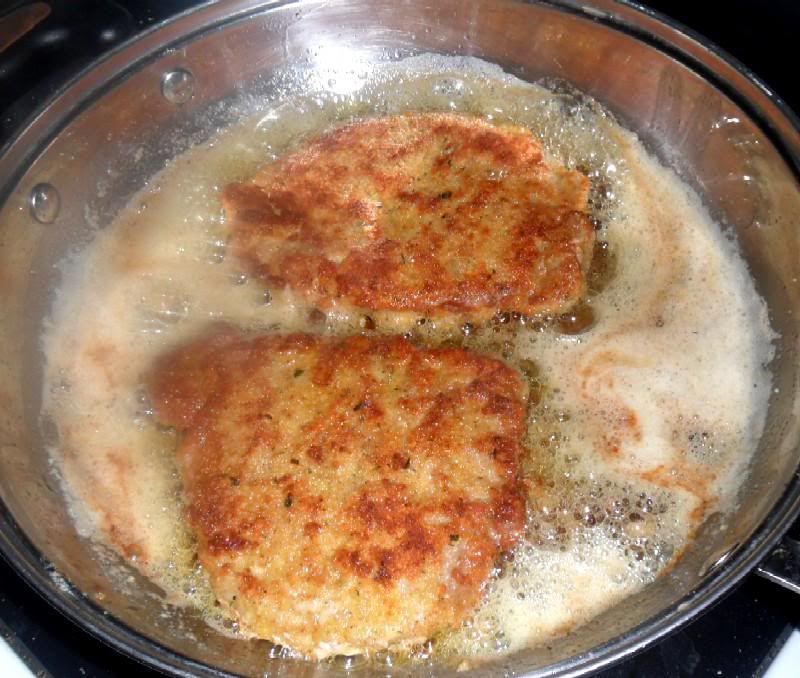 while cooking, i found it very helpful to keep the pan in motion now and then, sliding it briskly back and forth underneath the cotolette as if i were sautéing onions. this was especially important while cooking the second side, as it seemed that this was when the chances of the breading sticking to the pan were most likely to happen. keeping the pan in motion helped very much with this, and although it is not mentioned in the recipe, i advise it to anyone trying this.
the first batch always seems to look the prettiest:
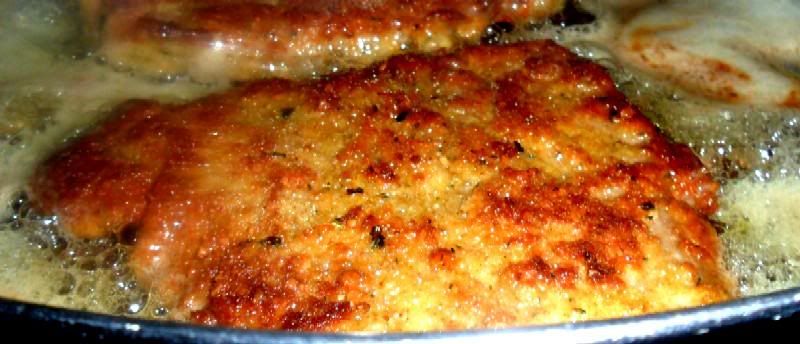 because successive batches get darker as the pan heats up and as the inevitable flour and breadcrumbs left in the pan tend to darken almost to the point of being burned, and because there is some danger of the butter and oil burning over time as well, i reduced heat a little as necessary and then discarded the oil and butter after two or three batches, wiping down the pan and re-heating fresh oil and butter each time. this made sense, since the original recipe calls for only two batches and does not anticipate the effect of prolonged heat and excess breadcrumbs etc. affecting the cooking during succeeding batches.
as each batch of cotolette finished, i sprinkled them with just a breath of salt and put them in the oven, on racks over baking sheets, to stay warm. once again, i do not know the science behind this phenomenon, but the rack allowed the cotolette to stay crisp on the outside and not get soggy. this was an important lesson, for as i discovered with my english fish and chips, breaded and fried foods are in constant danger of going soggy while they are holding between preparation and serving.
unfortunately, #3 son bill woefully underestimated my ability to cook thin-cut cotolette quicky, and because of this our side dish (a simple creamy garlic and broccoli pasta) was just getting started as i finished the final batch. no worries, i simply transferred the cotolette to a few plates and served them; the family and guests ate them first, followed by the pasta once it was finished.
no plated pic for an individual, but here are some very nice cotolette waiting to be picked up:
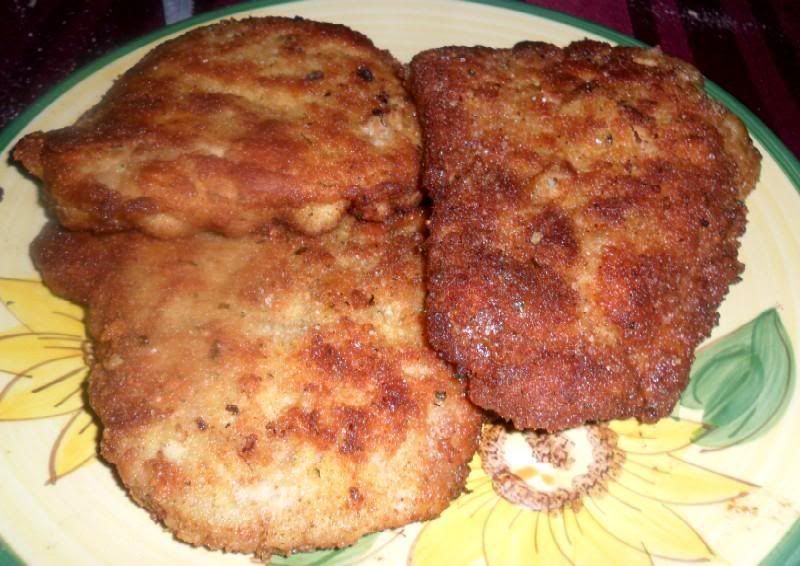 and a beautiful close-up showing the wonderful golden-brown breading:
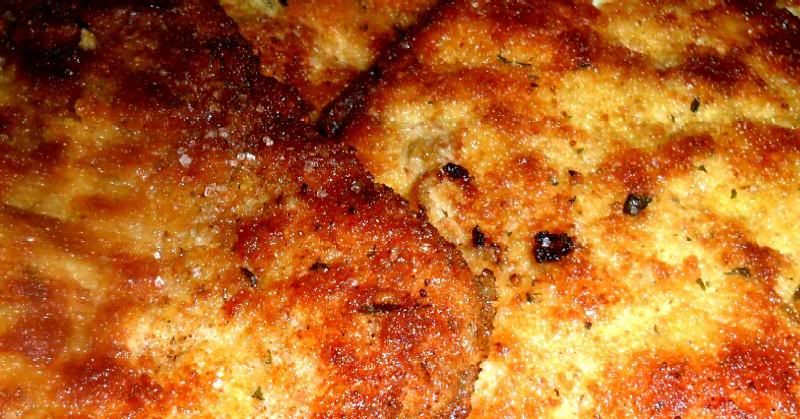 results were nothing short of spectacular. this meal is a true must-do due to its simple ingredients and ease of preparation. the crispy-savory breading was perfect for the thin pork, which was very flavourful and of course moist due to the tenderizing effect of the pounding as well as the quick cooking. we had no lemon wedges available, but for the sake of experimentation, i did squirt a bit of juice from a plastic lemon onto mine and found that, as good as the cotolette were before, they were very much brightened by the addition.
any worries about the herbs in the breadcrumbs were unfounded, as they blended perfectly with the pork and the parmesan, which added to the golden-brown toasty flavour and crustiness of the cotolette. the beautiful mrs. tas, who always gets nervous when i start cooking, was very fond of this and so was everyone else who tried it; in fact, i came home the next day to a very similar dish being cooked with boneless, skinless chicken breasts that had been pounded, breaded and fried.
my one and only criticism was in one minor step that i performed: the sprinkling of salt over the cotolette as they came out of the pan. i used a very small amount of salt, as specified in giada's recipe (which you can see in the above picture), but because it was sea salt, it seemed just a bit too salty, standing a bit in front of the italian seasonings in the breadcrumbs and the wonderful, savory parmesan in the breading, which nonetheless came through very well. it is possible that i put a little too much salt on before breading, or the breadcrumbs were salted as well at the progresso factory, or maybe the final dusting was just a little too much. of course, it is also true that parmesan itslef tends to be a bit salty as well. had i perhaps used "regular" salt, i probably wouldn't have noticed, as sea salt tends to give a lot of bang for the buck where flavour is concerned, but this final step seemed in my mind to take it just a bit over the edge. it could be that my finding of this minor fault was a singular event, as no one else complained or said a word about it, and usually i will hear about it if my food is too salty.
this, however, did not take anything away from thie dish on the whole - it was extremely good and provided much flavour for so little effort. so go ahead, get yourself some boneless pork chops, or skinless chicken breasts, or even veal, if you can find it; maybe even try venison or some other wild game - and give this a go!
|
|||
|
If you are a visitor and like what you see, please click here and join the discussions in our community!
|
|||
|
|||
|
MomInAnApron
Cook 

Joined: 09 March 2011 Location: Montana, USA Status: Offline Points: 99 |
Post Options
Thanks(0)
Quote Reply
Posted: 24 March 2011 at 13:01 |
||
|
Oh wow Ron, that looks PERFECTLY browned and absolutely marvelous! GREAT photos.
|
|||
|
~ Good Friends, Good Food, Good Times ~
|
|||
|
|||
|
Hoser
Admin Group
Joined: 06 February 2010 Location: Cumberland, RI Status: Offline Points: 3454 |
Post Options
Thanks(0)
Quote Reply
Posted: 24 March 2011 at 13:08 |
||
|
As a schnitzel connessieur, I can attest to the absolute perfection in the execution of this dish. The way that the coating tried to puff up and move away from the meat is exactly what you are looking for in a well-executed schnitzel. (I'm only calling it schnitzel because it's easier to spell Ron!
You followed all the rules...don't bread too heavily, and keep the opil or butter level halfway up the side of the cutlet and you will achieve schnzitel nirvana! High five to you my friend, we're going to have to get together some Octoberfest.   |
|||
|
Go ahead...play with your food!
|
|||
|
|||
|
TasunkaWitko
Admin Group
Joined: 25 January 2010 Location: Chinook, MT Status: Offline Points: 9389 |
Post Options
Thanks(0)
Quote Reply
Posted: 24 March 2011 at 14:14 |
||
|
thanks, guys!
debbie - this one is so easy you have to try it ~ it's fool-proof and very, very good!
dave, i'm looking forward to it!
 one thing i did not mention in my post above (will edit it to reflect this change) is that due to the number of pork chops we had (11), i made a preparation for this recipe that amounted to about two-and-a-half times the given amounts, which are for 4 cutlets.
this was a very good dish that was inspired by the simple desire for different weeknight meal, something different than simple shake-and-bake or otherwise "normal" pork chops. it was easy and took just as much time as it would have to do what we always do, so i imagine it will be something that we cook often around here....
|
|||
|
If you are a visitor and like what you see, please click here and join the discussions in our community!
|
|||
|
|||
|
Guests
Guest Group 
|
Post Options
Thanks(0)
Quote Reply
Posted: 24 March 2011 at 15:56 |
||
|
Okay, before I say anything else: WHAT PERFECTION!
Beautifully done, I can tell they were delicious and you did an outstanding job in making this Ron!
 I absolutely loved the pictures of that deliciously golden exterior that I know is just fluffy and crispy at the same time, the tastiness of the meat layered in the dredgings..........wow.
You are correct in the salt thing, the crumbs as well as the parmesan are heavy in salt, but no worries. Next time use regular table salt, and here's the trick: put it in the flour dredge mix. You'll have to salt that a bit on the heavy side since the flour masks a lot of flavor including salt, but it stays deep in th ecoating next to the meat and works fine.
You also were perfect in changing the oils for fresher, it made each one of your milanese's perfectly savory and pretty to look at!
Very nice...no; REALLY nice historical background on the naming and history of the dish. I enjoyed that immensly~ much more than the hair-pulling I went through the day before helping you out on the naming part!
 As you noticed, lemon really does add a major brightness to the meat, so if you get a chance, next time give that a go. Fresh lemon will really set that apart compared to bottled lemon juice. It is surprising how good a touch of citrus is to a golden fried meat, isn't it?
What kind of pasta did you serve with it? Just curious, any kind is best (in my book) and mashed patooties go great too. I liked the look of your cutlets so much I want to make them now meself! Wow, do they look so good.
Congratulations on what is another 'signature post" on the forum!
 |
|||
|
|||
|
Melissa Mead
Master Chef
Joined: 17 July 2010 Location: Albany, NY, USA Status: Offline Points: 1174 |
Post Options
Thanks(0)
Quote Reply
Posted: 24 March 2011 at 17:32 |
||
|
Thank you for the historical info!
|
|||
|
|||
|
TasunkaWitko
Admin Group
Joined: 25 January 2010 Location: Chinook, MT Status: Offline Points: 9389 |
Post Options
Thanks(0)
Quote Reply
Posted: 30 March 2011 at 10:45 |
||
|
hey, john - sorry i forgot to get back to you in all the chaos of last week. the pasta dish was really nothing special, just a noodle-roni type thing from KNORR. we had one that was scampi flavoured (butter and garlic) and antoher that was broccoli alfredo flavoured, so we put them together and although they are always a little too soupy and the noodles a little too gluey for my taste, it was not too bad. normally, i would be happy with mashed potatoes with simple butter and salt or some type of pan gravy, but wanted to take this as close to italy as possible. we didn't have any plain pasta in the house, otherwise i would have done some tossed with olive oil and lemon juice, maybe an herb or two and some parmesan.
anywy, you DO need to try this! i'd like to see your spin on it, especially since i know a meat other than pork would most likely be used - and also would like to see any additional information or history you could dig up on it ~
|
|||
|
If you are a visitor and like what you see, please click here and join the discussions in our community!
|
|||
|
|||
|
Margi Cintrano
Master Chef

Joined: 03 February 2012 Location: Spain Status: Offline Points: 6362 |
Post Options
Thanks(0)
Quote Reply
Posted: 27 February 2012 at 12:14 |
||
|
Ron.
Anything Milanese ... FABULOUS recipe and fotos too ... Truly enjoyed all the language fun ... Yes, each village has their own name for something ... in Spain too ... CHULETAS = chops in Spanish ...
Filetes de cerdo = pork cutlets in Spanish ...
Is the little boy, your son in the photo ?
The photos are lovely.
You sure do virtually travel ... However, you have to give yourself a taste of ITALIA ...
I make my cutlets the same way ... Just one thing, home made bread crumbs ! Olive oil extra virgin. Other than that, I pound them with a mallet too ... and sauté until golden brown ...
Thanks for posting ur recipes for me too ... I never have these simple life long recipes written, now I have your´s !!!
Thanks too, Margi.
|
|||
|
Volamos a Mediterraneo, un paraiso que conquista su gente u su cocina.
|
|||
|
|||
|
TasunkaWitko
Admin Group
Joined: 25 January 2010 Location: Chinook, MT Status: Offline Points: 9389 |
Post Options
Thanks(0)
Quote Reply
Posted: 27 February 2012 at 12:23 |
||
|
hi, margi - yes, the ""word play," trying to find the "right name" for something, can be a challenge - i would hate to put a title for a forum and have someone say to themself "what is wrong with this guy?" lol ~ i don't always get it 100% right, but i do try, and usually come very close. if not, i am always happy to be corrected, so that i know.
thanks for the kind words on the photos and preparation. the "step-by-step" photo process really helps, i believe, to assist people in understanding the little important steps in preparation to get the best results and understand why things are done the way they are done. it's a true hallmark that, i believe, sets us apart from other foodie forums. also, like you say:
>>>I never have these simple life long recipes written, now I have your´s !!! <<<
this is one of our goals, to have them here for people to learn what everyone is eating around the world, in the way that they would do it there ~ the "cucina contadina," so to speak ~
the hands you see there are from one of my other sons, who occasionally helps me cook ~ he acts like he hates it, but he usually does a really good job of it.
|
|||
|
If you are a visitor and like what you see, please click here and join the discussions in our community!
|
|||
|
|||
|
Margi Cintrano
Master Chef
Joined: 03 February 2012 Location: Spain Status: Offline Points: 6362 |
Post Options
Thanks(0)
Quote Reply
Posted: 27 February 2012 at 12:36 |
||
|
Ron,
The little one is adorable ... I have seen another foto of a little boy who looks older than the one with you --- in jeans ...
|
|||
|
Volamos a Mediterraneo, un paraiso que conquista su gente u su cocina.
|
|||
|
|||
|
TasunkaWitko
Admin Group
Joined: 25 January 2010 Location: Chinook, MT Status: Offline Points: 9389 |
Post Options
Thanks(0)
Quote Reply
Posted: 27 February 2012 at 12:45 |
||
|
yes, the little one is my son roger ~ he is 9 now. the other one you saw is billy. he was 12 at the time of the picture, i believe, but he is now 17 and full of angst - his dad just isn't "relevant" anymore....

hopefully, it is just a phase!
|
|||
|
If you are a visitor and like what you see, please click here and join the discussions in our community!
|
|||
|
|||
|
Post Reply
|
|
 Tweet
Tweet
|
| Forum Jump | Forum Permissions You cannot post new topics in this forum You cannot reply to topics in this forum You cannot delete your posts in this forum You cannot edit your posts in this forum You cannot create polls in this forum You cannot vote in polls in this forum |


 Topic Options
 4 main-course servings