
|
Thank you, from the Foods of the World Forums! |
Peter Reinhart's French Bread |
Post Reply 
|
| Author | |
Hoser 
Admin Group 

Joined: 06 February 2010 Location: Cumberland, RI Status: Offline Points: 3454 |
 Post Options Post Options
 Thanks(0) Thanks(0)
 Quote Reply Quote Reply
 Topic: Peter Reinhart's French Bread Topic: Peter Reinhart's French BreadPosted: 24 January 2011 at 11:41 |
|
A section from "The Bread Baker's Apprentice" By Peter Reinhart
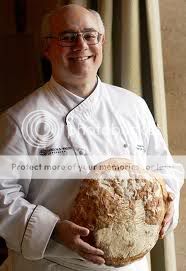 Pre-ferments; Pâte Fermentée, Poolish, and Biga Many of the formulas in this book call for a version of pre-ferment, one of the baker's most effective tools for manipulating time. A pre-ferment's main purpose is to improve flavor and structure, as discussed n page 52. The amount of pre-ferment required for each bread varies, so i am going to suggest approaches to preparing the pre-ferments that accommodate different batch size requirements, especially with the main pre-ferments: pâte fermentée, poolish, and biga. The very presence of pâte fermentée in a formula immediately improves most bread, a quantum leap in maturity and flavor. One way to make it is to make a batch of dough as shown opposite - which is in fact, simply French bread dough - and put it in the refrigerator overnight. The other option is to save back a portion of every batch of french bread dough that you make to use as a pre-ferment in future batches. The dough will keep for three days in the refrigerator and at least three months in the freezer if you store it in an airtight bag I will dispense with further comments on poolish and Biga, since we are onoly concerned with pâte fermentée in this recipe. Pâte Fermentée makes 16 to 17 ounces (enough for 1 batch of French Bread) 1-1/8 cups unbleached all purpose flour 1-1/8 cups unbleached bread flour 3/4 teaspoon salt 1/2 teaspoon instant yeast 3/4 cup (more if needed) water at room temperature 1. Stir together the flours, salt and yeast in a 4 quart bowl . Add 3/4 cup water and stir until everythng comes together and makes a coarse ball. 2. Lightly flour the counter and transfer the dough to the counter. Knead for 4 to 6 minutes or until the dough is soft and pliable, tacky, but not sticky. 3. Lightly oil a bowl and transfer the dough to the bowl, rollng it to coat with oil. Cover the bowl and and ferment for 1 hour at room temperature, or until it becomes 1-1/2 it's original size. 4. Remove from bowl and knead gently to degas, and return to bowl, covering with plastic wrap and place in the refrigerator overnight. French Bread
 3 cups pâte fermentée
1-1/4 cups unbleached all-pupose flour 1-1/4 cups unbleached bread flour 3/4 teaspoon salt 1/2 teaspoon instant yeast 3/4 cup (or more) water at room temperature 1. Remove the pâte fermentée from the refrigerator 1 hour before making the dough. Cut it into ten small pieces with a pastry scraper and cover with a towel or plastic wrap and let sit for 1 hour. 2. Stir together the flours, salt and yeast and pâte fermentée pieces in a 4 quart bowl and add the water , stirring until everything comes together and makes a coarse ball. 3. Lightly flour the counter and transfer the dough to it. Knead for about ten minutes or until the dough is soft and pliable, tacky but not sticky, and it passes the windowpane test. Lightly oil a large bowl and transfer the dough to the bowl, rolling it to coat with oil.Cover the bowl with plastic wrap. 4. Ferment at room temperature for two hours, or until the dough doubles in size. 5. Gently remove the dough from the bowland transfer to a lightly floured counter. For baguettes, cut into 3 equal pieces and form into baguettes, or whatever shape you prefer. 6. Proof at room temperature for 45 to 75 minutes or until the loaves have grown to about 1.5 times their original size. They should be slightly springy when poked with a finger. 7. Heat oven to 500°F, generously dust a peel or the back of a sheet pan with cornmeal or semolina flour and very gently transfer the baguettes to the baking stone or the pan. Pour one cup of hot water into the steam pan in the bottom of the oven and close the door. After 30 seconds, spray the oven walls with water and close the door. Repeat procedure twice more at 30 second intervals. After the final spray, lower the oven setting to 450°F and bake for 10 minutes. Rotate the loaves 180 ° and continue baki9ng until they are rich golden brown and register 205°f at the center. This may take from 10 to 20 additional minutes.
8. remove from oven and cool on a rack at least 40 minutes before slicing or serving. |
|
|
Go ahead...play with your food!
|
|
 |
|
| Sponsored Links | |
|
|
|
Post Reply
|
|
 Tweet
Tweet
|
| Forum Jump | Forum Permissions You cannot post new topics in this forum You cannot reply to topics in this forum You cannot delete your posts in this forum You cannot edit your posts in this forum You cannot create polls in this forum You cannot vote in polls in this forum |


 Topic Options