|
Thank you, from the Foods of the World Forums! |
Äppelfläsk |
Post Reply 
|
| Author | ||
TasunkaWitko 
Admin Group 

Joined: 25 January 2010 Location: Chinook, MT Status: Offline Points: 9389 |
 Post Options Post Options
 Thanks(0) Thanks(0)
 Quote Reply Quote Reply
 Topic: Äppelfläsk Topic: ÄppelfläskPosted: 21 March 2013 at 14:56 |
|
|
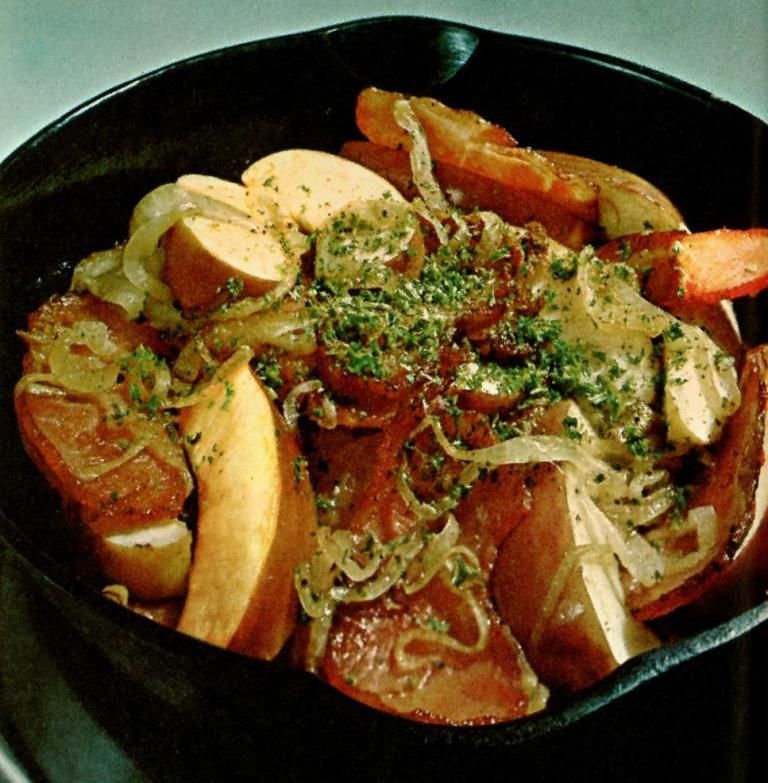
Äppelfläsk
Smoked Bacon with Onions and Apple Rings
From Time/Life's Foods of the World - The Cooking of Scandinavia, 1968:
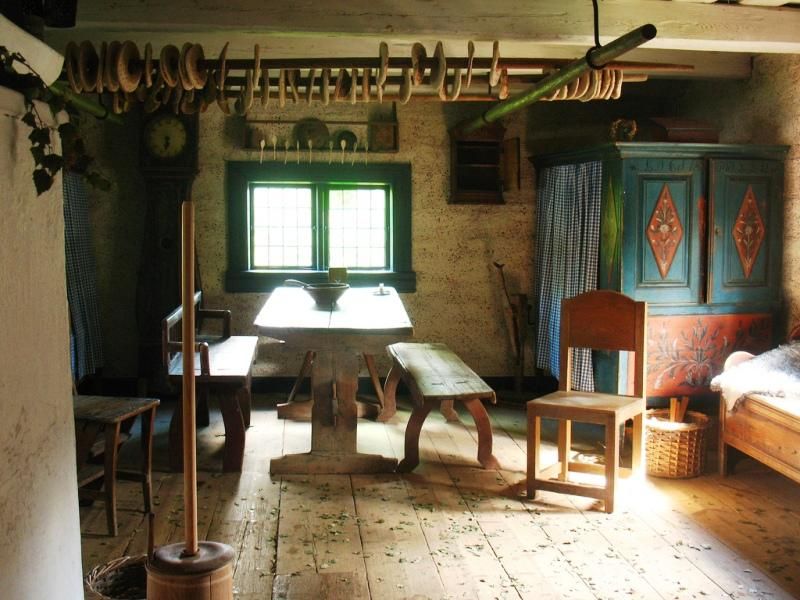
The Swedish concept of husmanskost could be a synopsis of my "culinary point of view" - almost to a T; food of the land, from a time when man was tied to the land. Call it rustic or peasant cooking, call it comfort or soul food - whatever you call it, it is honest, unassuming, wholesome and good, in more ways than one. It reaches back through the years to a time when a hot, satisfying meal was something to look forward to after a cold day's hard work, as opposed to the quick, on-the-go, over-processed, microwaved or "fast" foods that are now squeezed into a busy, hectic, modern schedule.
Coming from a rural Swedish heritage, it is a sure bet that my Scandinavian ancestors prepared this meal - in its original form - on more than one occasion, and it is my intention to try it. Today, I began curing a 2-pound pork loin; when the curing is finished, I will smoke it - transforming it into Canadian bacon - and use it to prepare this dish.
Here's the recipe, fromTime/Life:
Alright, let's make some äppelfläsk!
 As you can see in the recipe above, the primary ingredient for the modern version of this time-honoured Swedish peasant dish is Canadian bacon (cured and smoked pork loin); I figured that a rural home in Sweden would probably cure its own bacon, and set out to do exactly that.
The instructions for making Canadian bacon are pretty well laid out here, so there's no need to review them in-depth: Using Mad Hunky's Tenner Quack (which is a clone of Morton's Tender Quick) as a curing agent, I cured a 2-pound section of pork loin for the required amount of time. When the curing was done, I dusted the pork loin with a freshly-cracked medley of peppercorns: 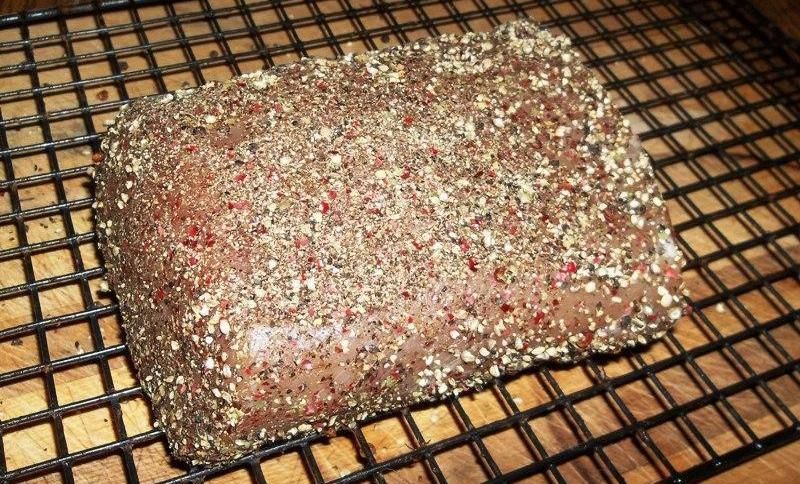 And let the loin rest for a while to develop a pellicle, which is a slightly-dry, slightly-tacky exterior that aids in smoke flavouring and penetration.
I then turned my attention to smoking the pork loin, using a new product that I had just recently acquired, the A-MAZE-N Pellet Smoker (also known as the AMNPS), which I ordered from my friends Marty and Tanya at www.owensbbq.com: This handy little unit is perfect for cold-smoking of meats, fish, jerky, sausages and other charcuterie; I am sure it has many other uses as well, and am looking forward to discovering them as I continue my food-smoking projects. Since this traditional Swedish dish features apples as well, it was only natural that I chose to smoke my Canadian bacon in apple. The AMNPS is designed to use convenient wood pellets, so I loaded up it up with some made from applewood: 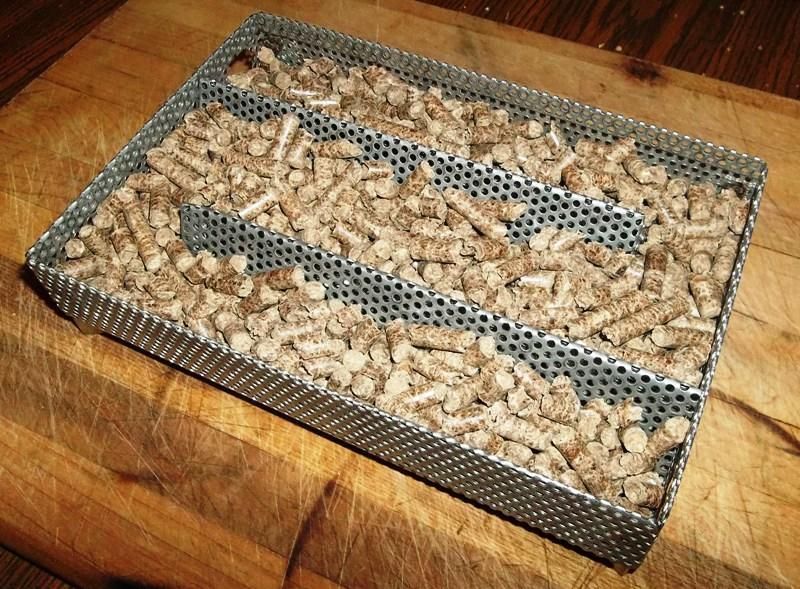 The AMNPS is designed to be used in some sort of enclosure; anything will do, as long as it will protect the unit (and the meat) from the elements and allow air-flow in and out. For this project, I made use of a most convenient enclosure, my 18.5-inch Weber Kettle. I placed the AMNPS on one side of the bottom of the kettle, then lit one end of the "maze" with a propane torch: 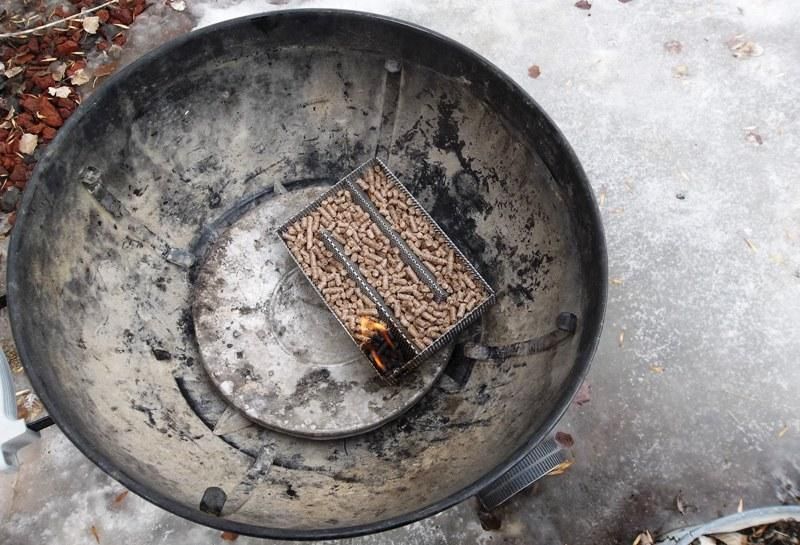 Once the smoke was going good: 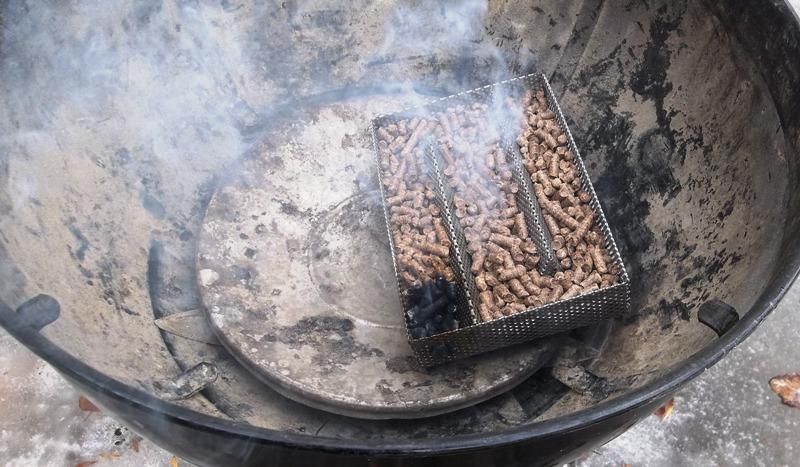 I placed the pork loin on the rack above the smoke on the opposite side of the kettle: 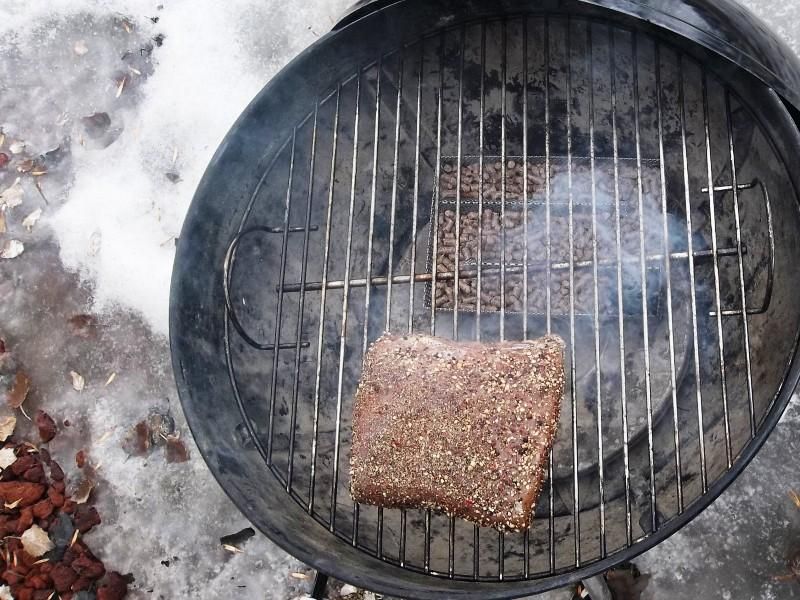 I then covered the kettle and left it entirely alone for several hours while the sweet, rustic apple smoke penetrated and infused itself into my pork loin. I was a little under the weather that day from a nasty virus, so I am not sure exactly how long the AMNPS produced smoke; I know it was at least 8 hours, but it could have been more, because I fell asleep. When I woke up, the smoking process was finished, so I wrapped the Canadian bacon in plastic wrap and placed it in the refrigerator for one week, so that the smoke could mellow and equalise throughout the loin. I don't know if this step is necessary, but I can certainly vouch for the results, because this Canadian bacon was the tastiest and "best-smoked" Canadian bacon I had ever made. Three cheers for Owens BBQ and the AMNPS!  Worthy of note is that this Canadian bacon was entirely cold-smoked, and not brought "up-to-temperature" (usually around 150-155 degrees internal), so it was not a "ready-to-eat" product and required cooking. I could have brought it up-to-temperature, but because the recipe instructions called for frying the Canadian bacon, I chose not to so that I would not run the risk of over-cooking it. This was indeed the right choice for this application. When the time came to prepare the äppelfläsk, things went pretty smoothly; here we are with the goods for a double recipe: 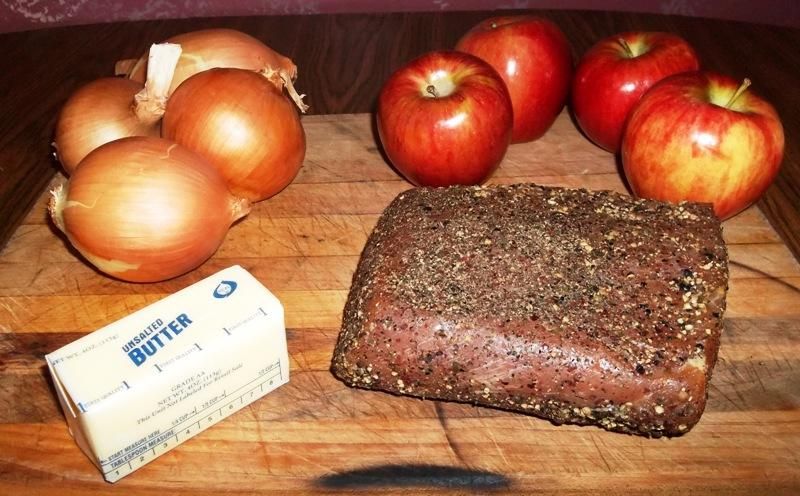 A note on the apples: the recipe calls for tart apples; normally, I would immediately think of Granny Smith apples, but I wanted to expand my horizons a bit, so I chose an apple I had never tried before: Braeburn apples. These were an excellent choice, with a sweet-tart, almost spicy taste; I'm a fan of them, now! Note that since I crusted the Canadian bacon with pepper, I did not add any to the recipe; I also did not add any salt, since the salt-cured loin brought plenty of its own. First, I ran the Canadian bacon through my slicer: 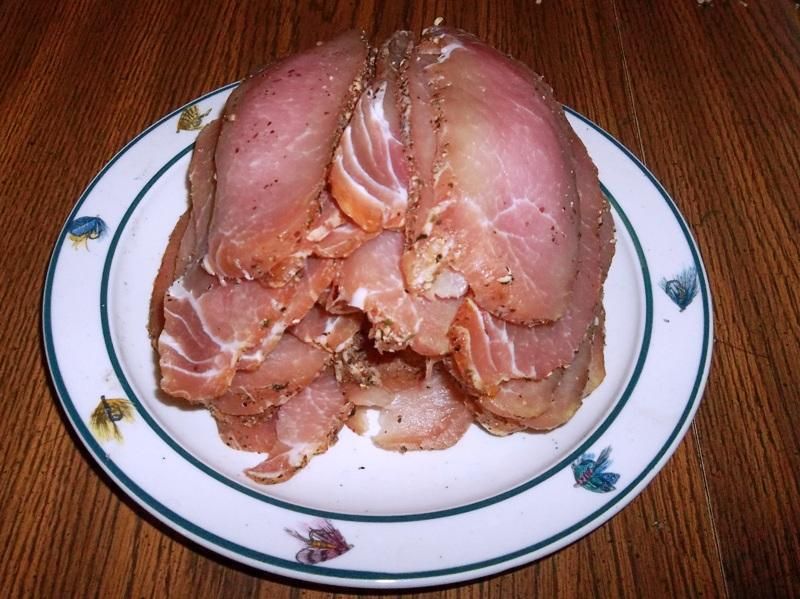 I tried to find a happy medium between "robust" and "not too thick," and think I did pretty well: 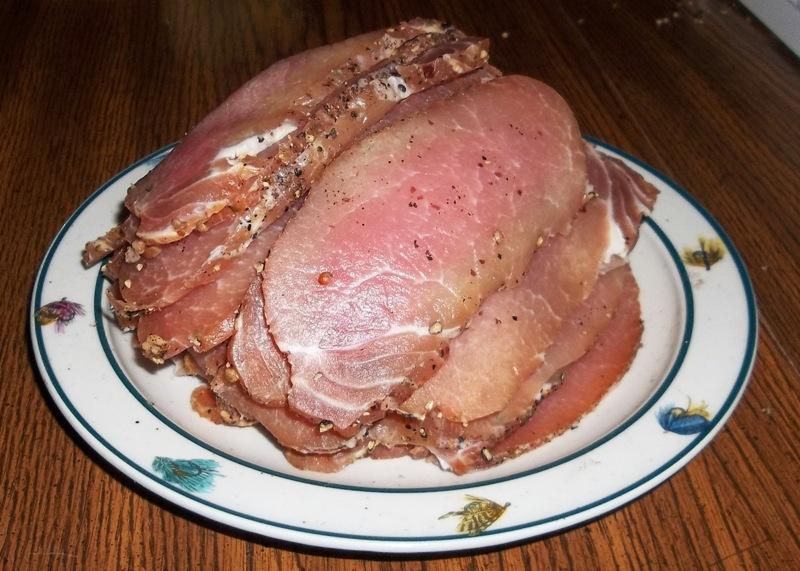 Next, I sliced the onions into thin half-moons: 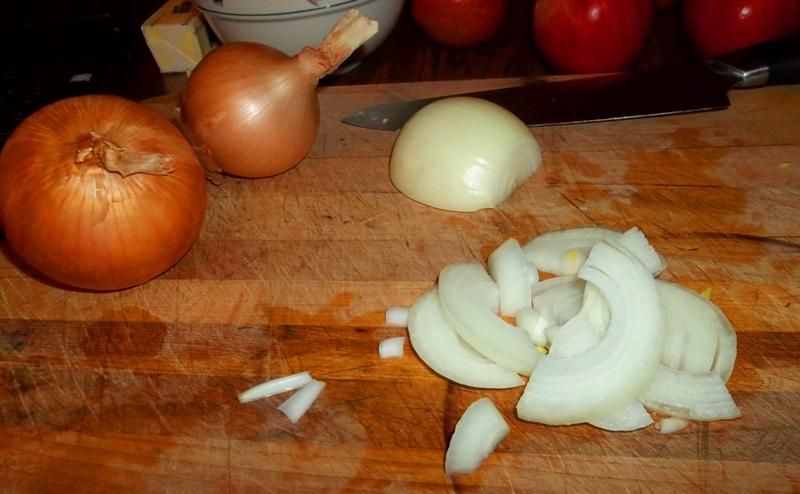 The recipe calls for rings, but it seemed to me that the half-moons would be easier to handle when eating, so that's what I went with. Since I did not want the apples to turn brown, I waited until I actually needed them to cut them up for the recipe; this departs from the instructions above, but it makes sense to me. Ready to put this dish together, I fried the slices of Canadian bacon in a little butter, aiming for a decent sear on each side, without burning the meat: 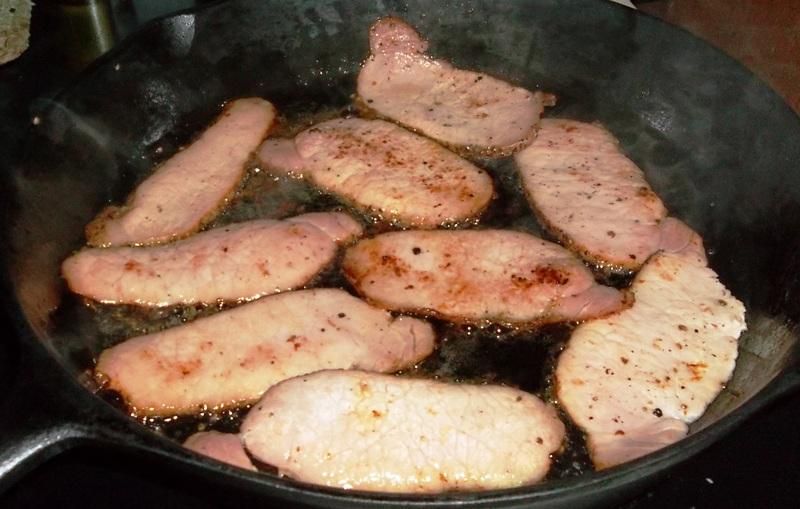 It's here that my decision not to bring the Canadian bacon up-to-temperature paid off; had I done so, it is very possible that the meat would have started burning - or at least blackening - before it could get a nice, even sear. As it was, things went along very well. Once all of the Canadian bacon was cooked and transferred to a tray in the oven on the lowest setting to keep warm, I tossed the onions into the cast-iron skillet, stirring them as they caramelised and released their moisture to naturally de-glase the pan: 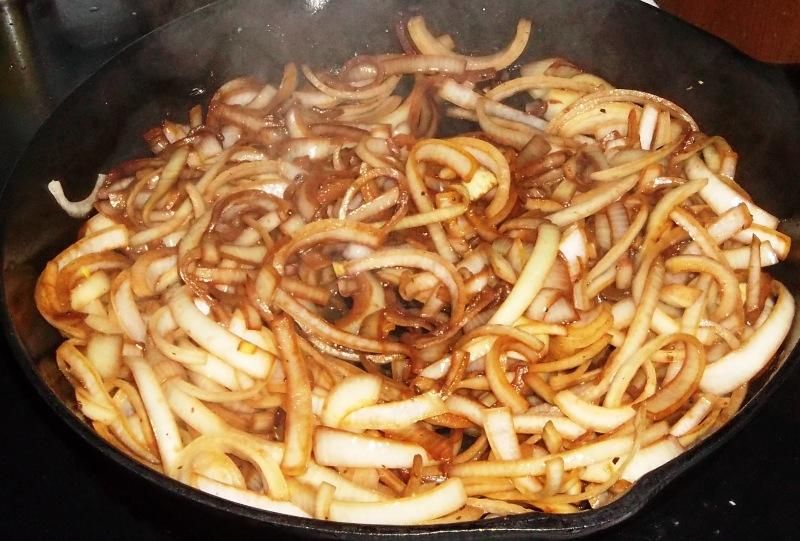 I tossed the onions around in the pan until they were fairly well-cooked; I didn't know what to expect when I added the apples, so I made the decision not to give them a deep caramelisation, for fear of burning them. As it turned out, there was no need to worry about this, since the apples released plenty of moisture that could keep the onions from burning. Speaking of the apples, while the onions were cooking, I sliced them into sections; the recipe says to cut them into thin rings, but as with the onions, this seemed like awkward eating, so I decided to go with the sections. Either way will work just fine, of course. Once I judged the onions to be just right, I added the apples: 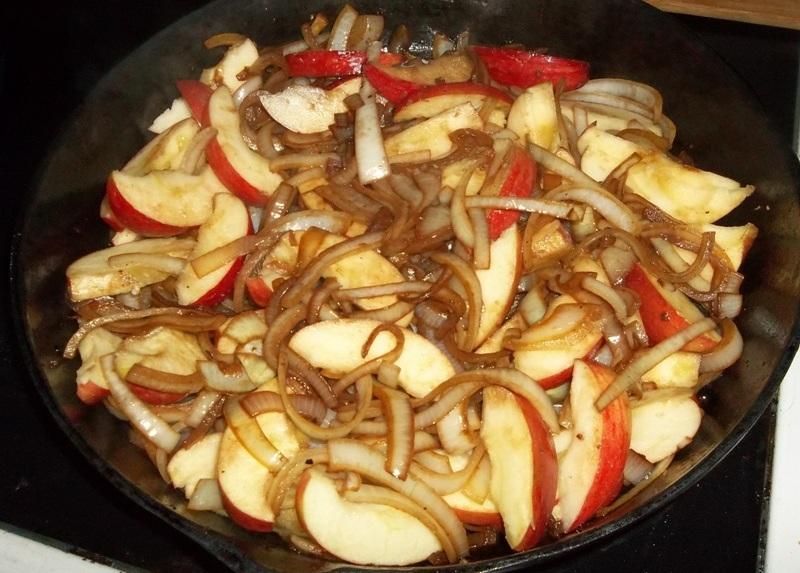 I tossed them around to mix them in well with the onions, then added the bacon back to the pan, covered it, and reduced the heat so that everything could simmer a bit while the apples softened up. After about 10 minutes, here's what I ended up with: 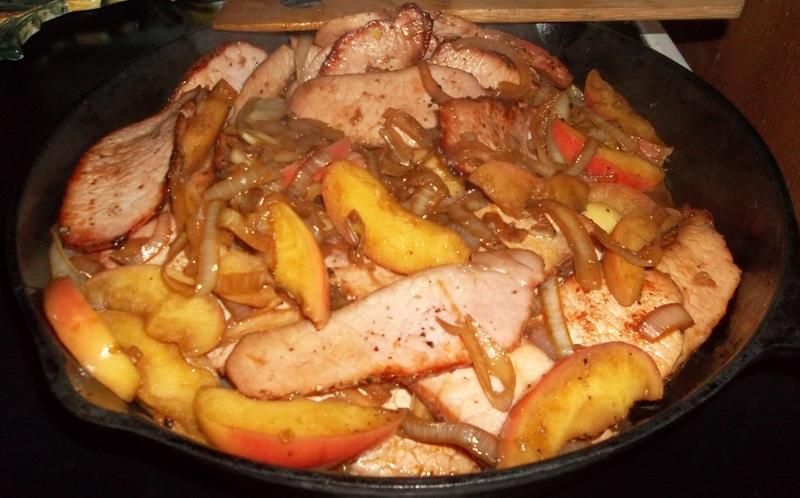 Talk about husmanskost ~ this is it, for sure! The meal was ready, so I plated up and served it with some plain, white bread to sop up any juices: 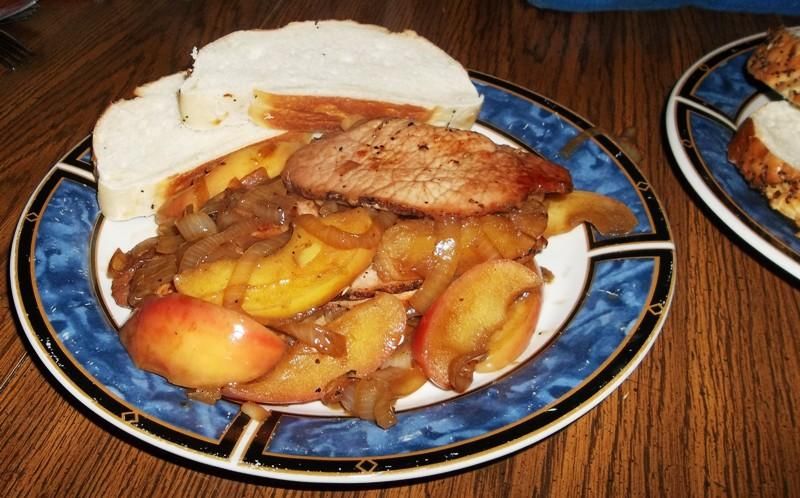 I can't think of enough good things to say about this dish - it was great! The salty-sweet-tart combination of the Canadian bacon and apples were in wonderful harmony, with the onions lending an outstanding savoury element. Everything went together beautifully, with a rustic sophistication that must be experienced to be appreciated. The fact that I had cured and smoked my own Canadian bacon for this project only made the meal even more satisfying. Of course, you don't have to make your own Canadian bacon to try this; however, if you are so inclined, it does, in my opinion, add to the experience. 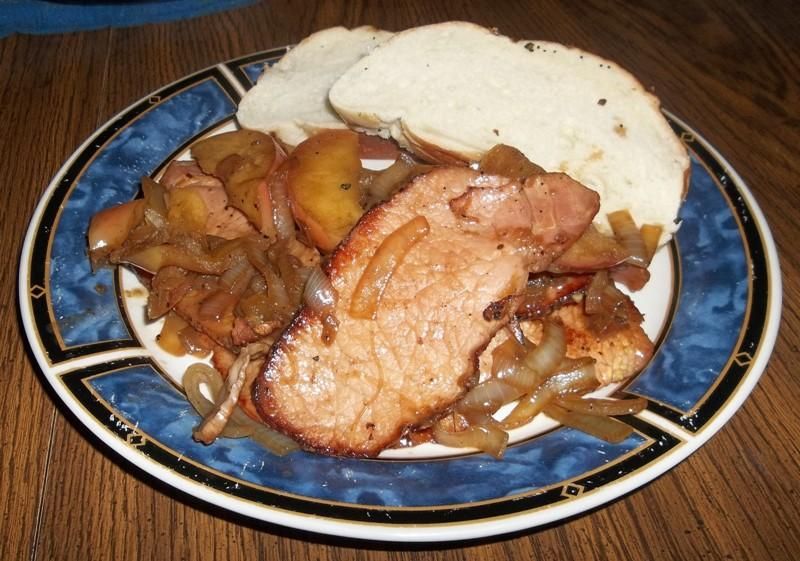 Everyone in the family did enjoy this dish very much; there were no complaints and no leftovers, and it will definitely be made again. I can't think of anything that I would do differently, so in my opinion, it must have gone pretty well. 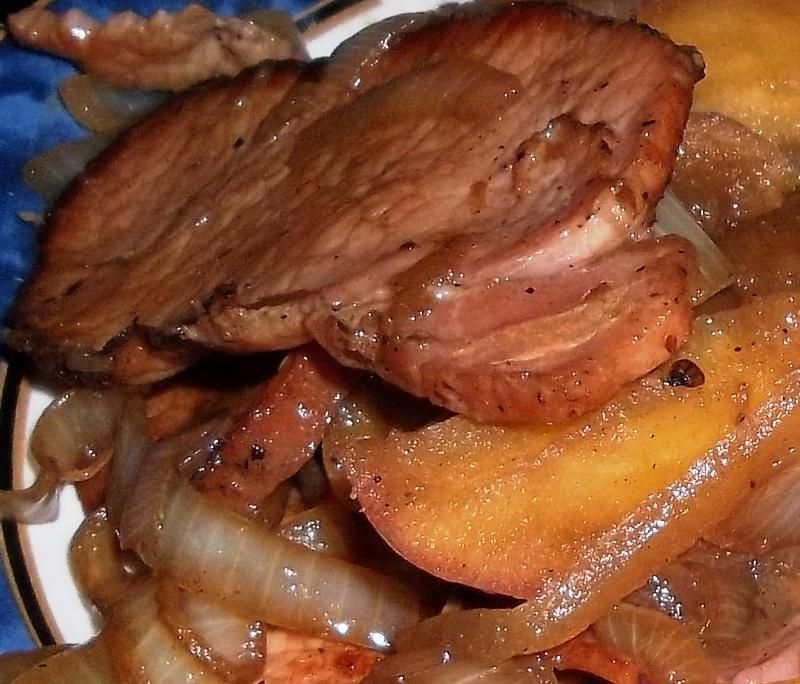 Thanks for taking the time to look at this ~ now please, go out and try it! You will not be disappointed, and will certainly get a first-hand view of what the concept of husmanskost is all about. If anyone has any questions, please feel free to ask, and maklig måltid!
|
||
|
If you are a visitor and like what you see, please click here and join the discussions in our community!
|
||
 |
||
| Sponsored Links | ||
|
||
|
HistoricFoodie
Admin Group
Joined: 21 February 2012 Location: Kentucky Status: Offline Points: 4945 |
Post Options
Thanks(0)
Quote Reply
Posted: 21 March 2013 at 17:03 |
|
|
That sounds like my kind of meal, Ron.
A comment on how you cut the onions and apples: Being as you have to use a knife on the bacon, anyway, I can't see as changing the shapes really makes much of a never mind. Nothing wrong with what you did, of course. Just probably unnecessary. Personally, I find this comment from the book---fat has been wiped out of the pan and replaced by butter---a bit on the ludicrous side. Butter is fat. If I ever get to make this, I believe I'll use lard. But, all in all, another great tutorial. |
||
|
||
|
Margi Cintrano
Master Chef

Joined: 03 February 2012 Location: Spain Status: Offline Points: 6362 |
Post Options
Thanks(0)
Quote Reply
Posted: 22 March 2013 at 01:39 |
|
|
Tas,
Apples and pork have always been a delicacy and special occasion dish in Northern and Western Europe ...
I can imagine that this pork in your pictorial is delicious ... Of course, imposs in a city apartment !
Looks marvelous and thanks for your pictorial.
Margi.
|
||
|
Volamos a Mediterraneo, un paraiso que conquista su gente u su cocina.
|
||
|
||
|
TasunkaWitko
Admin Group
Joined: 25 January 2010 Location: Chinook, MT Status: Offline Points: 9389 |
Post Options
Thanks(0)
Quote Reply
Posted: 25 March 2013 at 09:22 |
|
You're probably right about the cutting, Brook - and in fact, I've since decided that the one thing I probably would change would be to cut the Canadian bacon slices in half before cooking. In general, I like my ingredients to be fork- or spoon-ready, but it is sometimes not always practical.
As to the book's comment on fat, yeah ~ not sure what they were thinking, and the assertion did throw me for a bit of a loop; I can't say for sure but I am assuming that at the time it was written, butter may have been considered healthier (even if marginally so (ha-ha...catch the pun?)) than pork fat. This may or may not be true, but I am very confident that one can cook this with either butter or pork fat and truly enjoy it. This is, after all, simply a modern (for 1968) take on what must be a very old traditional meal.
This dish is definitely not impossible, Margi - Even though you might not be able to cure your own Canadian bacon, surely there is some form of ready-made Canadian bacon that you can buy. It might not be called Canadian bacon in your area, but it is simply cured and smoked pork loin. Check with Javier and I am sure that he can set you up. You can even use "regular" bacon or probably jamon serrano or lacon etc. The important thing is to use some sort of cured and smoked pork.
Once you have that, all you need is apples and onions. Keep in mind that I made a double batch, so you only need two onions and two apples with 1 pound (half a kilo) of meat. This will feed four people, so if you're cooking just for you and Fil, you can even use one onion and one apple with a half-pound (1/4 kilo) of meat - a nice laboral lunch or perhaps a weekend brunch.
 In fact, the more I think about it, the more I think you might be able to cure and smoke your own Canadian bacon, if you want. The great thing about the smoking product I used is that it is very small and very portable, producing no heat - so if you have a covered grill on your porch or deck, you can use it in there to smoke the meat and the cheese.
If you or Fil would like more information on that AMNPS, let me know - it truly is a wonderful product and perfect for anyone interested in charcuterie.
|
||
|
If you are a visitor and like what you see, please click here and join the discussions in our community!
|
||
|
||
|
Post Reply
|
|
 Tweet
Tweet
|
| Forum Jump | Forum Permissions You cannot post new topics in this forum You cannot reply to topics in this forum You cannot delete your posts in this forum You cannot edit your posts in this forum You cannot create polls in this forum You cannot vote in polls in this forum |


 Topic Options
 There is an excitement to Swedish cooking today....Of late [the Swedes] have come to know foreign dishes and to experiment with foreign recipes; their recent cookbooks are lavish affairs, veritable compendiums of world cooking. Yet in spite of all these culinary distractions, they have happily not forgotten their cuisine....