Paprika Hendl
Printed From: Foods of the World Forum
Category: Europe
Forum Name: Hungary
Forum Discription: A truly unique cuisine developed in this region of Europe.
URL: http://foodsoftheworld.ActiveBoards.net/forum_posts.asp?TID=1001
Printed Date: 26 March 2026 at 18:48
Topic: Paprika Hendl
Posted By: TasunkaWitko
Subject: Paprika Hendl
Date Posted: 15 December 2010 at 14:35
|
this wonderful and truly fantastic recipe for a true, rustic, winter peasant dish is similar to hungary's <SPAN id=result_ lang=hu c="4" a="undefined" ="short_text" closure_uid_wrn4ub="166" Tc="null"><SPAN>csirke paprikás - yet unique in its own right. it </SPAN></SPAN>was shared with me by john rivera, and i am grateful to him for introducing it to me. it is best enjoyed during the winter because it is so tasty, easy to make, and truly a stick-to-the-ribs cold-weather meal. once you all try it, you'll be hooked, not only for the taste, but for the historical background you have in every bite.  when i discovered this treasure and how delicious-yet-easy it was with ingredients that we all commonly have in the kitchen, i was intrigued; i knew it would simply be a matter of time before it was prepared in my kitchen, considering my own european background (germany) and that of my wife's, which is even closer to the region (slovakia). the literary tie-in to bram stoker's dracula was an added bonus, and i will quote it here:
 Photo from Leonard Wolf's Annotated Dracula this took me off on a tangent that brought me to a whole new understanding of this dish, and allowed me to appreciate it even more. i am no trained linguist or etymologist, but i do have some interest in the intersection of languages, words, history and geography. it seemed amazing to me that stoker would write of the german language being so prevalent in a region of what is now romania that seemed to me to be nowhere even close to germany. beyond that, the dish had definite hungarian influences as well, which stand out like a sore thumb (sour cream/flour sauce, beginning the dish with sauteed onions, heavy usage of paprika etc.). my first suspicion was that stoker may have "fudged" facts a little and that he gave us a hungarian dish with a german name (since i knew that hungary has a large german minority and romania has a large hungarian minority), and simply glossed it over. i couldn't have been more wrong, however, and after quick consultation with http://en.wikipedia.org/wiki/Languages_of_Romania - wiki i realized the error of my ways:
this makes perfect sense and of course stoker would have known this, since any well-educated person who even traveled out of his hometown back in those days would have been familiar with the breakdown of the various ethnic groups within the austro-hungarian empire. serbians, moldavians, slovaks and other groups that seem obscure-yet-recognizable to us today would have been as familiar to him as the bohemians and moravians (czechs), polish and lithuanians - none were major groups with their own sovereign boundaries (at the time), but they all were significant minorities within a larger empire, along with wallachians, transylvanians and many more that i can't even think of at the moment. this explained the vestigal usage of the german language as evidenced by the austro/german hendl as well as the name for the village, klausenburgh. now, all that was left was to tie in to the hungarian cooking influences. a little more digging confirmed this, as i learned that there was a significant intersection of the hungarian populations with the german populations in - you guessed it - transylvania. on the map below, note the location of transylvania (home of the "transylvanian saxons") and the location of the western portion of the carpathian mountains (separate from the eastern chain that runs south and curves to the west):  also, note that the modern, romanian name for klausenburgh is http://en.wikipedia.org/wiki/Cluj-Napoca - cluj-napoca (right above the second A in transylvania), and it is in fact the capital of the province of transylvania in romania. much information on the hungarian connection to klausenburgh/cluj-napoca from wiki can be found by clicking the embedded link in the modern name on the map below, the same location is in very close proximity to the small pokets of hungarian minority populations (in green). in fact, the location of cluj-napoca is, as far as i can tell, right smack in one of the green pockets. 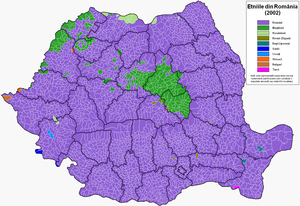 it was beginning to gel for me, and consultation of the http://en.wikipedia.org/wiki/Languages_of_Romania - linguistic demographics of romania made it clear:
it was here that the lightbulb came on and i realized what i should have known all along: that transylvania in stoker's time was associated with hungary and not with http://en.wikipedia.org/wiki/Romania - romania , which didn't incorporate transylvania until after world war one. it all fit beautifully - at least, it fit close enough so that i was convinced of its plausibility. stoker knew his stuff and i happily acknowledged that i had been schooled. this is a truly transylvanian dish, with hungarian origins, and the german name of the dish is a result of the fact that it was prepared by people of austro-hungarian descent; said dish was eaten by traveling guests who were looking out the window of a hotel (located in a town with saxon origins) at the carpathian mountains in what is now the romanian province of transylvania. i should have thought of this, since the town where my wife's family emigrated from (zakarovce) was also part of the hungarian empire and many hungarian traditions persist, even though it is now in slovakia. since it was proven to be a transylvanian dish and transylvania will always be transylvania, whether it is part of the ancient hungarian empire or the modern state of romania, it can be at home in either section; however, being the historian that i am, i reverted to history and placed it in hungary.  so, set straight and inspired, i decided to give this a go, using john's recipe to the letter:
next, i'll post pictures from my preparation of this, as well as reactions from the family and a couple of the neighbour kids, who always seem to show up at supper time these days..... ------------- If you are a visitor and like what you see, please http://foodsoftheworld.activeboards.net/registration_rules.asp?FID=0" rel="nofollow - click here and join the discussions in our community! |
 We left in pretty good time, and came after nightfall to Klausenburgh. Here I stopped for the night at the Hotel Royale. I had for dinner, or rather supper, a chicken done up some way with red pepper, which was very good but thirsty. (mem. get recipe for Mina.) I asked the waiter, and he said it was called "paprika hendl" and that, as it was a national dish, I should be able to get it anywhere along the Carpathians. I found my smattering of German very useful here; indeed, I don't know how I should be able to get on without it.
Replies:
Posted By: Guests
Date Posted: 15 December 2010 at 16:33
|
Wow, what a magnificent and detailed introduction to your making of paprika hendl, Ron! I've taken the time to read each one of your wiki-links, and of course each one engenders dozens more, all of which I want to read and find fascinating. One of the small detours I took was learning about the "Cumans", those warlike steppe people from the Northern coasts of the caspian and black seas the transylvanian saxons had to guard against.
In all, so much excellent history here, and I so plan on revisiting the links. Thanks for them
 For now, looking forward to your making of the dish and plated results! ------------- |
Posted By: TasunkaWitko
Date Posted: 16 December 2010 at 09:25
|
john - the research on this one was a true pleasure and taught me quite a few things. i went from wondering what the heck stoker was thinking (putting a hungarian dish with a german name in a town with a german name, then putting both in romania!) to really appreciating hsi knowledge of the area.
the deeper i dug, the more impressed i was with the intricate layers that stoker put for me to find, all these years later. stoker himself may or may not have been aware of these layers - it is probable that either he or an acquaintence had simply heard of or maybe even had eaten paprika hendl in that town or area, and that experience ended up in the book. maybe his housekeeper was from clausenburgh - who knows?
it would be interesting to know where that little excerpt came from and how it ended up in the book, but it is a perfdect tie-in that reaches way back into transylvania's past and form a brick in the foundation of what is to come in the story. ------------- If you are a visitor and like what you see, please http://foodsoftheworld.activeboards.net/registration_rules.asp?FID=0" rel="nofollow - click here and join the discussions in our community! |
Posted By: Guests
Date Posted: 16 December 2010 at 10:57
Now you got me wanting to read both the novel and the annotated again!  ------------- |
Posted By: TasunkaWitko
Date Posted: 16 December 2010 at 23:14
|
this one was a pleasure to make, and was enjoyed by all. it definitely will be made again and i encourage any interested person to try it, for you will not be disappointed!
The ingredients are simple and straightforward, and as all country-peasant dishes end up being, truly a nourishing delight to eat. Here a shot of the goods needed, except for the chicken (and of course, the fat rendered from the chicken) - all prepped and ready:
A note on Paprika: use Hungarian paprika for this dish, not smoked paprika or Spanish pimentón de la Vera; doing so might produce an excellent-tasting dish, but it would give an entirely different flavour profile and not be true to the Hungarian origins of the dish. I recommend authentic Hungarian paprika, and the brand that I really enjoy is called "Pride of Szeged," but even if you can only find plain, old, non-specific PAPRIKA in your grocery aisle, it will work very well.
A note on chicken: I prefer chicken leg quarters for this dish. You can make the recipe with the leg quarters as-is, or just drumsticks, or just thighs. They all work just fine. You can also use a whole chicken cut up, but the white meat never seems to incorporate the depth of taste like the dark meat does, and the wings tend to fall apart into bits by the time it is done.
The diced onions will need to be browned in some kind of fat. The best flavor this dish gets is from the rendered fat from the thigh's skin. If you prefer not to use chicken fat, there are options. Butter is the next best thing; use about 1/2 stick and you'll make a delicious dish. You can also use an equivalent amount of olive oil, but it never seems to taste as good as the butter or chicken fat versions. I think it is because the olive oil never quite emulsifies in the sauce as well as the butter or chicken fat does. It's not bad, just not as good as the other two versions. It goes without saying that pork fat (and - in particular - bacon fat) will work extremely well with this traditional Hungarian meal.
Let's get started! If you skin your chicken, or if you bought skinless chicken, you do not want to pre-brown it; just set the pieces aside and start rendering the fat from the skin, if you have it. If you choose not to skin your chicken, then begin the dish by browning the chicken pieces in batches to render the fat. Brown the skin over medium heat, gently, until it is brown and cunchy-looking, then set the pieces aside until after you add the V8 juice. Here we are, rendering the chicken fat from the skin:
Since taking the photo above, I've found that this step works better if you cut up the skin into smaller pieces; it also gives you nicer chicken "cracklin's that you can use in otehr dishes or as a topping/garnish for this dish. You want to render the fat at a fairly moderate heat - it's better for the heat to be a little too low, rather than too high, so that you can render the fat without burning the skin, which would ruin a lot of good flavour. Also, some people like to reserve the "cracklings" from the skin when rendering is complete, and serve them as a garnish or as a special treat of their own. This can't be done if the skin is burnt, of course. I chose not to do reserve the cracklings, but did give a few to the pets, and they seemed to like them. As you can see from this picture, quite a bit of fat is rendered from the skin:
Save about 4 or 5 tablespoons of fat and discard the rest; this is plenty for all the onions and garlic. Add it back to the Dutch oven:
Once most of the fat is removed from the dutch oven, it is heated and then the onions are added. Here we are, sweating them out:
 i read somewhere that in hungarian cooking, the onions are slowly sautéed just to the point where they are on the verge of carmelising, about like this:
This is another step that you want to do rather slowly over moderate heat; the idea is to get the onions just to the point where they release their sugars and add a rich depth and subtle sweetness to a dish. This may take up to 15 or 20 minutes, but is wirth the time invested. Usually, it is a moment or two before they start to turn brown; consequently, it takes a little bit of experience to judge how much cooking of the onions is enough. In Hungary, great pride is taken in slow-carmelisation of onions as the foundation of a good meal, and it is one of the things that will make your Hungarian dining experience a truly authentic one. a couple-three minutes later, i removed the dutch oven from the heat (this is important, so as not to scorch the garlic and paprika) and added the garlic cloves (which i had forgotten to leave whole and ended up chopping) as well as the salt and pepper:
 it was here that i decided that i probably retained a little too much fat in the dutch oven after rendering, and made a note to use less next time (see note above).
i then added half the paprika, stirring to mix well until it turned a nice, brick-red colour and the mess in the pan got stick. This is normal and exactly what you want. You want to be sure to do this off the heat, so as not to scorch the paprika. I then added about four-fifths of the bottle of V8 juice:
 you might be thinking, where did one find v8 juice in 19th-century klausenburgh? i wondered that myself, until i realized that v8 is simply tomatoes, which would have been available at any market or garden, and vegetable stock, which would have been the base of many, many dishes (including this one, presumably), especially once combined with the juices of the chicken to make what is essentially a tomato-infused chicken stock - quite plausible.
using the v8 juice as a de-glazing liquid, i returned the dutch oven to the heat and scraped the brown bits of chicken (left over from the rendering) off the bottom. save the last fifth of the bottle of juice, in case you need to thin down the sauce at the end. When everything was stirred well, i added the chicken thighs and legs, settling them into the sauce, and then reduced the heat to low, for simmering.
here's how everything looked just as i was putting the heavy lid of the dutch oven down:
 do not peek, stir or otherwise distrub the chicken - just let it cook! after an hour of simmering to cook the chicken pieces, here's the first thing we saw when we lifted the lid:
 check the pieces to make sure tehy are done by inserting a sharp knife into the thickest part of the thigh. the juices should run out clear, not pink or cloudy. if they need more cooking, set the lid back on and let them simmer for another 15 minutes or a half hour. luckily, these were done, so after carefully removing all of the chicken thighs and legs:
 we took a look at the wonderful, rich sauce that was forming.:
 it was a true treasure, but this is hungarian cooking, so there was another step that would ensure a creamy richness to this dish.
Put the heat up to medium, and beat the flouor into the sour cream; a wire whisk is the most efficient way, but a wooden spoon will work, also. i've even used a stand mixer, which is ponderous but gives the best results - but in truth, any of these will work. Please do not ever make this with low-fat or fat-free sour cream - it doesn't mix well and there is no comparing the final flavour.
After stirring the flour into the sour cream (this is a really bad picture, but it was the best i had):
 we folded the sour cream and flour into the sauce. i immediately realized that i should have mixed the flour in more thoroughly, perhaps with a wire whisk:
 but before long the sour cream melted into creamy richness and the flour incorporated itself into the sauce just fine. You then want to simmer the sauce for a few minutes, in order to cook the flour into the gravy. this is important, so you do not end up tasting raw flour in your final dish.
Once that was done, I then added the remaining paprika (which probably could just as easily have been added and incorporated to the sour cream/flour mixture):
 Once the paprika was stirred into the sauce and well-blended, I brought the pot back to a simmer over medium heat and returned the chicken pieces to the dutch oven:
 the picture does not quite do justice to the wonderful, old-world goodness that was bubbling in that pot. the flash brightens the sauce far too much, and the chicken was sinking to the bottom, making it hard to look as good as it really was - but no matter, because the smells were making up for it.
After 5 or 10 minutes of simmering, adjust for seasoning (salt, pepper etc.). If the gravy is too thick, use some of the reserved V8 juice in order to thin it out. In our case, it turned out perfectly, so no need.
We prepared the plates and served the meal with mashed potatoes. The diced onions are well cooked - but still holding their shape - and they settle at the bottom of the pot, so make sure you scoop deep to get some of those wonderful onions and garlic, too. You can also dot the chicken with some sour cream and sprinkle on a bit of fresh parsley for some pretty garnish, if you choose, but please keep things simple; no manner of gussying up or fancy tricks is going to improve this ur-recipe. It is just right, because of the simplicity of it!
About side dishes, traditionally and most authentically, this dish would primarily be served with dumplings or boiled potatoes; it is a simple rustic peasant dish and that is most likely what a poor peasant would have available. Those better off, or the kitchens of an inn may have served it over flat noodles. You can of course serve it with noodles, dumplings, pasta or with potatoes prepared in any way you desire - we simply prefer mashed potatoes, using the wonderful sauce as a rich, savory gravy, but the truth is that boiled or roasted potatoes - which could be found in any hearth or at any inn - would probably be much more authentic, and you can mash them with your forks on the plate to help get every bit of that delicious gravy at the end. This is my favourite of the plated pictures, because it shows just how dark, warm and savory the sauce was:
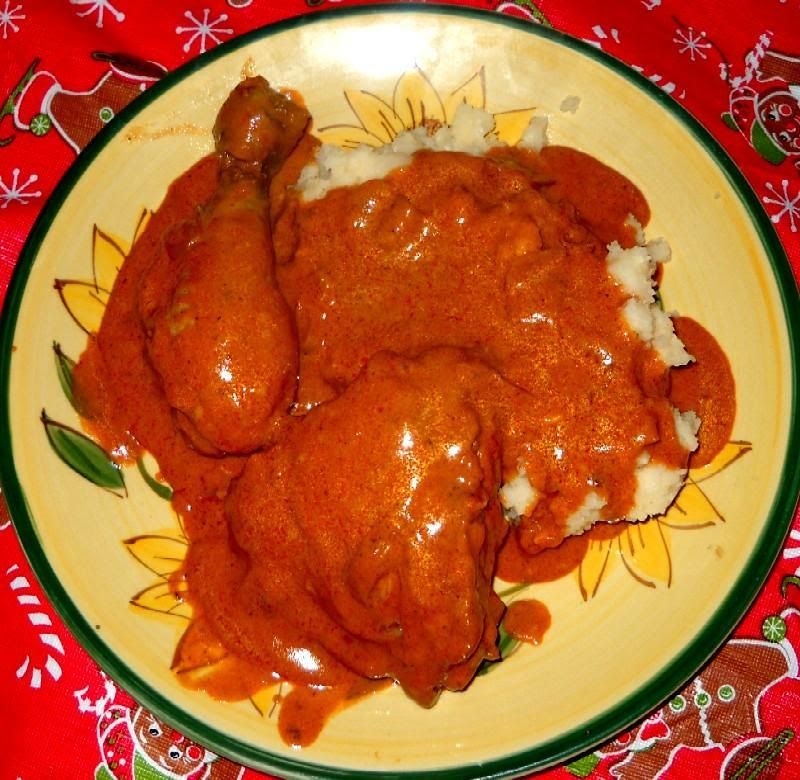 as i said before, too many times the flash would wash this deep richness out:
 but no worries, this one was a definite keeper!
i served this to the beautiful mrs. tas, who actually said she enjoyed it, to my pleasure and surprise - and also to our four children, who all were pretty enthusiastic about it and had no complaints. also, two friends of the boys were over and they also enjoyed this meal. it seems that whenever i am cooking, they show up for supper, which is alright.
 the two mistakes i encountered while making this were that i did not remove more chicken fat after rendering, and that i did not mix the sour cream/flour mixture better before adding to the pot. neither of these errors hurt the dish; however, correcting them will certainly result in a better experience next time.
in all, this was definitely a do-again meal and a complete success, reaching back a hundred-and-fifty years or so into the dark hollows of the carpathians and the fascinating heritage that is a mixture of german, transylvanian and hungarian traditions. i would encourage anyone who wants to appreciate true old-world dining to give this simple meal a try. ------------- If you are a visitor and like what you see, please http://foodsoftheworld.activeboards.net/registration_rules.asp?FID=0" rel="nofollow - click here and join the discussions in our community! |


Posted By: Guests
Date Posted: 17 December 2010 at 05:23
Well, your background research, process and plating were extraordinary, Ron  Sure glad to hear your whole family and smaller guests liked it. I agree with you in that it is one fine example of delicious old-world cooking. The story's tie in sure makes good meal-time conversation too. Outstanding post! Sure glad to hear your whole family and smaller guests liked it. I agree with you in that it is one fine example of delicious old-world cooking. The story's tie in sure makes good meal-time conversation too. Outstanding post!------------- |
Posted By: got14u
Date Posted: 17 December 2010 at 08:17
|
I tell ya I love me some hungarian dishes....I have a friend from Hungry and the dishes his mother would make were always amazing....I will give this a shot for sure....thanks Ron. And I love the history lesson as well. I think we tend to forget that Hungry use to be a lot bigger then it was. Lots of history in that country. ------------- Jerod Life's hard, it's even harder when your stupid. |
Posted By: Melissa Mead
Date Posted: 17 December 2010 at 17:36
|
That looks SO good!
------------- Melissa http://carpelibris.wordpress.com/ - http://carpelibris.wordpress.com/ |
Posted By: Hoser
Date Posted: 18 December 2010 at 03:23
|
This is on my list to do before the winter is out!
------------- Go ahead...play with your food! |
Posted By: TasunkaWitko
Date Posted: 19 December 2011 at 09:32
|
hey, dave - were you ever able to give this a try? it can't be beat!
in fact, it looks like we have another paprika hendl convert. after psoting my results from my preparation of http://foodsoftheworld.activeboards.net/forum_posts.asp?TID=1468&title=draculas-2011-paprika-hendl-dinner-party - dracula's 2011 paprika hendl dinner party on another forum ( http://www.handloadersbench.com - www.handloadersbench.com ), a member there named SavageShooter gave it a try, using boneless/skinless chicken, a little hot pepper powder and roasted potatoes for a side - here is what he had to say:
------------- If you are a visitor and like what you see, please http://foodsoftheworld.activeboards.net/registration_rules.asp?FID=0" rel="nofollow - click here and join the discussions in our community! |


Posted By: urs-vie
Date Posted: 01 January 2012 at 14:56
|
Paprika Hendl is an "Austro-Hungarian" dish! The German word "Hendl" is typically Austrian. Most likely the dish "Paprika Hendl" -- even today still a very common dish in Vienna and all over Austria -- was a dish prepared throughout the whole Austro-Hungarian Empire. In Bram Stokers time he capital of the Empire was Vienna (and Budapest at times), so a lot of german language was spoken throughout the empire, and former regions such as "Siebenbürgen", where Klausenburg was located. The different cuisines of the multinational empire merged over the centuries, which developed into traditional dishes that still parallel today in the Hungarian, Austrian, and Slovak cuisines, just to name a few. The etymology of the word "Hendl" has its origin in Vienna/Austria. Goulash has originated in Hungary, and "Paprika Hendl" resembles very much a goulash, especially with its use of "Hungarian Paprika". So that would put the dish "Paprika Hendl" into the Austro-Hungarian tradition. By the way: I am about to make a Paprika Hendl right now... Grew up with it (in Vienna), it's definitely a fantastic comfort food! ------------- |
Posted By: TasunkaWitko
Date Posted: 01 January 2012 at 15:04
|
hello, urs-vie, and welcome to our forum! thank you very much for your excellent information - often, we are limited to what we can find in books (or on google), and we always enjoy learning from someone who is actually there. we are grateful for any insight you can provide, and hope that we can return some information to you as well. very pleased to "meet" you, and we look forward to hearing about the results of your dish! if you are able to post a picture, p[lease do so! ------------- If you are a visitor and like what you see, please http://foodsoftheworld.activeboards.net/registration_rules.asp?FID=0" rel="nofollow - click here and join the discussions in our community! |
Posted By: Melissa Mead
Date Posted: 15 April 2012 at 11:56
|
I'm attempting to make a crockpot version of Paprika Hendl. I suspect I'm in way over my head. ------------- Melissa http://carpelibris.wordpress.com/ - http://carpelibris.wordpress.com/ |
Posted By: HistoricFoodie
Date Posted: 15 April 2012 at 13:06
|
Melissa, there is no reason this shouldn't work in a slow cooker. It is, when all is said and done, a braised dish. And slow cookers are ideal for them. Just watch your timing; I'm guessing no more than six hours on low. ------------- But we hae meat and we can eat And sae the Lord be thanket |
Posted By: HistoricFoodie
Date Posted: 15 April 2012 at 13:20
|
An incredible research job, Ron. You done good.
One of the things it highlights, when doing research, is that you have to look at the when, as well as the where and who. Romania post WW I is not the same place it was in the late 19th century. Hungary after the Russian invasion was not the same Hungary that was part of a vast empire that ruled much of Europe.
The format of Stoker's book is not all that unusual, as it follows the usual pattern of British travelers. They recorded all sorts of data; scenery, and customs, and foodways encountered along the way. It wouldn't surprise me to learn that Stoker actually made the trip from England to Romania, in the form of first-hand research, and that much of the book comes from his own diary.
One thing we find, because of this penchant to record minutia, is that journals, dairies, and logs are often the best source of food and cooking info; much better, in fact, then contemporary cookbooks. One reason being that they not only recorded what they ate, they commented on it.
|
Posted By: Daikon
Date Posted: 15 April 2012 at 13:32
| As manager of a traveling theater company, Stoker visited quite a number of countries, but he never made it to Eastern Europe. |
Posted By: Melissa Mead
Date Posted: 15 April 2012 at 13:48
|
I've never eaten anything with paprika that I know of, so if it's not authentic I won't be able to tell. I just hope I like paprika. ;)
------------- Melissa http://carpelibris.wordpress.com/ - http://carpelibris.wordpress.com/ |
Posted By: HistoricFoodie
Date Posted: 15 April 2012 at 14:12
|
Melissa, if you like this dish as you make it, then you'll like anything with paprika.
If the paprika flavor dominates too much, just add some more sour cream, which will cut it.
Also keep in mind that once you get away from Mezo-Europe, paprika is used in considerably smaller quantities. A typical Hungarian dish might call for 5-8 tablespoons, whereas an American dish might only use a single tablespoon. ------------- But we hae meat and we can eat And sae the Lord be thanket |
Posted By: Melissa Mead
Date Posted: 15 April 2012 at 14:31
|
All I knew was that it smelled good in the container. ;) Well, we'll see! I've seen it sprinkled on deviled eggs, but that's about it, and I'm not a boiled-egg fan. ------------- Melissa http://carpelibris.wordpress.com/ - http://carpelibris.wordpress.com/ |
Posted By: HistoricFoodie
Date Posted: 15 April 2012 at 14:52
|
What's not to smell good?
Come what may, (add in best melodramatic Cherman accent) ve vill hexpect ein complete report on ze results!
|
Posted By: Melissa Mead
Date Posted: 15 April 2012 at 16:46
|
It wasn't bad, but the "sweet"paprika had a bitter edge. Maybe I'd like it better with less of it. I do like how tender the chicken came out. ------------- Melissa http://carpelibris.wordpress.com/ - http://carpelibris.wordpress.com/ |
Posted By: Margi Cintrano
Date Posted: 16 April 2012 at 02:11
|
Tas,
Firstly, the historical research is exemplary and was truly enjoyed.
The recipe looks divine too.
I would like to read it over real carefully before attempting, however, it could be a lovely Sunday lunch for us ...
Mediterraneans spend hours at the table for lunch, and the best part is the discussing the lunch on all points, slow cooking and sipping lots of wine ...
What would be your side dish ? Potato ? Rice ? Salad ?
I always do light with these type of dishes, as they tend to be heavy-ish, so I would go with crusty bread for sauce dipping, red wine and a serrated lettuce variety green & magenta salad, simple with evoo and vinegar Balsamic or rasberry which I like because of its lightness or just a drizzle of lemon juice and the Evoo with a sprinkle of salt ...
For the Vet, perhaps, a baked or boiled potato.
Hope the dish is successfully delicious. Thanks for posting.
Margi. ------------- Volamos a Mediterraneo, un paraiso que conquista su gente u su cocina. |
Posted By: Melissa Mead
Date Posted: 16 April 2012 at 15:42
|
I put it over noodles. The salad sounds delicious. There's magenta lettuce?
------------- Melissa http://carpelibris.wordpress.com/ - http://carpelibris.wordpress.com/ |
Posted By: Margi Cintrano
Date Posted: 17 April 2012 at 03:32
|
@ Melissa,
1stly, thanks so much for your post.
Yes, there are several types of Magenta red violet lettuces both in Italia, Spain, Greece and France.
1) radicchio - Italian ( this is a Venetian lettuce that is quite bitter )
2. lollo rosso - Italian and Spanish ( this is a curly lightly watery leaf lettuce with serrated edges that are magenta, and the upper section of the leaf is a celery tone green ) ...
*** Rosso means red in Italian ... It is an Oak Leaf lettuce, however, NOT FROM AMERICAN OAK TREE ... This ( I ) had been explained on an older thread someplace --- This is a gorgeous salad lettuce !
If you would like more information on these varieties of red violet magenta lettuce, I shall send the list translated later this evening.
Thanks and kindest regards.
Margi. ------------- Volamos a Mediterraneo, un paraiso que conquista su gente u su cocina. |
Posted By: Melissa Mead
Date Posted: 17 April 2012 at 15:38
|
Now that you mention it, I've had radicchio. And I love oak leaf lettuce.
------------- Melissa http://carpelibris.wordpress.com/ - http://carpelibris.wordpress.com/ |
Posted By: Margi Cintrano
Date Posted: 18 April 2012 at 08:40
|
@ Melissa, Good evening.
Yes, Radicchio is quite a popular magenta lettuce from Veneto, Italy originally.
LOLLO ROSSO is a curly serrated edged half green and half magenta lettuce with a refreshing flavor. I am sure, you can look on internet and find it ... It is also grown in California, if I am not mistaken ... It is also Italian in origin. *** ROSSO means Red in Italian.
It is my fave and delightful paired with other lettuces too.
Ask around at the Farmer´s Markets and your fruit & vegetable store ...
Perhaps, you can grow it !
Kind regards,
Margi. Cintrano.
------------- Volamos a Mediterraneo, un paraiso que conquista su gente u su cocina. |
Posted By: Melissa Mead
Date Posted: 18 April 2012 at 16:22
|
It does sound good.
------------- Melissa http://carpelibris.wordpress.com/ - http://carpelibris.wordpress.com/ |
Posted By: AK1
Date Posted: 20 April 2012 at 13:51
| I definitely have to try this. Heck I love Gulyas & Paprikas, so this will fit perfectly. And I love the taste of all kinds of paprika. |
Posted By: Rod Franklin
Date Posted: 31 October 2012 at 16:58
|
I made this tonight and wrecked it. Wrecked it by using bad paprika. I should have known better. It wasn't the usual brand. Even though the brand new can said sweet and delicate, and had an expiration date of more than a year out it was no good. I had already started the dish and when I popped the lid on the can so I could spoon the paprika out I noticed it was not a brilliant red like it should be. It was brown. I shouldn't have used it, but I did any way and I wrecked the dish. This is likely akin to what happened to Melissa. So, learn from my mistakes and make sure the paprika you buy is the good stuff. Use only a can that says "Pride of Szeged, Hungarian, Exquisite 100% Sweet Delicacy, Paprika" and open the can right in the store and make sure it is filled with brilliant red powder. DO NOT bother with anything else. ------------- Hungry |
Posted By: TasunkaWitko
Date Posted: 01 November 2012 at 07:25
|
youch - sorry to hear about that, rod ~ i know that the paprika makes the dish in this case, but were you able to salvage anything?
i checked my hungarian paprika at home that i got in billings, and it is indeed the exact same brand you mentioned (pride of szeged). i'm looking forward to giving it go with various dishes. ------------- If you are a visitor and like what you see, please http://foodsoftheworld.activeboards.net/registration_rules.asp?FID=0" rel="nofollow - click here and join the discussions in our community! |
Posted By: gracoman
Date Posted: 17 October 2015 at 08:05
|
I think I need to give this one a try. It is, after all, that time of year. I'm a huge fan of Hungarian dishes and never skimp on the paprika. http://www.thespicehouse.com/spices/hungarian-sweet-paprika#content - I Just made an order for the finest Hungarian paprika I've ever come across . If you've never tried this deep mahogany red, awesome paprika, I highly recommend it. |
Posted By: drinks
Date Posted: 17 October 2015 at 12:36
|
A note, raddico is not a lettuce, but a heading chicory. I use it quite a bit, really like it just by itself. A nice addition to a tossed salad. |
Posted By: gracoman
Date Posted: 02 November 2015 at 08:02
|
At first I was going to fancy this dish up but decided to stick to the roots and make it as intended. I followed the Paprika Hendi recipe posted here closely except for the addition of a few tablespoons of hot paprika. Served with fried potatoes. http://s1293.photobucket.com/user/gracoman/media/Paprika%20Hendi_zpsd7fpyhub.jpg.html"> 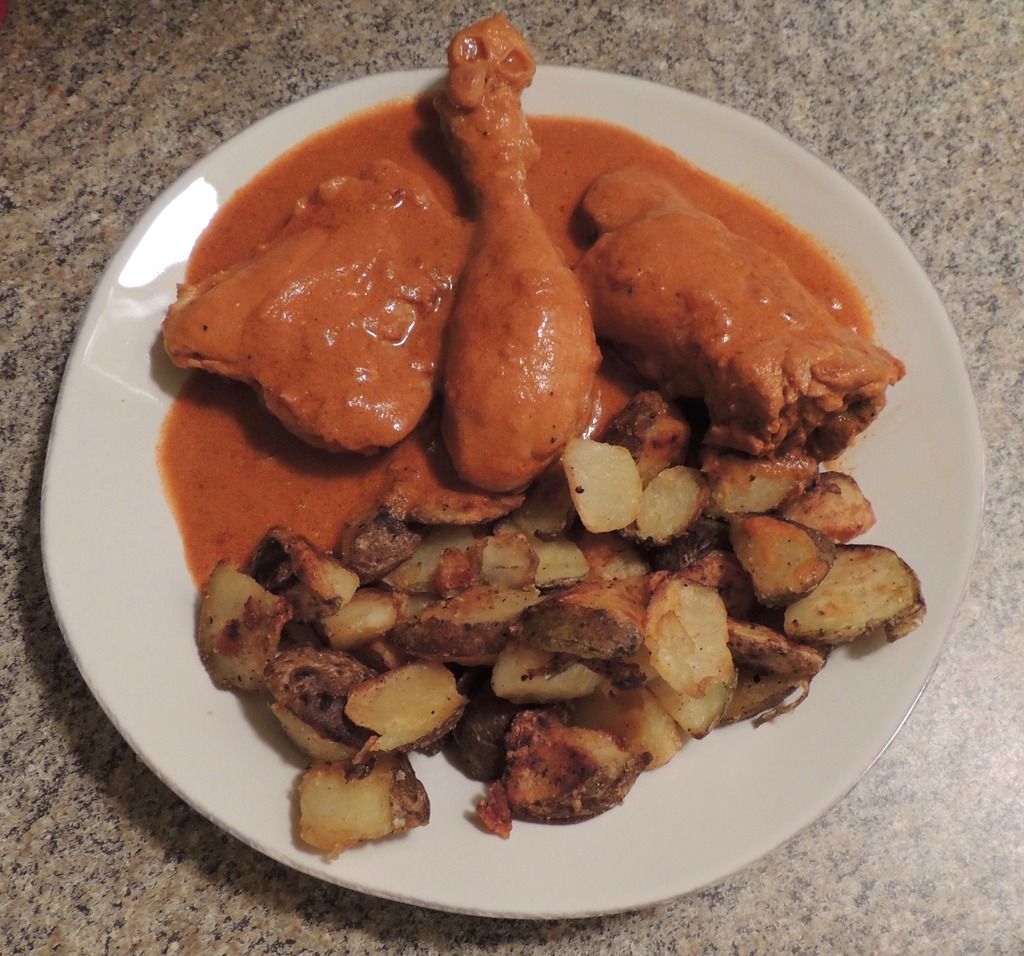 |
Posted By: TasunkaWitko
Date Posted: 02 November 2015 at 19:45
That looks outstanding to me, gMan - I would happily sit down to a late of that, right now!  And the big question: how did you like it? ------------- If you are a visitor and like what you see, please http://foodsoftheworld.activeboards.net/registration_rules.asp?FID=0" rel="nofollow - click here and join the discussions in our community! |
Posted By: gracoman
Date Posted: 03 November 2015 at 07:28
| I'm a sucker for all Hungarian foods and this one is no different. I will lighten it up for the next go around but it's a keeper for sure. |
Posted By: gonefishin
Date Posted: 03 November 2015 at 17:34
|
I made this the other day at work...this time with some fat noddles. I use Hungarian Sweet Paprika from Penzy's Spice. The Hungarian paprika from Penzy's is Kulonleges grade. There's a bit of difference from grade to grade...which may be what people are running into. I'll try to find something decent on this and post it. ------------- Enjoy The Food! |