Pickled bell peppers filled with slaw
Printed From: Foods of the World Forum
Category: Europe
Forum Name: The Balkans
Forum Discription: Romania, Bulgaria and the former Yugoslavia.
URL: http://foodsoftheworld.ActiveBoards.net/forum_posts.asp?TID=1499
Printed Date: 26 March 2026 at 20:33
Topic: Pickled bell peppers filled with slaw
Posted By: TasunkaWitko
Subject: Pickled bell peppers filled with slaw
Date Posted: 01 November 2011 at 08:39
|
This intriguing Balkan specialty was sent to me by our own CARMENUKA, with this note:
She also sent a really beautiful picture, which i think captures the colorful spirit of this recipe and also romanian living in general ~
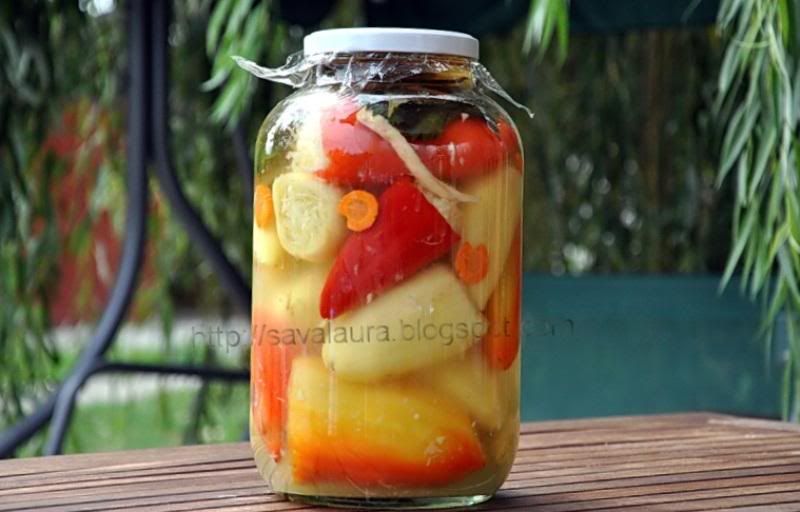 If anyone tries this, you might need to do some conversions from metric to standard measurements; but it seems that the directions are clear and easy to follow. Cherry leaves might be a little hard to come by in some areas, so if anyone can find out a possible substitute, be sure to let us know ~
Thanks for sharing this wonderful recipe, Carmen!  ------------- If you are a visitor and like what you see, please http://foodsoftheworld.activeboards.net/registration_rules.asp?FID=0" rel="nofollow - click here and join the discussions in our community! |
 you may need to adjust some food terms:)
Replies:
Posted By: Melissa Mead
Date Posted: 05 November 2011 at 07:43
|
I didn't even know cherry leaves were edible!
------------- Melissa http://carpelibris.wordpress.com/ - http://carpelibris.wordpress.com/ |
Posted By: Rod Franklin
Date Posted: 05 November 2011 at 16:12
|
I would make this, but I might modify the procedure. Cherry leaves are used to make the pickles crisper. They have tannins in them. So do oak leaves, grape leaves and many others. Some cherry leaves can be mildly poisonous, but I don't think enough to be concerned about. They aren't eaten. ------------- Hungry |
Posted By: TasunkaWitko
Date Posted: 07 November 2011 at 09:59
hey, rod - i figured this one might catch your interest ~  the procedure given is of course the "old school" way of doing it. as i recall from your outstanding sauerkraut tuorial, there are a lot of things a person can do to minimize pitfalls in the final product. i imagine many of those same methods coule be employed here, if you want to give this a try. as for the cherry leaves - we don't have any available here, but carmen offered to send me some from her home country if i want to try this, using them. if anyone wants to try this and needs cherry leaves, let me know and we can arrange a box to send to her with a few goodies in order to trade for some!  ------------- If you are a visitor and like what you see, please http://foodsoftheworld.activeboards.net/registration_rules.asp?FID=0" rel="nofollow - click here and join the discussions in our community! |
Posted By: Melissa Mead
Date Posted: 11 November 2011 at 15:28
|
Would cherry or grape leaves "crisp up" store-bought pickles? The ones I just got are kinda mushy. (I wonder if there's a way to use the tannins in a tea bag without making your pickles taste like tea?) ------------- Melissa http://carpelibris.wordpress.com/ - http://carpelibris.wordpress.com/ |
Posted By: Rod Franklin
Date Posted: 11 November 2011 at 15:54
|
I don't believe there is anything that will make a mushy pickle crisp again. I'm not convinced the tannin thing really has any effect on crispness. Leaves do impart an element of flavor though. ------------- Hungry |
Posted By: HistoricFoodie
Date Posted: 04 May 2017 at 19:23
|
Interesting thread. Back in colonial days, similarly stuffed and pickled peppers were very common. These were called "mangoes," for some reason. To this day there are places in the U.S. where small peppers are called mangoes. ------------- But we hae meat and we can eat And sae the Lord be thanket |
Posted By: TasunkaWitko
Date Posted: 05 May 2017 at 08:45
|
Hi, Brook - This is something I would definitely like to try. I'm not a fan of green bell peppers, but if I can get my hands on some of those Hungarian-type, horned shaped red and/or yellow peppers, I think that they'd really be good with this. ------------- If you are a visitor and like what you see, please http://foodsoftheworld.activeboards.net/registration_rules.asp?FID=0" rel="nofollow - click here and join the discussions in our community! |
Posted By: pitrow
Date Posted: 05 May 2017 at 10:17
|
wow. Thanks for bumping this Ron. I definitely would like to try this one. I wonder if you could substitute pickle crisp for the cherry leaves? Wouldn't have the same flavor, but might help with the crunch factor. My previous house had two huge cherry trees in the back yard, but alas that's just a memory now. I do have a small fig tree, I wonder if a fig leaf would substitute? ------------- Mike http://lifeinpitrow.blogspot.com/" rel="nofollow - Life in PitRow - My often neglected, somewhat eccentric, occasionally outstanding blog |
Posted By: TasunkaWitko
Date Posted: 05 May 2017 at 10:26
|
Mike - I'm guessing that the cherry leaves are not "critical" to this. There are probably good substitutes, including oak, grape and others. Not sure which, but it looks to the tannins in the leaves that would be important. Pickle crisp could work - I just don't know.... Brook? ------------- If you are a visitor and like what you see, please http://foodsoftheworld.activeboards.net/registration_rules.asp?FID=0" rel="nofollow - click here and join the discussions in our community! |
Posted By: TasunkaWitko
Date Posted: 05 May 2017 at 11:04
|
Bay leaves, perhaps? ------------- If you are a visitor and like what you see, please http://foodsoftheworld.activeboards.net/registration_rules.asp?FID=0" rel="nofollow - click here and join the discussions in our community! |
Posted By: Margi Cintrano
Date Posted: 05 May 2017 at 14:05
|
Ron, This is very common in the Transylvania Pass Route of Brasov / Poina. Due to the long cold Eastern European winters, The Brasovian Region of north eastern Romania, located on The Transylvania Passage, during 1377, travelers, with a lack of vegetables due to harsh blizzards and snows, had also found means to store their vegetables as all cultures and indigenous peoples did and still do .. There is a place that I had lunch at, where they sell uncountable types of jarred peppers with cabbage and other vegetables. It was amazing ! Good luck. Fabulous project. Have a lovely weekend everyone. ------------- Volamos a Mediterraneo, un paraiso que conquista su gente u su cocina. |
Posted By: HistoricFoodie
Date Posted: 05 May 2017 at 19:22
|
"Modern" preservation methods, particularly what they call jarring in England and canning in the U.S. dates only from 1812. Napoleon had offered a cash prize for anyone who could devise a method of preserving food for troops in the field. The mangoes I refer to above would have been put up in barrels. The most popular variety for making them was a pepper called Bullnose. ------------- But we hae meat and we can eat And sae the Lord be thanket |