Coconuts 101
Printed From: Foods of the World Forum
Category: Food Groups
Forum Name: Fruits, Nuts, Fungi and Vegetables
Forum Discription: A place to discuss fruits, nuts, fungi and vegetables in general.
URL: http://foodsoftheworld.ActiveBoards.net/forum_posts.asp?TID=1538
Printed Date: 26 March 2026 at 21:49
Topic: Coconuts 101
Posted By: TasunkaWitko
Subject: Coconuts 101
Date Posted: 30 November 2011 at 14:26
|
Coconuts 101
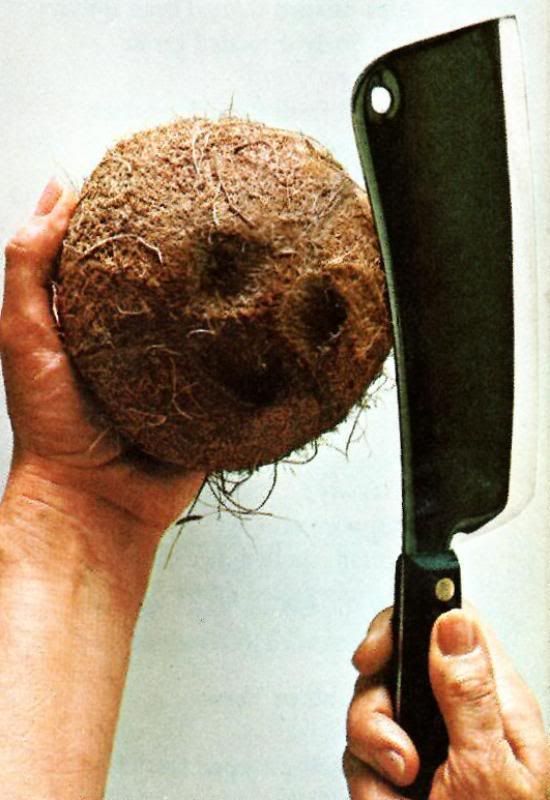
Living in the middle of north-central Montana, I don't get much of an opportunity to try foods that will utilize fresh coconut, so when I do, I want it to be a good coconut, and I want to do it right. Here is some outstanding information on this topic from Time-Life's Foods of the World Series:
------------- If you are a visitor and like what you see, please http://foodsoftheworld.activeboards.net/registration_rules.asp?FID=0" rel="nofollow - click here and join the discussions in our community! |
 How to Buy, Open and Prepare a Coconut
Replies:
Posted By: The Farmer's Wife
Date Posted: 30 November 2011 at 19:06
|
Thanks for posting this great info Ron! My problem with buying coconuts has been that they seem to nearly always be moldy on the inside, no matter how hard I try to find fresh ones. Now I will try to find ones that are full of lots of coconut milk...so glad to know there is a way to distinguish fresh ones from moldy! |
Posted By: TasunkaWitko
Date Posted: 01 December 2011 at 09:13
good morning! i had the same problem, especially buying coconuts...(ahem)....locally ~ 
it's understandable, since i am sure that our town and the surrounding ones are at the VERY END of the supply chain, especially when it comes to "exotic" things like coconuts. i've had experienes the same as you describe, but with the tips above, i figure i can maximise my chances of getting good coconuts AND, when i am able to, getting the best usage out of them! ------------- If you are a visitor and like what you see, please http://foodsoftheworld.activeboards.net/registration_rules.asp?FID=0" rel="nofollow - click here and join the discussions in our community! |
Posted By: Melissa Mead
Date Posted: 02 December 2011 at 20:32
|
Somewhat OT, but I have the same problem with avocados. Any suggestions?
------------- Melissa http://carpelibris.wordpress.com/ - http://carpelibris.wordpress.com/ |
Posted By: TasunkaWitko
Date Posted: 02 December 2011 at 21:05
|
i'll see what i can find, melissa!
------------- If you are a visitor and like what you see, please http://foodsoftheworld.activeboards.net/registration_rules.asp?FID=0" rel="nofollow - click here and join the discussions in our community! |
Posted By: Melissa Mead
Date Posted: 03 December 2011 at 15:02
|
Thanks!
------------- Melissa http://carpelibris.wordpress.com/ - http://carpelibris.wordpress.com/ |
Posted By: Rod Franklin
Date Posted: 03 December 2011 at 18:36
|
I just bought a bad coconut today. It was moldy inside. Nasty. I took it back and they gave me 2, $2.50 coupons off my next purchase. So that's good. I paid $1.69 for the little thing. I miss being able to go to the Asian grocery and getting nice green coconuts for $0.99 a piece. I used to eat 3 or more a week. Last I saw them here they were $2.49 and I'm afraid to buy one.
------------- Hungry |
Posted By: The Farmer's Wife
Date Posted: 03 December 2011 at 19:03
If customers joined forces and began demanding FRESH coconuts, perhaps our grocers would locate better sources? 
|
Posted By: TasunkaWitko
Date Posted: 05 December 2011 at 15:58
here you go, Melissa!
http://foodsoftheworld.activeboards.net/topic1562_post9880.html#9880 - http://foodsoftheworld.activeboards.net/topic1562_post9880.html#9880
------------- If you are a visitor and like what you see, please http://foodsoftheworld.activeboards.net/registration_rules.asp?FID=0" rel="nofollow - click here and join the discussions in our community! |
Posted By: Melissa Mead
Date Posted: 05 December 2011 at 16:14
|
Thanks! Alas, I'd already heard that, and I still get bad ones. Oh well. ------------- Melissa http://carpelibris.wordpress.com/ - http://carpelibris.wordpress.com/ |