Carne de Res Kalimotxo
Printed From: Foods of the World Forum
Category: Europe
Forum Name: The Iberian Peninsula
Forum Discription: Spain, Portugal and diverse influences such as Moorish, Celtic and Basque.
URL: http://foodsoftheworld.ActiveBoards.net/forum_posts.asp?TID=1582
Printed Date: 26 March 2026 at 17:34
Topic: Carne de Res Kalimotxo
Posted By: TasunkaWitko
Subject: Carne de Res Kalimotxo
Date Posted: 10 December 2011 at 17:31
|
Carne de Res Kalimotxo
Beef Braised in Red Wine and Cola
When I saw Dave's captivating post for http://foodsoftheworld.activeboards.net/kalimotxo-short-ribs_topic1462.html - Kalimotxo Short Ribs , I was instantly hooked and eager to try this Basque method on a beef dish of my own. Short ribs often seem to be in short supply in this area, and are awfully expensive as well, if they can be found (around 7$/pound). Consequently, I kept pushing the project farther and farther back, until I had almost forgotten it.
And then it happened....
A few days ago, I had taken out a small rump roast to thaw, intending to simply roast it in a simple onion-soup-mix-and-cream-of-mushroom-soup concoction that has worked well for us over the years. While shopping for some ingredients today at our local, small-town grocery, I saw a rare treat in the meat case.
Every now and then, the meat guy trims a rack of ribs off a special-order prime rib roast, and packages the rack for sale at an amazingly low price. As far as I can tell, it probably doesn't happen even a dozen times a year, but whenever it does, I snatch the ribs up for barbecue, if I am lucky enough to discover them before anyone else. Today, much to my delighted surprise, I saw a tray of these lovely ribs sitting on display; I literally stopped the cart and slapped my forehead as the lightbulb burst on in my mind, rather like the mushroom cloud at Trinity:
 "We're eating in Basque country tonight!"
I reached for the package, ready to do battle in case anyone happened to be coming up behind me to grab them; luckily, I was alone in this little corner of the Food Farm. I searched thoroughly throughout the case to see if there was another one, but no dice. No worries - I was happy to have the one I got, and proceeded to get a few necessary ingredients that weren't already at home. My plan was to chunk up the roast and braise it - with the ribs cut into portions - in Kalimotxo. To be clear, a person can use this method to braise nearly any beef, but my opinion it is the chunked roasts, the chucks, the ribs and other "lesser," yet oh-so-flavourful cuts, that are perfectly suited for this.
One thing that I found interesting was that Kalimotxo, under various guises, seems to be a rather popular, widespread beverage, although I had never heard of it until http://foodsoftheworld.activeboards.net/kalimotxo-short-ribs_topic1462.html - Dave's post . From http://en.wikipedia.org/wiki/Kalimotxo - Wikipedia :
http://en.wikipedia.org/wiki/Kalimotxo - Wiki went on to provide some ideas on where Kalimotxo got its moniker:
Recipe, pictures and method to follow.... ------------- If you are a visitor and like what you see, please http://foodsoftheworld.activeboards.net/registration_rules.asp?FID=0" rel="nofollow - click here and join the discussions in our community! |
 Kalimotxo...is a drink consisting of approximately 50% red wine and 50% cola-based soft drink. Alternative names include Rioja libre (from "Rioja", and "Cuba Libre"), kali, motxo. In Chile the drink is known as jote (Chilean Spanish for the Black Vulture), and in Bosnia and Herzegovina, Serbia, the Republic of Macedonia, Croatia, Slovenia and other former Yugoslav republics it is known as bambus (meaning bamboo) and musolini (as in Benito Mussolini). The person who mixes bamboo 50:50 , is often defined as "gulozan". In the Czech Republic it is known as houba (meaning mushroom), and in Hungary as Vadász (meaning hunter) or vörösboros kóla or VBK for short. In Mozambique and South Africa it is known as Catemba, and in Germany it is sometimes called Korea.
Replies:
Posted By: Hoser
Date Posted: 11 December 2011 at 08:09
|
Glad to see you took the leap into some kalimotxo Ron....great stuff!
I can hardly wait to see your pics and hear your review on it. ------------- Go ahead...play with your food! |
Posted By: TasunkaWitko
Date Posted: 22 December 2011 at 21:05
|
Dave - my reaction to this kalimotxo concept can be summed up in one word: outstanding! I thoroughly enjoyed this preparation for beef, and wholeheartedly recommend it to anyone wanting to take a voyage to Spain, without leaving the house!
When I got home from the store and appraised my beef situation (ribs and roast in toto), it seemed that I had maybe half again as much as Dave used in http://foodsoftheworld.activeboards.net/kalimotxo-short-ribs_topic1462.html - his preparation . Because of this, I guesstimated an increase in the ingredients and came up with this method of preparation:
Here's a step-by-step on how I put this wonderful meal together, adapting http://foodsoftheworld.activeboards.net/kalimotxo-short-ribs_topic1462.html - Dave's method to the meat i was using, the ingredients available to me, and the crowd i was serving.
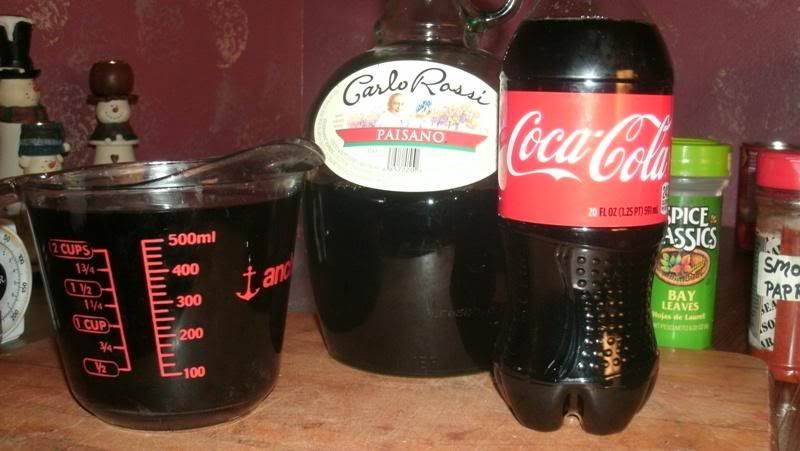
First, of course, is a shot of the goods, less the beef:
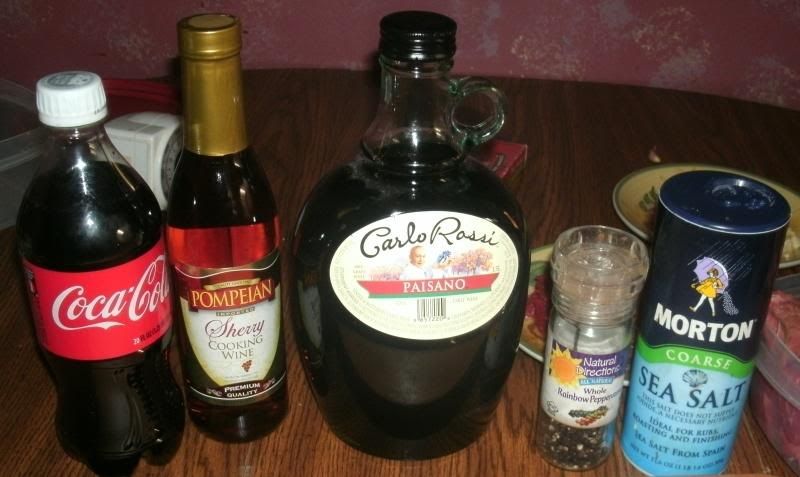
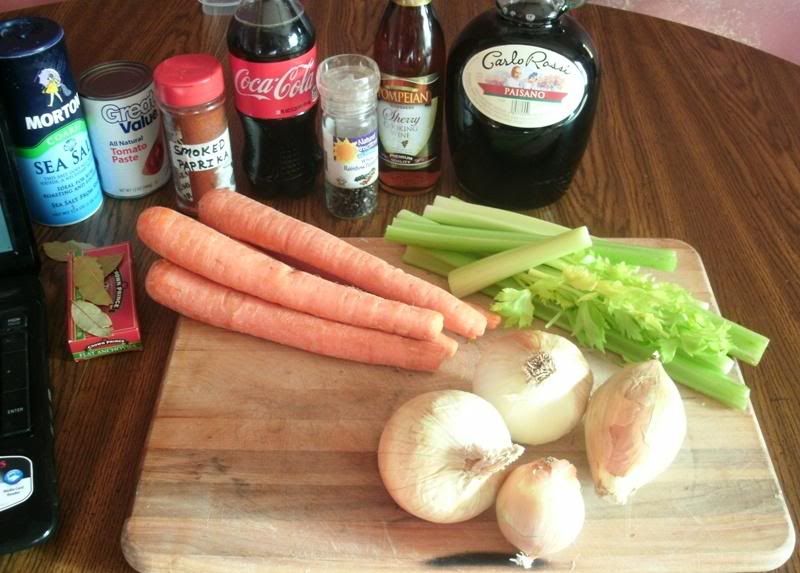 Pretty easy stuff (back to front, left to right): coarse sea salt, tomato paste, pimentón ahumado, cola, whole black pepper, sherry (all I had available to me was cooking sherry, which contains some salt, so I used less salt when cooking), cheap, red wine, bay leaves, anchovies, carrots, celery and onions. Not pictured: olive oil and garlic.
These are simple ingredients that are widely available, yet capture the essence of the bold and fresh profiles in Basque cooking.
As always, mise en place was critical in preparing this dish, and once I finished all the prep work, the dish came together fairly easily. I began by converting the carrots, onions and celery into mirepoix:
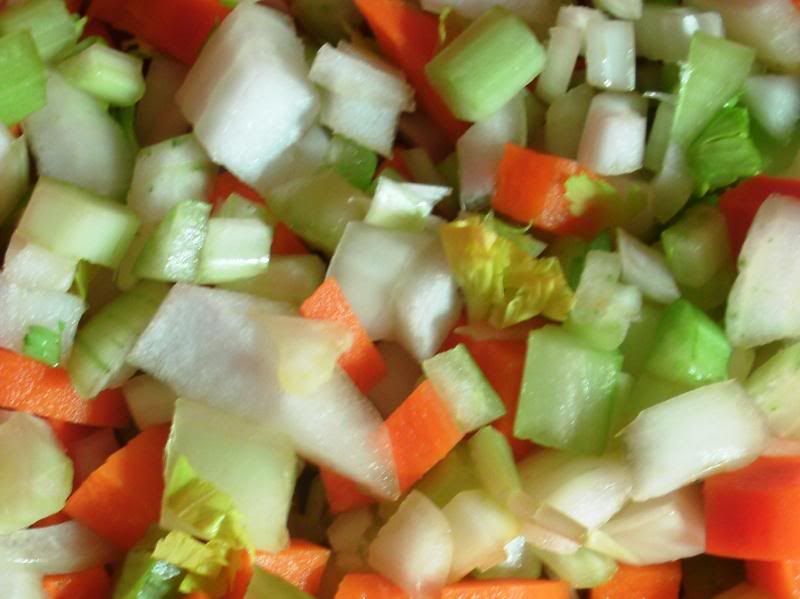 Next, I appraised my impressive store of beef, forming a plan that would put it to best use:
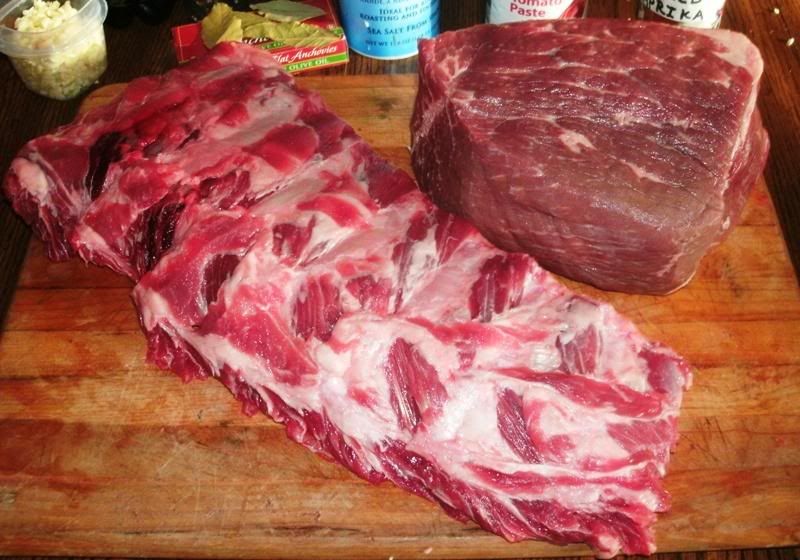 I decided to trim the membrane off the back of the rack, then section the ribs into individual portions:
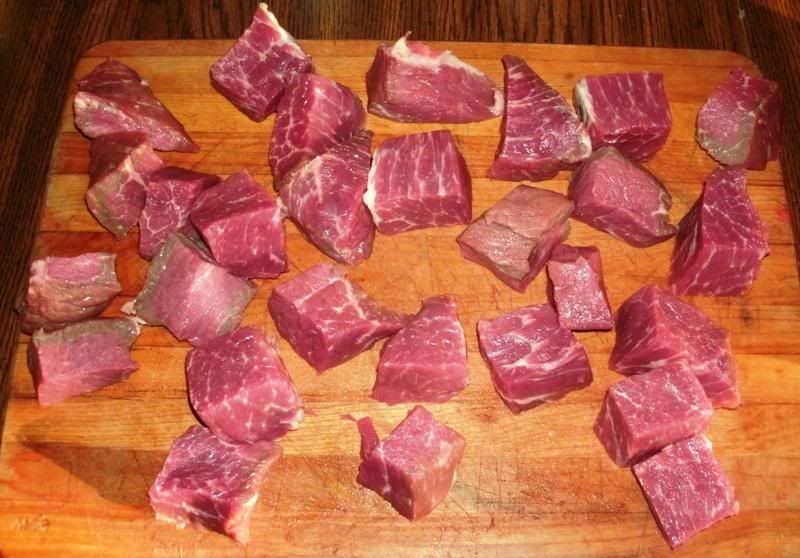
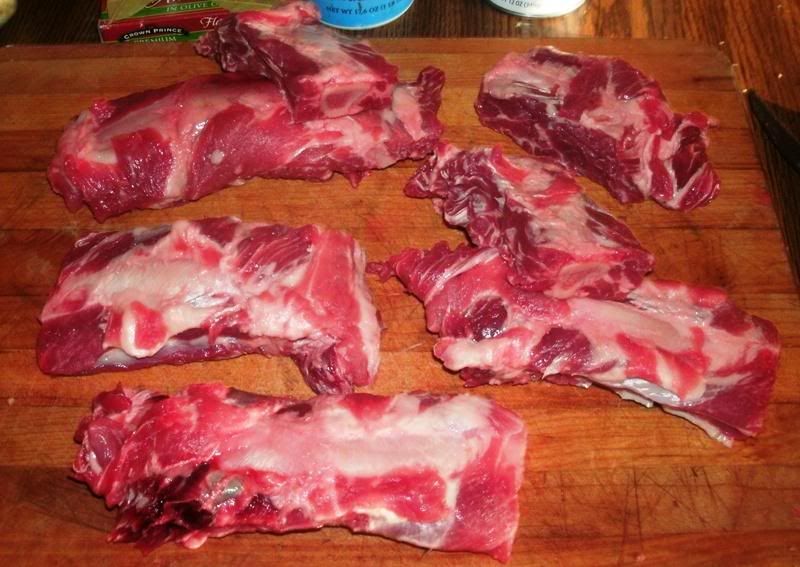 For the roast, I trimmed the fat cap off, along with the small amount of silverskin present, and cut it into large chunks:
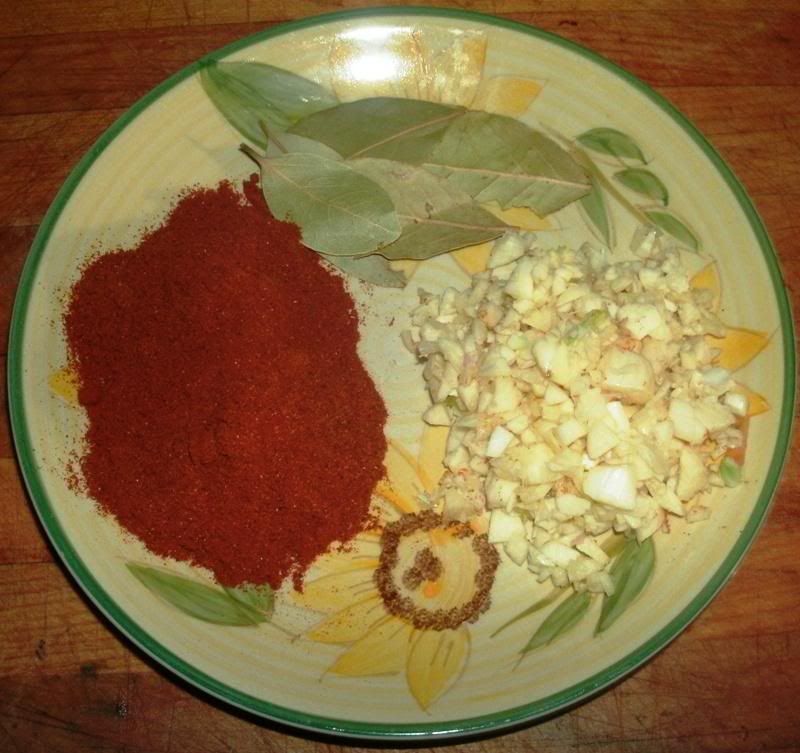
 I then measured out my fresh, crushed-and-chopped garlic and the pimentón ahumado, placing them on a small saucer with the bay leaves:
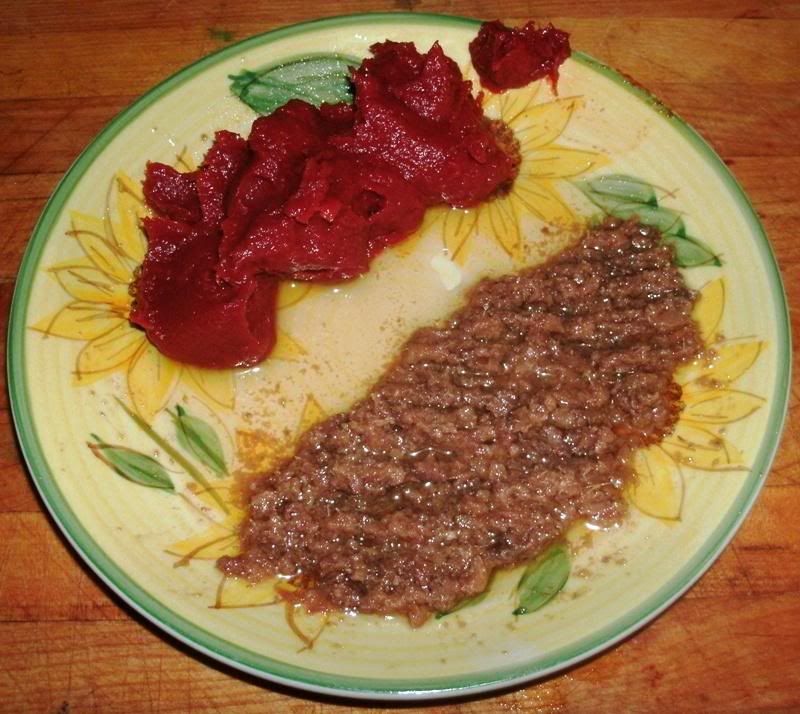
 Then I mashed the anchovies in their own oil until they were nore-or-less a paste, and measured out the tomato paste:
 This left only these few ingredients:
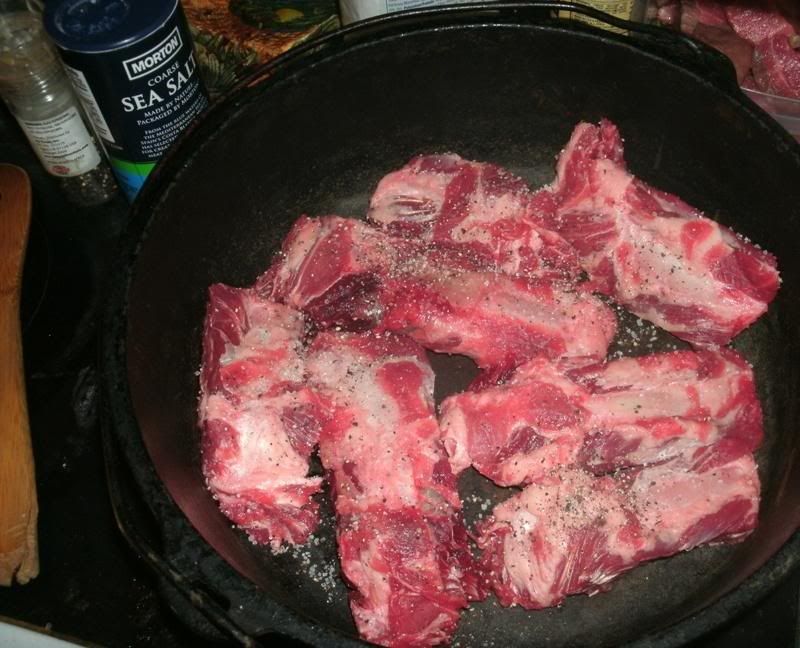
 After sprinkling a little salt and a generous amount of freshly-ground black pepper on the beef to season it, I measured out the wine and the sherry (not pictured):
 Mise en place complete, I began this journey to Basque country by searing the ribs in my Dutch oven over medium-high heat:
 Until they looked about like this:
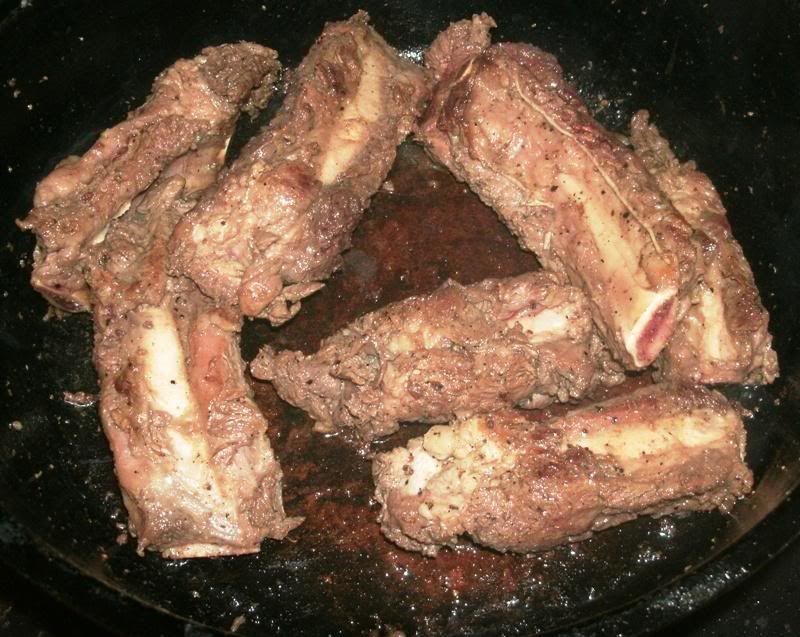 My plan was to render the fat out of the ribs to use in searing the chunks of roast, but there didn't seem to be enough fat by the time I was done; either the ribs simply didn't have enough fat to render for the job (unlikely), or my heat was a little too high to effectively render the fat (probable). No big deal - I simply set the ribs aside, de-glazed with a shot of sherry and and then heated a little olive oil in order to sear the chunks of roast:
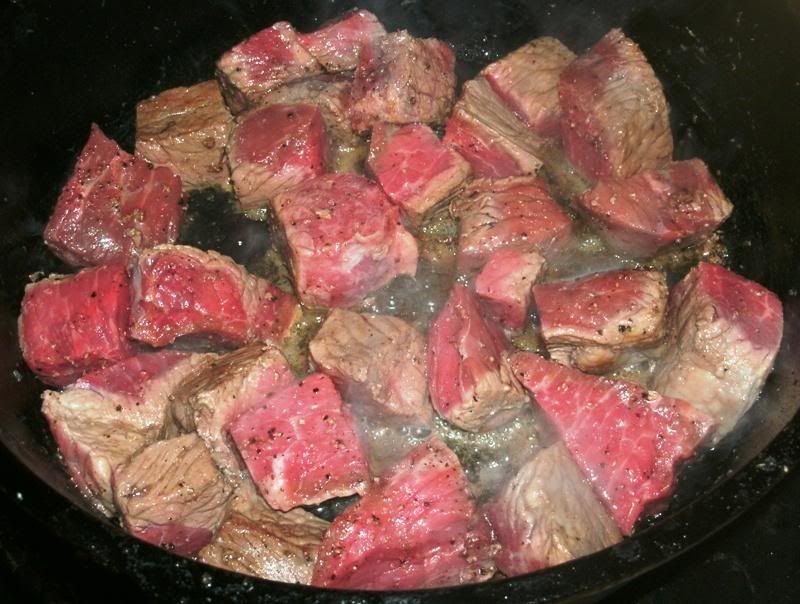
As with most similar dishes, such as http://foodsoftheworld.activeboards.net/forum_posts.asp?TID=274&title=carbonade-flamande - Carbonade Flamande , you want to sear the beef well and dark, stirring the chunks around in the liquid that is released until the moisture is all but gone, and the pieces are coated with their own thickly-reduced juices.
I then removed the chunks and de-glazed the Dutch oven, lifting all the bits and reducing the resulting liquid down to a rich bunch of goodness. After transfering this to a bowl with the ribs and chunks of roast, I heated a couple tablespoons of olive oil and began sweating out the mirepoix:
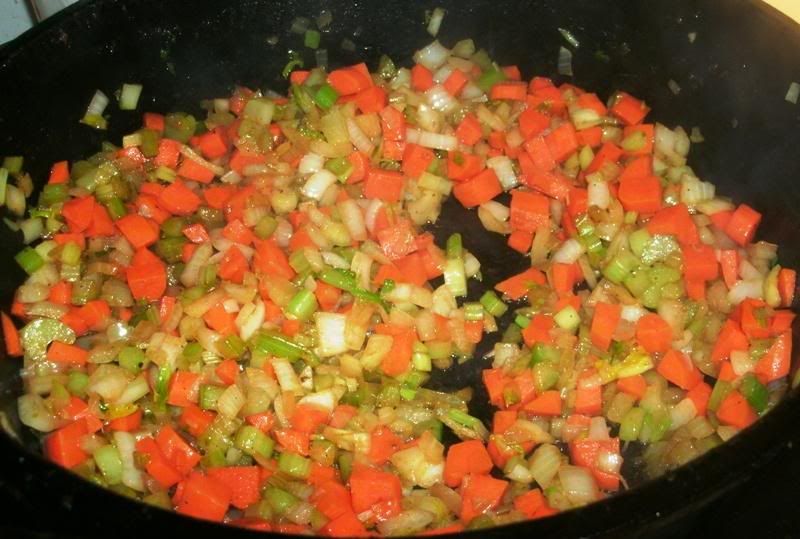 When the onions were just beginning to carmelise, I removed the Dutch oven from the heat and added the anchovies, tomato paste, garlic, bay leaves and pimentón ahumado, stirring the mixture thoroughly so that the garlic could sweat out in the indirect heat while the pimentón released its aromatic, exotic oils and began to darken into a beautiful brick-coloured red: 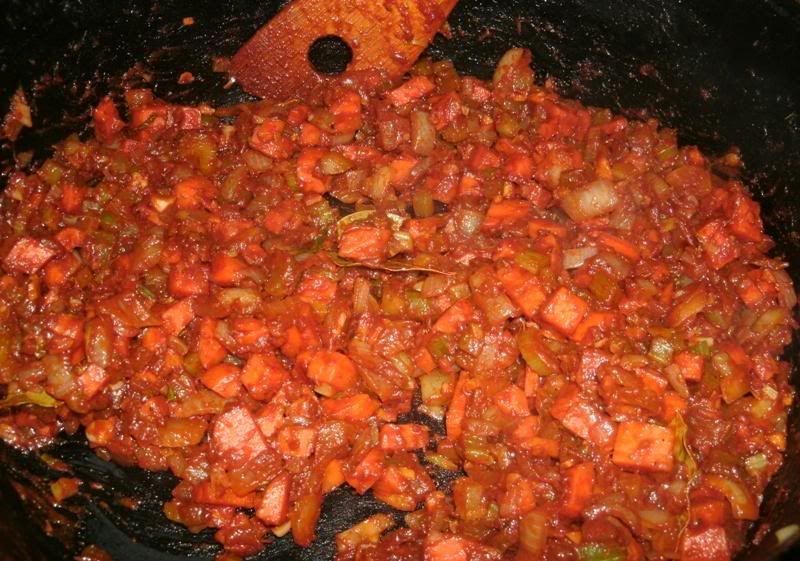 When the mixture thickened up and began to stick to the bottom of the Dutch oven, I deglazed with the sherry and returned the pot to the heat to reduce. When the last of the residual moisture was nearly absorbed, I added the cola and red wine, stirring to get everything mixed together until the braising liquid just began to boil:
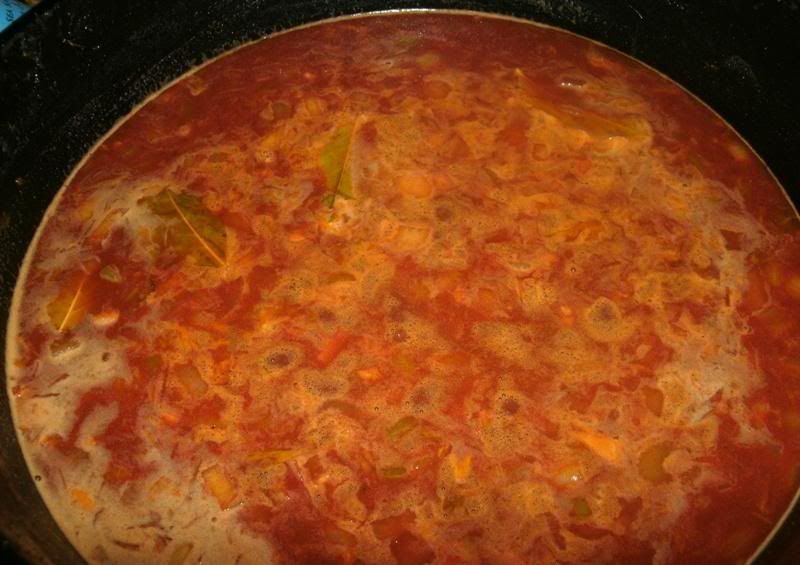 Then I returned all the beef (along with de-glazing liquids) to the Dutch oven, stirring gently to make sure they were all coated. When the pot started to bubble again, I covered the Dutch oven with its heavy, cast iron lid and put it in the oven at 300 degrees to braise.
I was very impressed with the layers of aroma and the wonderful promise of rustic flavours that were to be found while this meal was cooking. Even as it was braising in the oven, I found myself catching whiffs of new dimensions not present before, but definitely consistent with the ingredients used and so fundamentally Spanish (Basque, particularly) in nature.
Like many worthwhile things, braising takes time, and after about two-and-a-half hours, when I could stand the aroma no longer, I removed the Dutch oven from the oven and checked the beef. I was pleased to find that it was perfect, with the meat on the ribs just at the point where it was barely clinging the bone, and the chunks of roast perfectly fork-tender without being mushy. I carefully removed the beef to a casserole dish:
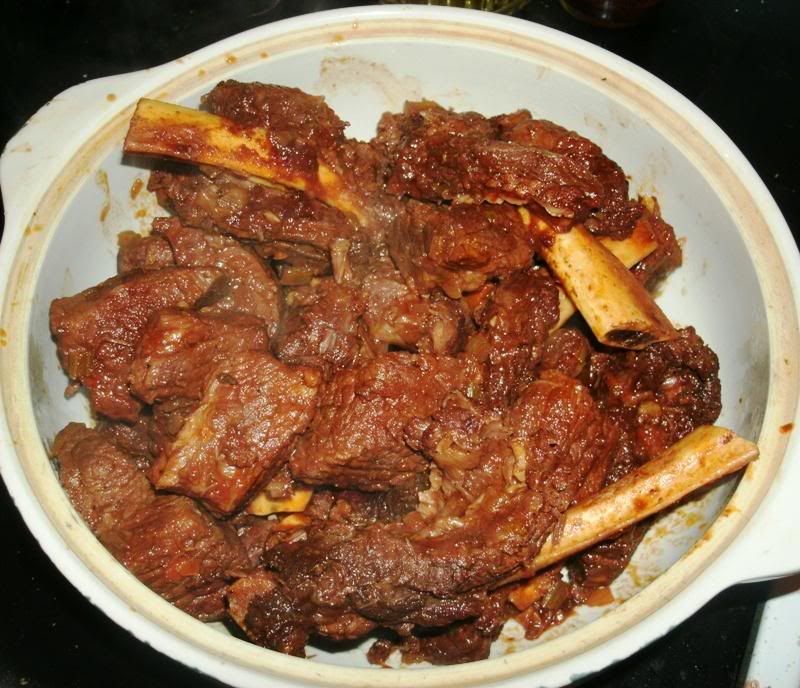 Then covered it and set it into the oven (now turned off) in order to stay warm while I prepared the sauce.
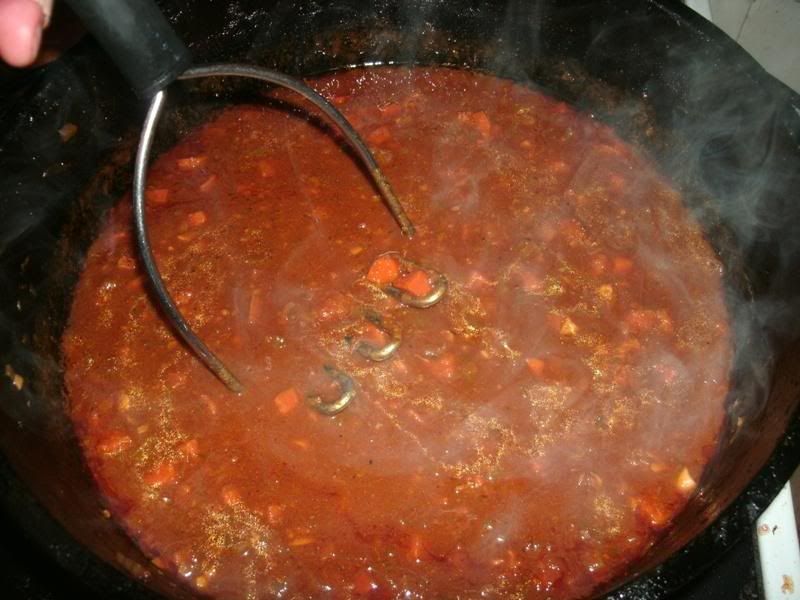
For my preparation, I decided to use the procedure outlined above for the chunky sauce/gravy; I had done something similar during my http://foodsoftheworld.activeboards.net/forum_posts.asp?TID=806&title=manzo-brasato-alla-lombarda - Manzo Brasato alla Lombarda project, and was pleased with the results. So I got to work with my potato masher, pulping the soft chunks of carrots, onions and celery that hadn't already melted into the cooking liquid:
 I then skimmed off the small amount of fat from the surface of the cooking liquid and heated it up to reduce a little, stirring constantly so that the vegetables could continue melting into the gravy:
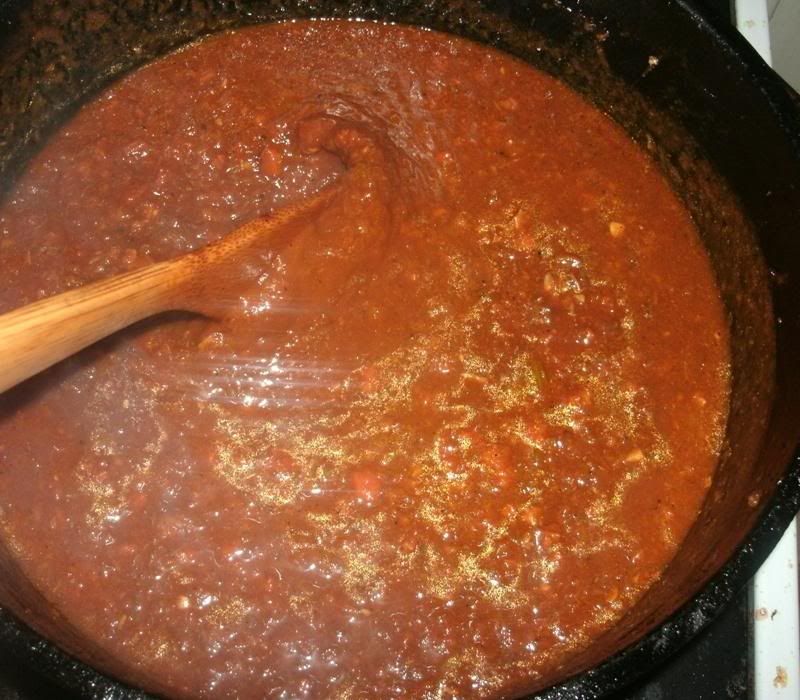 Alternately, one could strain the solids, then reduce the liquids to a rich sauce, thickening with a cornstarch slurry if desired, but for this rustic preparation, I decided to put the vegetables to work.
When the gravy had reduced a little (it probably could have reduced even more, but the family was eager to dig in), I added the beef back to the Dutch oven and gently stirred it in the gravy to coat it and heat through.
My carne de res kalimotxo complete, I then plated our Basque meal aside mashed potatoes:
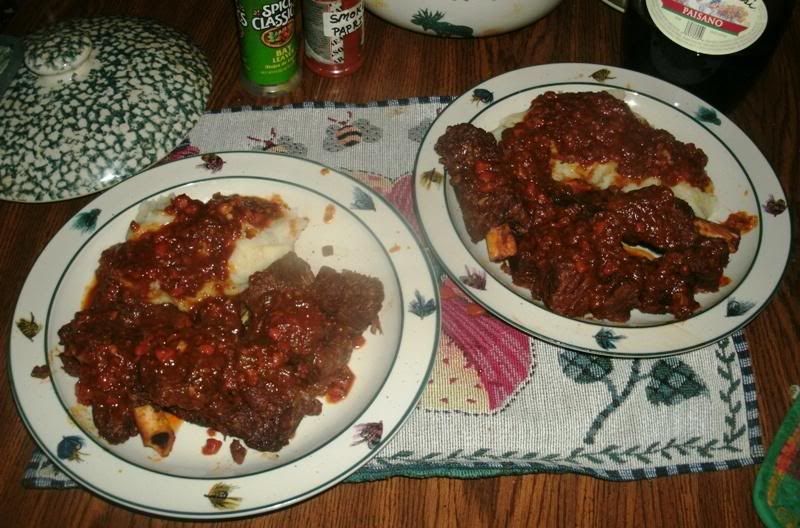 And presented it to my famished family.
Results were very far out of the park, as this dish was a home-run in every way! Aroma, flavour and even the warm, rich colours of the kalimotxo all worked together to produce a wonderful, cold-weather meal that filled the body with rich warmth and satisfaction:
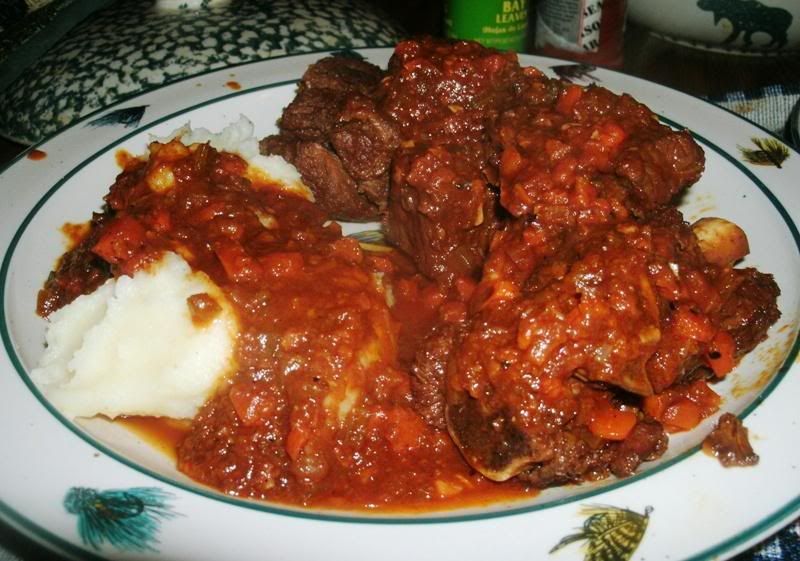 Every component in this dish lends another layer of flavour, building on the foundation of the beef and vegetables to construct a pyramid of good things. The savory tang from the tomato paste and anchovy wrapped around the smoky earthiness of the pimentón ahumado, fortifying the rich depth of the red wine and cola combination, which was accented by the spices. I have prepared some good meals before, but this was one for the books. My only regret was that I had no proper sherry, which would have lent its unique facet in a way that would really have been special; having said that, this was truly an inspiring meal.
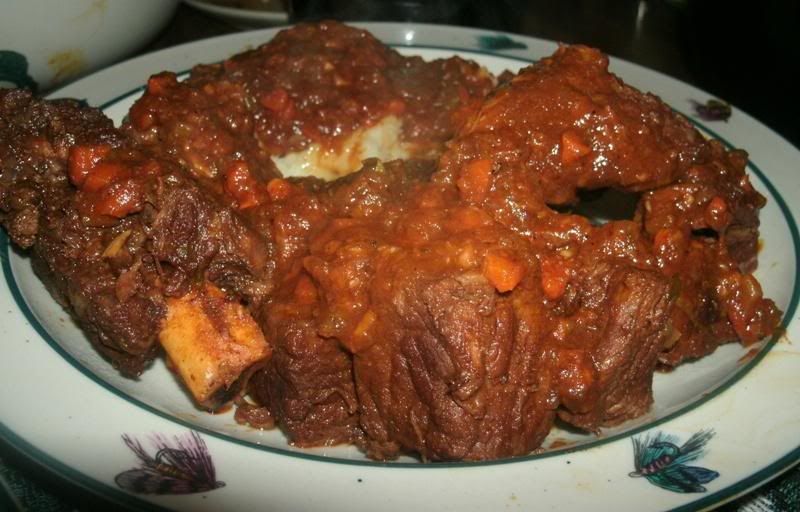 If you're looking to travel to a truly wonderful region of Spain, and experience a rustic, satisfying meal like none other, i urge you to give this one a try! The simple ingredients and method belie the complex layers of amazing flavours to be found! ------------- If you are a visitor and like what you see, please http://foodsoftheworld.activeboards.net/registration_rules.asp?FID=0" rel="nofollow - click here and join the discussions in our community! |
Posted By: Hoser
Date Posted: 23 December 2011 at 02:32
Out of the ball park my friend!  Wow! Is it not amazing what that combination of cola and red wine can do for a piece of meat? I know when I did the short ribs that way it was really hard trying to explain the complicated layers of flavor when I did the post myself. Wow! Is it not amazing what that combination of cola and red wine can do for a piece of meat? I know when I did the short ribs that way it was really hard trying to explain the complicated layers of flavor when I did the post myself.A beautiful post my friend, and a superb meal for the family.  ------------- Go ahead...play with your food! |
Posted By: TasunkaWitko
Date Posted: 23 December 2011 at 08:51
|
hey, dave - i'm glad that you like it. it was certainly a pleasure to make, and even more enjoyable to eat.
i am grateful to you for introducing it to me, my friend.... ------------- If you are a visitor and like what you see, please http://foodsoftheworld.activeboards.net/registration_rules.asp?FID=0" rel="nofollow - click here and join the discussions in our community! |