Canonical cookbooks and nominations
Printed From: Foods of the World Forum
Category: Other Food-Related Topics
Forum Name: The Library
Forum Discription: A place to discuss cooking media such as books, DVDs, websites, television shows and magazines.
URL: http://foodsoftheworld.ActiveBoards.net/forum_posts.asp?TID=1898
Printed Date: 26 March 2026 at 20:33
Topic: Canonical cookbooks and nominations
Posted By: Daikon
Subject: Canonical cookbooks and nominations
Date Posted: 19 March 2012 at 13:41
|
There are lots and lots and lots of cookbooks out there. Many of them are useful or inspirational, but there are only a few that legitimately form the canon of at least one cuisine. I am thinking of definitive, encyclopedic works like Marie Antoine Carême's L'Art de la Cuisine Française and Georges Auguste Escoffier's Le Guide Culinaire. Then there are important secondary works like Julia Child's Mastering the Art of French Cooking, and there are significant, more recent treatises and textbooks like Shirley O. Corriher's Cookwise and Bakewise, Nathan Myhrvold's Modernist Cuisine, James Peterson's Sauces, various Culinary Institute of America texts (right now, I've got my eye on the CIA's Garde Manger.) What I am interested in here is putting together a list of "important" cookbooks -- books that are definitely many steps removed from one put out by the women's auxiliary of your neighborhood church, and are also quite different from most celebrity chef cookbooks. I'm also not interested in introductory or survey texts that aim to give you a first taste or an overview of one or more cuisines, a family of techniques, etc. What I am looking for are the truly definitive texts, the places that you would go to find the first, last, best, and most comprehensive words on culinary matters. That's actually probably a fairly good taxonomy for labeling the books I am interested in. For example, Carême in some sense is the first word on French cooking (although I am sure that some of the food historians among us can identify even earlier important works), Escoffier is the most comprehensive on classical French cuisine, but neither of them are the best (particularly for non-French-speaking cooks) since their recipes can often be difficult to follow or interpret. Some might classify Julia Child as the best work on French cooking for English-speakers, but that is open to dispute/discussion... And books like Cookwise, Bakewise, and Modernist Cuisine all aim in some fashion to be the last word on particular culinary topics, seeking to cut through received wisdom (and nonsense) and rules-of-thumb to identify and explain the basic science that makes certain foods and techniques work. Anyway, I hope I've been clear enough in identifying the kinds of cookbooks that I am interested in listing, and I think I've given us a decent start on such a list, but I'm interested in seeing what your contributions to this list of great and near-great cookbooks will include and how they can help fill the huge gaps in my knowledge (e.g., who were the Carême and Escoffier of Indian cuisine? Chinese? Italian? ...?) I'll try to keep the list updated in the first post.
|
Replies:
Posted By: TasunkaWitko
Date Posted: 20 March 2012 at 08:47
|
i don't have much to contribute here, since i don't consider my main sources (the culinaria series and the "foods of the world" series) to be in the same class at all - but i am looking forward to the discussion on this, and learning from it.
great topic, daikon ~ ------------- If you are a visitor and like what you see, please http://foodsoftheworld.activeboards.net/registration_rules.asp?FID=0" rel="nofollow - click here and join the discussions in our community! |
Posted By: pitrow
Date Posted: 20 March 2012 at 08:59
|
Not sure if these fall in the same category as you've started or not, but for anyone doing sausage making or the like, these two are considered the Bibles... Charcuterie: The Craft of Salting, Smoking, and Curing -- Brian Polcyn and Michael Ruhlman Great Sausage Recipes & Meat Curing -- Rytek Kutas |
Posted By: Daikon
Date Posted: 20 March 2012 at 09:56
|
Hmmm... and now I am stuck with the task of deciding whether a book deserves inclusion on the list, even though I can't possibly examine and review each of the nominees myself. Here's what I think I'll do: Older books that still receive a lot of mentions in online discussions of best cookbooks are pretty much guaranteed a place on the list -- I'm biasing toward classics and away from whatever happens to be most recent; If I can easily find a lot of online references that clearly position a nominated book as the first, best, last, or most comprehensive word on a subject, then I'll put it on the list; If I can find some such references, but they are not entirely convincing or leave me with some reservations, I'll put them on a "nominees" list and let the rest of you try to convince me whether they should be moved up into the real list or should be dropped even from the nominees list; If I'm not initially impressed by what I am able to easily find out about your nominee, then I won't put it on the nominees list until I see a significant amount of protest over my omission. So, for your two nominees, pitrow, I was able to find enough supporting evidence (largely here: http://forums.egullet.org/index.php?/topic/131433-best-charcuterie-cookbooks/ - http://forums.egullet.org/index.php?/topic/131433-best-charcuterie-cookbooks/ ) to put both books on the nominees list, but I have some reservations about Ruhlman and Polcyn's book repeatedly being referred to as a good starter book with some errors, and I haven't yet seen enough discussion about Kutas to make a final decision. (I also found this comment from the eGullet discussion interesting: "I think the Great Charcuterie Book has yet to be written...") Further comments, links to reviews, etc. always welcome, as are indications as to whether you think a book fits into one or more of the first, best, last, and most comprehensive categories....
|
Posted By: TasunkaWitko
Date Posted: 20 March 2012 at 10:13
|
for what it's worth, the sausage, curing and charcuterie places i hang out at all point to rytek as "the bible" where these topics are concerned. ------------- If you are a visitor and like what you see, please http://foodsoftheworld.activeboards.net/registration_rules.asp?FID=0" rel="nofollow - click here and join the discussions in our community! |
Posted By: TasunkaWitko
Date Posted: 20 March 2012 at 10:31
|
say, daikon, i might be able to find some source material on various countries if you are interested. both the culinaria and FotW volumes have pretty extensive bibliographies, and there might be some information there you could find useful. ------------- If you are a visitor and like what you see, please http://foodsoftheworld.activeboards.net/registration_rules.asp?FID=0" rel="nofollow - click here and join the discussions in our community! |
Posted By: HistoricFoodie
Date Posted: 20 March 2012 at 10:40
|
Daikon, I suspect that any book you choose to include will have its detractors; especally considering that the needs of a professional in the industry, and the needs of a home cook---even an advanced foodie---are often quite different.
So the open question is: Where do you draw the line?
Then, what about books that are neither definative nor "best" (whatever that means), but which make a significant contribution to the state of the art. Would you include, for instance, Bruce Aidells The Complete Meat Cookbook on your list? To me, it fits the rubric I just described.
Another aspect: With the proviso that I don't find egullet to be a particularly authoritative voice, let's look at this quote: "I think the Great Charcuterie Book has yet to be written..."). Let's assume this is correct. There is certainly, among the current books on charcuterie, one that is the best of the breed. Do you leave it off your list because a better one is waiting to be written?
And, finally, how do you fit textbooks into the listing? Among professionals, for instance, John Kowalski's relatively new The Art of Charcuterie, written for the CIA, is likely to surpass both the Polcyn and Kutas books in importance. But what does that mean to the semi-pro, or hobbiest? Kowalski's book might, objectively, be the most important (the "best" if you will), but for them, it's not as useful as the Polcyn.
Ha! Betcha thought this would be easy.
 |
Posted By: Daikon
Date Posted: 20 March 2012 at 11:31
|
On the contrary, I had no illusions that the task would be easy, and I share many of your concerns -- particularly as to how more specialized books like culinary arts textbooks, publications aimed at commercial food scientists, and government food regulations fit in. Are people interested in collecting a list including the important or definitive works in these areas of more direct concern to food professionals, or should we restrict ourselves only to works that are more accessible and applicable to home cooks? Personally, I find culinary textbooks quite useful, and have no problem declaring most of them to be good; but which of them are truly great or important? Anyway, Aidell's big book, at over 600 pages (and not a complete newcomer at more than 10 years-old), deserves at least a nominee listing as a comprehensive work on meat.
|
Posted By: HistoricFoodie
Date Posted: 20 March 2012 at 14:30
|
Are people interested in collecting a list including the important or definitive works in these areas of more direct concern to food professionals, .......
And if they are, how do you decide which to include? Is The Professioal Chef the definative work of this type? If you attended the CIA you might think so. If not, perhaps not.
and not a complete newcomer at more than 10 years-old
Er, uhm, eh who was it that mentioned Careme?
 And the first edition of Sauces was published nearly 30 years ago. The current (3rd) edition was published in 2008.
I'm just pulling your chain on this, of course. If age were a criterium there would be no great books.
One on-going problem will be the scope of any book. Practically by definition, the broader its nature, the more superficial it is. The more tightly drawn, the more precise. So, while I agree that Sauces is an important work, that belongs on your list, is it more important than, say, a book only a hundred pages long that explores only white sauces in depth? Take that as rhetorical, cuz I wouldn't even attempt answering it.
Another question (I'm great at questions, not so good at answers) is: who is such a list for? It could be argued, for instance, that, in America at least, Joy Of Cooking is the most important culinary work every published. Certainly the most influential. Yet it holds no place in my culinary library, nor, I suspect, in yours.
By the same token, if you leave Harold McGee off your list, shame on you.
|
Posted By: Hoser
Date Posted: 20 March 2012 at 14:40
|
I would like to nominate what I consider to be a masterful work...Jacques Pepin's Complete Techniques, which delves into what we all want to know....exactly how to bone out a rabbit, make a decent glace...you name it...it's in there. It is written in excruciating detail, with photos of each step along the way. I highly recommend this tome for any serious foodie. 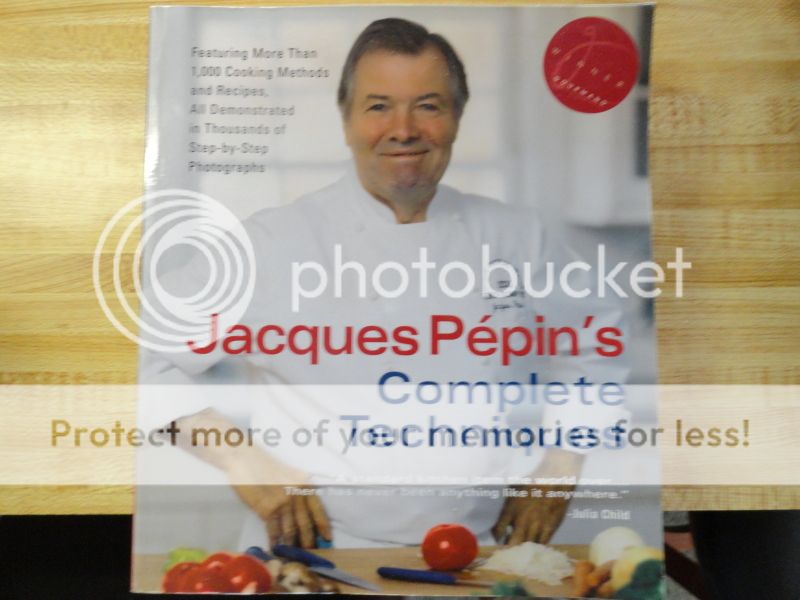 ------------- Go ahead...play with your food! |
Posted By: Daikon
Date Posted: 20 March 2012 at 15:18
|
McGee's On Food and Cooking definitely belongs on the list proper -- it's kind of the first word on the last-word type books. I actually haven't looked at Pepin's Complete Techniques, but I'm a big fan of his and of his technical knowledge and skill, so I have no problem putting it on the nominees list -- and would take very little nudging and evidence for me to promote it to the main list.
|
Posted By: Daikon
Date Posted: 20 March 2012 at 15:36
Inclusion of textbooks remains an open question... I suppose if one were unquestionably great and important, its nature as a textbook (or cross-over, professional/non-professional book) will be of lesser importance.
At least one of us isn't communicating well. For me, the fact that a cookbook is old and is still frequently mentioned as among the best and most important is a major plus, while I am suspicious of whether the latest is really the greatest despite generating significant buzz.
I think specialist books of more limited scope are going to have a hard time making it off the nominees list -- but there are undoubtedly some good ones that deserve some recognition there.
Well, it's for me, of course -- y'all just get to tag along and do much of the work!
 That being said, Joy of Cooking has no importance or significance for me (I've never even read from it more than an isolated recipe here or there -- and I'm not sure I ever actually used one of those recipes instead of something that I deemed better found elsewhere...), nor do I imagine that it ever will have much meaning for me, so it doesn't get a spot on the list. That being said, Joy of Cooking has no importance or significance for me (I've never even read from it more than an isolated recipe here or there -- and I'm not sure I ever actually used one of those recipes instead of something that I deemed better found elsewhere...), nor do I imagine that it ever will have much meaning for me, so it doesn't get a spot on the list. |
 HistoricFoodie wrote:
Posted By: Daikon
Date Posted: 20 March 2012 at 15:46
| Okay, Pepin fans, which deserve to be on the list and which deserve to stay nominees: the more recent Complete Techniques, or the earlier and slightly larger pair La Technique and La Methode? |
Posted By: Rod Franklin
Date Posted: 20 March 2012 at 19:17
|
I can't contribute any titles to this thread, but count me as having a lot of respect for the technical abilities of Pepin. I look forward to the compiled list of must have books.
------------- Hungry |
Posted By: Hoser
Date Posted: 21 March 2012 at 02:40
Actually, Joy of Cooking is in my library and I admit to referring to it often. It is a very informative work, especially in the area of knowing different ingredients. And from what I see Jacques Pepins Complete Techniques is a condensed version of La technique and La Method, cleaned up a bit and organized a little better, but since I do not own the original I do not feel qualified to pick which one should stay on the library list. ------------- Go ahead...play with your food! |
Posted By: HistoricFoodie
Date Posted: 21 March 2012 at 02:58
|
Actually, Joy of Cooking is in my library and I admit to referring to it often. It is a very informative work, especially in the area of knowing different ingredients.
I rest my case.
Joy is in what, now? The 8th edition? Something like that. Thousands of Americans actually learned to cook using it; thousands of others developed advanced skills and knowledge of terms and techniques as a result of being exposed to it. I was not being facetious when I said it's the most influential cookbook in American culinary history.
By the time I "discovered" Joy of Cooking I had already progressed beyond it. So I've never owned a copy, and see no need to do so. Nor, despite it's importance to the culinary arts, do I believe it fits Daikon's concept.
|
Posted By: HistoricFoodie
Date Posted: 21 March 2012 at 03:30
|
e.g., who were the Carême and Escoffier of Indian cuisine? Chinese? Italian? ...?
This is the crux of the problem, Daikon.
The one thing that Careme and Escoffier did was codify French cooking, and, as it happens, cast it in stone. This had never before been done with a cuisine, nor has it been done since.
Most national cuisines aren't. We say "Italian," or "Indian," or "Chinese," or "Greek." But those are only shorthand for describing groups of related cuisines inside arbitrary political borders. Each "national" cuisine is actually regional in nature, and represents different influences, both internal and external.
Because Careme and Escoffier codified it, there is a unified whole called classic French cuisine. But the same cannot be said of any other I'm aware of. Thus, there is no definative book about Italian cuisine, for instance, because there is no unified whole making up such a cuisine. We look at culinary practices of the ER, for instance, and of Sicily, and call them both Italian. Yet they have little to do with each other. They use different ingredients, have different geographies affecting their agricuture, and have certainly been influenced differently by outsiders.
What I'm saying is that L'Art de la Cuisine Française's influence was an accident, one that is not likely to happen again.
|
Posted By: Hoser
Date Posted: 21 March 2012 at 04:05
I suppose the closest thing to a "bible" of Italian cuisine would be The Silver Spoon published in English by Phaidon press. Much like Joy of Cooking, it is more a collection of recipes than a compendium of Italian technique, because that simply does not exist. I think the regionalization of cooking is probably more evident in Italian cooking than almost any other culture. ------------- Go ahead...play with your food! |
Posted By: HistoricFoodie
Date Posted: 21 March 2012 at 04:40
|
I think the regionalization of cooking is probably more evident in Italian cooking than almost any other culture.
I'd have to disagree with that, Dave.
Because Italian is the most familiar ethnic cuisine we tend to know more about it. But, in fact, all of the countries lining the north shore of the Med have the same sort of regionalization. And for the same reason: Each of them is actually a confederation of countries, city states, and ethnicities.
Just ask Margi, for example, about the various regions (and ethnic animosities) that make up Spain.
Although less regionalized, the southern Med's cuisines are broken down ethnically within three large groups. Turkey is regional. So is the group of countries we used to identify as Persian.
All of Asia is regionalized, sometimes with an even greater disparity than that comparing ER & Sicily. India's cuisine is broken down both regionally and ethnically; most southeast Asian countries have similar separations (i.e., Viet Nam's cusine breaks down into both ethinic and regional differences---which are often the same, btw--- plus the unique Franco-Nam fusian foods). China has 7 major cuisines and who knows how many differences within them. And so forth.
I have always disliked the word "fusion." On one hand, it too often refers to the act of adding generic Asian ingredients to an otherwise unremarkable dish to produce a truly awful one. But, more to the point, a case can be made that all cusines are fusions.
|
Posted By: HistoricFoodie
Date Posted: 21 March 2012 at 04:43
| Comparing The Silver Spoon to Joy Of Cooking was pretty astute. Not only are they similar in nature, they are most often purchased for the same reason---to be used as gifts for new brides. More recently there is a Spanish analog called something like 1001 Recipes that is achieving the same sort of status. |
Posted By: ChrisFlanders
Date Posted: 21 March 2012 at 05:45
|
There simply are no "best" books imo. "Best" is so relative and personal and I always prefer "fit for use"instead of best. What's good for person A is a joke for person B, so you need to look for what's fit for you at this very moment. As a European it always strikes me how much Americans are focused on technique ("how to") as if it were gospel and are so against a pragmatic approach. I've seen it on the other forum looking at insane discussions like "how to" prepare a pedestrian bechamel and other things. Many times Escoffiers and C° are quoted to prove a point but sadly enough cooking has evolved incredibly since then... Also, accepting the Escoffiers and C° as the only truth and gospel is a genuine creativity-killer,... and since cooking is a creative occupation, not my thing. Homecooks have no use for the Escoffiers & C°. It's such a waist of money. Modern European highly trained and qualified professional cooks know their classic preparations and will use Escoffier as a reference and for re-sourcing but will many times go their own modern way, which imo is the right way. Same for homecooks; go your own way... as long as you keep acquiring an ever growing basic set of skills. What are good sources for homecooks? The Culinaria books, but not so much for the recipes. They are so cheap now that you cannot call yourself a cooking fanatic if you don't have at least the French, Italian and Spanish Culinaria. You will at least learn where many products come from, how they are grown, bred, processed etc. What an incredible source of basic knowledge! And my advice to all starting and serious homecooks will never change; buy good food magazines every now and then. They are always focused on seasonal products, so you will learn how to prepare seasonal food step by step. Anyone who can read can learn how to cook, including making a lot of necessary mistakes which we all make and learn from. As a homecook you will slowly build up a nice set of skills and discover a lot of analogies in technique which you can rely on to create your own plates. That's the time to stick your nose in the moldy Escoffier &C°'s books. Even now I only read occasionally in the Escoffier... at the bookstore or the library. I prefer to buy cookbooks from modern cooks. They are more fit for me in this time. Just one hint; try Jason Atherton's book "Maze", a good view to where classic cooking can ànd probably will go to in the future; modernized and amazing tapa-deluxe style... A note on "The Silver Spoon". I have that book in my collection. It's not Italian-only! There are a lot of generally known European dishes in there too. It's very confusing... there are a lot of better things about Italian cooking imo. |
Posted By: HistoricFoodie
Date Posted: 21 March 2012 at 06:37
|
Something we actually disagree on, Chris. Hard to believe.
To me, technique is everything. Indeed, good cooking can be defined as using good techniques to manipulate good ingredients to a desirable end. My cooking classes are based on teaching techniques for that very reason.
Indeed, if you learn good techniques, recipes, per se, are unnecessary. I could, for instance, teach somebody a chicken recipe. And they'd know how to make one great chicken dish. But if, instead, I teach them how to fabricate chickens, and the basic techniques of cooking them, they can then create hundreds of great chicken meals.
Or, to put a point on it: Once you taught me how to make your shiitake flans you actually taught me how to make dozens of different vegetable flans. It's the flan-making technique that's important. The precise mixture of vegetables and spices is all but irrelevant to the process.
The problem, as you know from that other site, is that too often self-styled experts define "technique" as "do it this way with no variation or you're doing it wrong." And that's just ridiculous.
"Technique" and "pragmatism" are not mutually exclusive terms, IMO. There are reasons, for instance, why the pinch grip and claw hold are the most efficient ways of using a knife in a professional kitchen. But those reasons do not, necessarily, apply to a home cook. If you're comfortable holding the knife by the back of the handle, and can maintain control that way, then it's the right way. That's the pragmatic part. The technique part comes from understanding the various cuts and how they are accomplished.
Or let's use your example about bechamel. Bechamel, at base, is merely a dairy-based liaison. So the technique part is making a liaison. Arguing about whether bechamel is made with milk or cream, whether it does or does not include nutmeg, which is the correct starch, whether it's one of the mother sauces or not, might be fun. But it has nothing to do with the technique of making a dairy-based liaison.
|
Posted By: TasunkaWitko
Date Posted: 21 March 2012 at 08:51
this may be a little off the path from daikon's intent with this thread, but after reading chris's comment:
i definitely agree. i own several of these books (spain, italy, greece, germany, hungary, russia and france) and find them to be an excellent introduction into their respective cuisines - not only for the recipes, but also for the vast information on the regions, the people and the ingredients that make up the heart and soul of the cuisines. the foods of the world series from time/life does this as well (i own the entire series, which, as far as i can tell, covers the entire globe except for korea and australia for some reason - with several volumes devoted to the regions of the US), and i like to think of the older time/life series as an ancestor to the culinaria series. there are differences, of course ~ to me, the time/life series is like taking a trip to each country, province or region, meeting the people there and learning the histories of the foods. in the time-life series, it is as though you are actually there. the culinaria series is more modern and in-depth, of course, like a "travelogue" for someone who is preparing to go there. the differences are such that i believe both series should be owned in order to be fully appreciated, but being the history buff that i am, if i had to choose only one, it would be the time/life series with its more nostalgic feel. in both series, the recipes themselves are almost secondary, especially in this day and age of the itnernet, where one can get a reliable recipe for almost anything, with a little research.
i'm not convinced that either series is "worth" nomination, based on daikon's goals for this discussion - however, i will assert that they are very, very useful and beneficial for interested american home cooks (who might not otherwise have an opportunity to travel and experience these regions first-hand) as "gateways" into their respective geographic areas vis a vis the history and culture of the cuisines, much the same way that julia's book is a "gateway" for so many american home cooks who might not otherwise have an opportunity get an introduction into french cooking. ------------- If you are a visitor and like what you see, please http://foodsoftheworld.activeboards.net/registration_rules.asp?FID=0" rel="nofollow - click here and join the discussions in our community! |
Posted By: ChrisFlanders
Date Posted: 22 March 2012 at 04:58
|
Brook, I still believe that the best way of learning how to cook is simply to start cooking and learning technique on the fly by executing simple recipes. This way you learn how a particular cooking technique fits in and relates to a dish but also to other dishes. Later on it's a good thing to understand that the flour used in certain fishsoups is related to the roux made for a bechamel and is also related to sprinkling flour on seared meat in a beef stew etc. You could call it somewhat a more "holistic" approach versus teaching technique as part of the whole. I prefer the "holistic" approach since it doesn't put the emphasis too much on things you need to do in performing a certain technique. But, look at our Italian friends. No more creative people like in designing furniture, cars and... food. I truly believe their creative genes are fed by their natural aversion for rules and reglementations, including strict technique. Balancing on the edge of chaos is the best way for stimulating creativity; many Italian dishes were born out of desperation. It was getting inspired or having hunger. Nowadays they are still the masters of creating outstanding dishes with a minimum of ingredients, and in their more elaborate dishes, as I heared Antonio Carluccio say, cooking "MUFMUF"; minimum of fuss, maximum of flavor. Sorry for going off-topic, Daikon. |
Posted By: HistoricFoodie
Date Posted: 22 March 2012 at 05:00
|
where one can get a reliable recipe for almost anything, with a little research.
Well, yes and no, Ron.
Sites like this one, where we are, in effect, a group of friends sharing recipes and culinary info, are one thing. The recipe-dump sites are quite another.
I used to peruse the recipe-dumps when looking for recipes. My conclusion: There isn't one of them that's reliable. Recipes are not tested. Recipes as written are often wrong, with ingredients left out, ingredient amounts grossly incorrect, or directions with missing parts or ambiguous instructions. Simply put, I don't trust any of them.
Sites like this, on the other hand, where a friend has tested the recipe, are much more reliable. We know, for instance, that if you, or Hoser, or Daikon, or Chris, or anyone posts a recipe it's one that they've tried, and the results, good or bad, accurately reflect their in-the-kitchen experience.
|
Posted By: TasunkaWitko
Date Posted: 22 March 2012 at 08:26
|
regarding the holistic versus technical approach: i myself see great value in a blend of the two approaches. for isntance, as brook described learning a "method" and allowing it to apply to many situations, i recalled my own experiences in doing just that. but when chris described the yeastiness and the fertile atmosphere for healthy creativity in using a more holistic or on-the-fly approach, i've also seen the value there, as well. lastly, i find myself inspired by the humble, peasant foods that were born out of necessity, and the fact that similar dishes and methods can spring up from those common, rustic roots.
steering this back on topic (hopefully), i would love to see a book written on that - or, if one has been written, i would think that, if it is a good one and carefully researched/written, it could be worthy of nomination.
brook - your post directly above describes in exact detail one of our primary goals here, and why i find all of our active members to be so valuable here. when we undertake a project, tutorial or other, similar enterprise, we look into it, the history of it, the people behind it and the steps leading to the conclusion. we put it in CONTEXT, historical, cultural or otherwise, and i do believe that is extremely important in establishing this place as a credible source for people who are into the things we are into. ------------- If you are a visitor and like what you see, please http://foodsoftheworld.activeboards.net/registration_rules.asp?FID=0" rel="nofollow - click here and join the discussions in our community! |
Posted By: Hoser
Date Posted: 23 March 2012 at 03:23
Quite right Brook....just yesterday I was perusing some of the citrus based marinade recipes at one of the aforementioned "dump sites". It was for about 2 cups of marinade and called for 11-1/2 teaspoons of salt! Holey Moley! if some rookie just followed that recipe they would be in a world of hurt.  As usual, I decided to just make up my own marinade like I usually do.
------------- Go ahead...play with your food! |
Posted By: HistoricFoodie
Date Posted: 23 March 2012 at 05:07
|
And the real problem is, of course, that those sites are used mostly by beginners, or casual cooks, or others who do not have a great deal of experience. So they find a recipe that sounds good, follow it precisely, and, when it doesn't work out, blame themselves. After all, it can't be a published recipe that's wrong, so it must have been something I did.
Looking at those sites you will no doubt notice how often the same recipe appears on all of them. That's because they constantly steal from one another (copyright laws, on the web, are virtually nonexistent). But nobody, along the way, corrects any errors that may appear....making it even harder for the novice to find a recipe that works.
For that and similar reasons, chef-written cookbooks, as a group, are the worst ones for tyros. Putting aside the complexity of the recipes, their cheffyness, if you will, very often they are not actually tested as written. Rather, they are mathematically scaled down from a recipe designed to feed many more than 4 or 6; they have not been prepared on home equipment; and they have not been proofread by the chef author or even his ghost writer.
And, of course, chef-written cookbooks often are produced with a secret agenda in mind that has nothing to do with actually sharing the chef''s methods and recipes.
|
Posted By: HistoricFoodie
Date Posted: 23 March 2012 at 05:31
|
I still believe that the best way of learning how to cook is simply to start cooking and learning technique on the fly by executing simple recipes. This way you learn how a particular cooking technique fits in and relates to a dish but also to other dishes.
I've no argument with that at all, Chris.
What I think we have is a difference of opinion based on semantics, rather than actuality. It's how we are using the word "technique."
To me, technique is the physical act, or series of acts, that allows you to consistently produce the same desired end. I don't care how you learned those acts.
If I'm reading you correctly, you're using the word to mean both the act, and how you learned the act.
In America particularly we have a problem in that we're now into the third generation that uses the words "cooking" and "microwaving" as synonyms. So, when somebody with no basics, no geshtalt, wants to learn real cooking, the holistic approach can translate into "floundering around in the hopes something will work."
This is one reason so many of our cookbooks have directions that go into minutia. If somebody has never learned pan-frying, and is trying to make a recipe using that technique, they have to be told, step-by-step how to accomplish that action.
Unfortunately, using this approach, many, perhaps most, of these new cooks do not absorb the idea that pan-frying can be used with many ingredients, and can be combined with other techniques to produce "new" dishes.
Even worse, they never absorb the fact that the most complex recipe is merely a series or combination of simple techniques.
|
Posted By: Daikon
Date Posted: 23 March 2012 at 11:05
|
Okay, I've added a couple of new nominees (books that I'm not really very familiar with directly, but know by reputation): Rick Bayless and Claudia Roden. I've also made the choice to move Pepin's newer, slightly condensed Complete Techniques up to the main list while keeping the earlier La Technique and La Methode on the nominees list -- you can't really go wrong with any of those three, but as much as you need any of them, you don't really need or probably want all three. Here's another pretty good list to stimulate some more discussion: http://www.villagevoice.com/slideshow/the-best-cook-books-of-all-time-28718904/ - http://www.villagevoice.com/slideshow/the-best-cook-books-of-all-time-28718904/ We've covered some of them already, but I'd be interested in seeing comments if you are familiar with some of those on the Village Voice list that we haven't already discussed.
|
Posted By: HistoricFoodie
Date Posted: 24 March 2012 at 06:13
|
Just some random thoughts after watching the slide show.
One thing that struck me: Taken as a whole, "all time" translates into "the past ten years." At least based on publication dates. The vast majority of the books on that list were published post 2000.
That aside, I don't think many of those would fit into the criteria you've established. They are, by and large, standard cookbooks, heavy on how-to recpes.
I also don't begin to understand their criteria for inclusion. In some cases it might be that a book is the only one of the genre the authors were familiar with. I'm thinking, for instance, of Mary Randolph's The Virginia Housewife as one example.
While The Virginia Housewife is an important book, it's primary contribution to food history is that, as with Randolph's life as a hostess, it bridges the colonial/federalist culinary worlds. So we gain insights into the evolution of American foodways. But the seminal work of that genre is Elizabeth Smith's 1729 The Compleat Housewife. With the possible exception of Amelia Simmons' American Cookery, virtually every cookbook of the period---including the Randolph work---derives from Smith's book.
I would include the original Fanny Farmer on your list. It was as important, in its way, as Escoffier. But does that apply to a modern revision? Deponent sayeth not.
I think, too, that many of the books the Voice listed are included just because conventional wisdom says to. Nothing against Prudhomme, for instance, but his books hardly define cajun cuisine, let alone creole. Edie Hand and William Paul's Cajun and Creole Cooking with Miss Edie & The Colonel comes much closer to that. But, as was said in another context, the definative work on cajun cookery has yet to be written.
|
Posted By: Daikon
Date Posted: 24 March 2012 at 08:55
| So which of the "American foodways" books are worth noting and listing? Or are all of them only of historical interest with little relevance to how we now cook? |
Posted By: HistoricFoodie
Date Posted: 24 March 2012 at 10:56
|
Well, strictly speaking, there were no American cookbooks until 1796, with the publication of Amelia Simmons' American Cookery. Until then, in British North America and the emerging United States, English cookbooks were used, along with cookery manuscripts. Those English cookbooks continued to influence American cookery, however, until well into the 19th century. Remember, there were no copyright laws in those days, and authors quite happily stole from each other.
.....with little relevance to how we now cook?
Hmmmmmm? How relevent, really, is Le Guide Culinaire? Even French cooking has evolved out of the straightjacket imposed by Careme and Escoffier. And I'd suggest that most top-ranked American chefs do not cook classic French, and could care less about it. But I digress.
Putting aside the fact that I make a significant portion of my income as an historic foodways interpreter, and thus find them very relevent, I'd say there is both a known and not so well known influence on todays cooking.
I noticed that the Voice includes Alice Waters' The Art of Simple Food on its list. That's one of those PC choices, cuz, imo, that book is the next best thing to worthless. But I'm not an Alice Waters fan to begin with. Does anyone really think that Alice Waters dreamed up the idea of fresh, local, seasonal ingredients out of whole cloth. Time after time, in those 18th and early 19 century cookbooks, the authors stress those very things. Waters et als didn't create that concept; they're merely preaching a return to it, albeit on an elitist level.
That's the less known part; the fact that there is a continuum involved, rather than new thinking.
More directly, however, one of the big trends the past couple of years has been a return to live fire cooking. Not merely grilling and backyard barbecuing, but the whole gamut of cooking techniques applied to open-fire and hearth- cooking. There are many influences on this, but the fact remains that people want to cook "real" food, and they want to do it over wood- and charcoal.
Obviously, the recipes and text in those books is germane to that trend. After all, everything in those books represented live-fire cookery.
Going beyong that is the "real" food concept. People are not only returning to cooking, after a 2 1/2 generation hiatus, they want to cook "real" food, using "real" methods. Thus, we see a great interest in older cookbooks and methods, because of the widespread belief that only things published previous to WWII fit that rubric. It's no accident, for instance, that the so-called Martha Washington's Book of Cookery has been continually in print since the late 1930s.
Nor was it a yearning to do extra work that led us, in our own cookbooks dealing with colonial cooking, to double proof the recipes; assuring that they work in modern home kitchens, using modern equipment, as well as over live-fires using 18th century type gear.
One more aspect, adding to the appeal of many 18th and early 19th century cookbooks, is that they are more than collections of recipes. Most of them include instructions for choosing meats, produce, and other ingredients, with tips for judging quality, etc. And they have a greater degree of instructional material than is typical of modern cookbooks. So, for somebody new to cooking, they are great resources.
Unfortunately, most of them are not readily available, even in reprint. But there are numerous modern cookbooks which adapt and modify those originals to make them relevent to modern cooks. In my opinion, if Nancy Carter Crump's Hearthside Cooking isn't the best of that breed it runs whichever is a very close second. But there are many others, including my own A Colonial Virginia Book of Cookery and A Colonial Virginia Book of Cookery Second Table.
One need only check out the incredible number of recent books dealing with Dutch oven cooking to realize how relevent those old books really are.
|
Posted By: Daikon
Date Posted: 24 March 2012 at 12:32
| Okay, so to try to put it in concrete terms, if an already competent cook is interested in learning about and doing live-fire cooking of "real" food, then Hearthside Cooking is the book to reference? |
Posted By: HistoricFoodie
Date Posted: 24 March 2012 at 21:27
|
Live-fire based on colonial/federalist would be more accurate about Hearthside Cooking. But, in the same sense that Le Guide Culinaire is important because it defined a cuisine, I would say Smith's The Compleat Housewife would have to be on your list. Although it didn't codify English cookery, it certainly defined it, and influenced its direction for the next century or so.
Interestingly, many of the things we will later find codified in Le Guide Culinaire are to be found in The Compleat Housewife; either unchanged, or changed only as it reflects changes in technology. For instance, while rouxes were virtually unknown in Smith's day, what would later be called a beurre marne was quite common. There was less use of stocks and broths in 18th century English cookery, but more use of compound sauces so complex that even Careme would blush.
If we're simply talking about live fire cooking, however, then any of the Raichlen books make sense. My nod would go to Planet Barbecue! It's as close to canonical as you're going to get, as it both defines and explores the world-wide barbecue culture.
Slight change of subject: If you're going to include Fanny Farmer, as you should, then I would also nominate The Settlement Cookbook. By teaching millions of immigrants a unified and consistent way of cooking, it served as a tool of assimilation unmatched by any other. While it didn't quite create an American cuisine, it certainly unified how we looked at food and cooking.
|
Posted By: Daikon
Date Posted: 24 March 2012 at 22:02
| Some interesting things to look at and think about there. I must admit though, that I am having trouble seeing a continuous culinary line through the likes of Compleat Housewife, Boston Cooking-School Cook Book, and The Settlement Cookbook to 20th and 21st century American cooking. Is there an actual disconnect in historical reality, or is the gap just in my knowledge and understanding? |
Posted By: HistoricFoodie
Date Posted: 24 March 2012 at 22:50
|
In a nutshell, WWII and its technological & sociological aftermath got in the way. A least when it comes to American food and cooking. There is a very discernable disconnect in historical reality (love that phrase, btw).
In the second half of 20th century America, cooking just wasn't an important activity. The focus was on convenience in all things.....premade foods, instant ingredients, microwavers, heat 'n eat, dining in restaurants instead of at home, and, eventually fast-food and take-out.
While there was a greater awareness of different cuisines, there was less of it being prepared at home. The great cookbooks of this period were either professional in nature, or designed to promote the return of home cooking, and instruct people how to do that. The bulk of cookbooks, on the other hand, were tightly drawn how-to manuals. How to cook Chinese. How to braise. How to cook like Chef Imaegoist.
So, yeah, there's a very distinct break in the continuum.
|
Posted By: TasunkaWitko
Date Posted: 29 March 2012 at 13:00
|
I claim no expertise or real experience, but in http://www.amazon.com/Bread-Bakers-Apprentice-Mastering-Extraordinary/dp/1580082688 - Peter Reinhart's book, http://www.amazon.com/Bread-Bakers-Apprentice-Mastering-Extraordinary/dp/1580082688 - The Bread Baker's Apprentice , is the one i most often see mentioned in relation to bread baking. ------------- If you are a visitor and like what you see, please http://foodsoftheworld.activeboards.net/registration_rules.asp?FID=0" rel="nofollow - click here and join the discussions in our community! |
Posted By: Daikon
Date Posted: 29 March 2012 at 16:57
I'm not sure about this one. Certainly The Bread Baker's Apprentice looks to be a good book on bread baking, but I'm having trouble determining whether this book really stands out from Reinhart's other books or from lots of other recent books on artisanal bread making. Is this truly a great and definitive book in some sense, or is it "just" a very good book for many amateur bakers? I suspect that a lot of its popularity has to do with the http://pinchmysalt.com/the-bba-challenge/ - BBA Challenge , and is as much an accident of Nicole Hamaker's choice as it is a matter of intrinsic merit:
If somebody who is familiar with this and other bread baking books wants to try to convince me as to whether BBA does or doesn't belong on the list, I'd be glad to read such a response. |
Posted By: HistoricFoodie
Date Posted: 29 March 2012 at 18:54
|
It's really a rough one, Daikon.
There's no question that BBA brought together a lot of things that were in the wind at the time---preferments, and retarded fermentation, and steam-treating, and pushing Americans in the direction of weighing rather than volume measuring. Nor is there much doubt you can attribute the trend towards home-baking of artisanal breads to it.
But is it the iconic book on bread making? I dunno. If forced to state an opinion, I'd say "no," even though BBA is, for me and hundreds of others, the basic bible of bread baking. Indeed, one could build a strong case that Hamelman's Bread: A Baker's Book of Techniques & Recipes comes closer to being the definitive bread book.
There are so many influences on bread making, though, and so many directions to take with it, that I doubt a canonical book can be written. And if there was a good nominee it would likely be outdated by tomorrow. Let's not forget that Beard On Bread was considered the final word on home bread baking when it was new.
Does BBA stand out from his other work? I would say "yes." For the home-baker, especially one relatively new to serious baking, it is better than Crust & Crumb. Whole Grain Breads can be thought of as a continuation of BBA, sort of volume II if you will. But it's not written nearly so well. And certainly has not been as influential as BBA.
I haven't read his newest. I'm told by others, however, that it merely capitalizes on the word "Artisan," without actually bringing any new insights to bear. Obviously, I have no opinion either way.
|
Posted By: TasunkaWitko
Date Posted: 31 October 2012 at 10:49
|
Looking through some old posts, I came across this and was wondering if anyone had done any reading over the summer to suggest new nominations for the list? ------------- If you are a visitor and like what you see, please http://foodsoftheworld.activeboards.net/registration_rules.asp?FID=0" rel="nofollow - click here and join the discussions in our community! |
Posted By: Rod Franklin
Date Posted: 31 October 2012 at 12:38
|
The Thousand Recipe Chinese Cookbook, Gloria Bley Miller. 926 pages of everything you would ever need to know about preparing Chinese food. The preparation techniques and the ingredient combinations are probably all in there. It seems entirely authentic and exhaustively thorough. ------------- Hungry |
Posted By: Margi Cintrano
Date Posted: 01 November 2012 at 11:58
|
Daikon and Tas, *** For Spanish Regional Cuisine, I am going to mention, that I would select from these: 1) Simone Ortega - 1,080 Recetas de Cocina, Volume 1 and 2. 2) Chef Karlos Arguiñano ( all of his books are well worth this classification ); as his Mentor Luis Irizar, also mentored and coached: Pedro Subijana, Juan Mari Arzak and numerous other well known Basque Chefs have studied the culinary arts under Luis Irizar including Ferrán Adriá. 3) La Herencia de Gastronomía Española : Alicia Ríos y Lourdes Marche *** I believe Alicia Ríos and Lourdes Marche have published their book in English. *** One can go to http://www.amazon.com" rel="nofollow - www.amazon.com and check by author´s name. In the French category, I would state, Chef Michel Bras, Joel Rubuchon and Alain Ducasse, all whom have published books over the years. I am not mentioning Julia Child only not to be repetitious, however, she was the Mentor & Coach to many great USA and international Chefs during her culinary career. James Beard and Jacqués Pepin, of course as well have numerous published works. Kind Regards. Margaux. ------------- Volamos a Mediterraneo, un paraiso que conquista su gente u su cocina. |
Posted By: Rod Franklin
Date Posted: 01 November 2012 at 15:21
|
How about Modernist Cuisine, The Art and Science of Cooking – Six
volumes by Nathan P. Myhrvold, a serious science guy who always loved food and cooking. Vol 1 History and fundamentals Vol 2 Techniques and equipment Vol 3 animals and plants Vol 4 Ingredients and preparations Vol 5 Plated dish recipes Vol 6 a spiral bound supplemental More than 40 pounds of books and you can get them for a mere $450! Such a deal. There is a lot of weird things in these volumes though about using high tech tools and methods, like making dinner in a laboratory kind of weird, however the food science appears sound and well researched. I saw a piece on it on NOVA on PBS TV. But the most interesting thing about this whole series is that it brings the science, and brings it hard, and in my mind that has been long overdue. I seem to find what strikes me as food myths and outright dumb ideas out there in the recipe world. Myths and dumb ideas that just need to go away already. ------------- Hungry |
Posted By: Daikon
Date Posted: 01 November 2012 at 15:27
| Modernist Cuisine has been on the list since day one. |
Posted By: Rod Franklin
Date Posted: 01 November 2012 at 17:16
|
Oh. I should have read this thread before I posted. My bad.
------------- Hungry |
Posted By: Margi Cintrano
Date Posted: 02 November 2012 at 06:39
|
Good Afternoon Daikon, There are several highly recommendable Italian Cookbooks in English, that I have collected over the years, and thus here are my suggestions: 1) As Hoser mentioned: The Silver Spoon - Phaidon Publishers. Phaidon also has 4 or 5 other cookbooks on the vast regional Italian cuisines, as well as an exemplary Greek Cookbook, which is another gem. http://www.phaidon.com" rel="nofollow - www.phaidon.com or http://www.amazon.com" rel="nofollow - www.amazon.com 2) In Nonna´s Kitchen - Carol Field - Harper Collins: this is a treasure. 3) La Cucina Siciliana di Gangivecchio - Wanda & Giovanna Tornabene: a family album of countryside Sicilian recipes. 4) The Splendid Table - Michelle Scicolone ( highly recommendable ) 5) Chef Mario Batali´s Cookbooks 6) Barilla´s Series of Italian Cookbooks: http://www.barilla.com" rel="nofollow - www.barilla.com / http://www.barilla.it" rel="nofollow - www.barilla.it Kind regards, Margaux. ------------- Volamos a Mediterraneo, un paraiso que conquista su gente u su cocina. |
Posted By: TasunkaWitko
Date Posted: 23 May 2013 at 11:01
|
I'm finding myself wondering if Mark Kurlanksy has a place on either list; his work as a food historian is really starting to catch my interest. Here are just a few from him that earn him an author's nomination, in my opinion: Food of a Younger Land: A portrait of American food- before the national highway system, before
chainrestaurants, and before frozen food, when the nation's food was seasonal.... http://www.amazon.com/The-Food-Younger-Land-chainrestaurants/dp/B0040RMF2A/ref=cm_cr_pr_product_top" rel="nofollow - http://www.amazon.com/The-Food-Younger-Land-chainrestaurants/dp/B0040RMF2A/ref=cm_cr_pr_product_top Salt: A World History http://www.amazon.com/Salt-World-History-Mark-Kurlansky/dp/0142001619/ref=cm_cr_pr_product_top" rel="nofollow - http://www.amazon.com/Salt-World-History-Mark-Kurlansky/dp/0142001619/ref=cm_cr_pr_product_top Cod: A Biography of the Fish that Changed the World http://www.amazon.com/Cod-Biography-Fish-Changed-World/dp/0140275010/ref=cm_cr_pr_product_top" rel="nofollow - http://www.amazon.com/Cod-Biography-Fish-Changed-World/dp/0140275010/ref=cm_cr_pr_product_top Choice Cuts: A Savory Selection of Food Writing from Around the World and Throughout History: http://www.amazon.com/Choice-Cuts-Selection-Writing-Throughout/dp/B002SB8OJ8/ref=cm_cr_pr_product_top" rel="nofollow - http://www.amazon.com/Choice-Cuts-Selection-Writing-Throughout/dp/B002SB8OJ8/ref=cm_cr_pr_product_top Please click on the links above; take a look at the book descriptions and consider ordering - doing so helps this forum to help pay for itself!  ------------- If you are a visitor and like what you see, please http://foodsoftheworld.activeboards.net/registration_rules.asp?FID=0" rel="nofollow - click here and join the discussions in our community! |
Posted By: Margi Cintrano
Date Posted: 23 May 2013 at 12:00
|
Tas, Thank you for the great post ... COD, A biography of the Fish that changed the world ... I have seen in Spanish, so it is on my next paycheck purchase list ... Thanks alot, margi. ------------- Volamos a Mediterraneo, un paraiso que conquista su gente u su cocina. |