Greek Spoon Sweets
Printed From: Foods of the World Forum
Category: Europe
Forum Name: Greece
Forum Discription: Cradle of Western civilization and good food.
URL: http://foodsoftheworld.ActiveBoards.net/forum_posts.asp?TID=2462
Printed Date: 26 March 2026 at 21:08
Topic: Greek Spoon Sweets
Posted By: Margi Cintrano
Subject: Greek Spoon Sweets
Date Posted: 17 August 2012 at 03:04
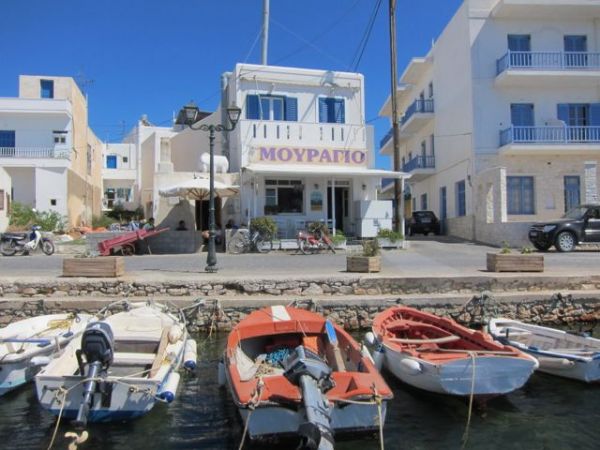 The Island of Paros, Greece.
Greek Spoon Sweets ...
Firstly, what are Spoon Sweets ?
They are the rainbow of colorful preserves in which fruit, nuts, and some varieties of vegetables are placed in sugar syrup, and preserved however, differently than jams or marmalades.
 Spoon sweets are made all over Greece, however, each region has its specialties basically depending on the agricultural crops. The island of Chios, in the eastern Aegean is known for its grape, fig, and citrus spoon sweets.
Their production in fact, has become an enormous commercial enterprise for Greece. The island of Andros, is renowned for its Lemon and Orange Blossom preserves. Santorini where we lived for one year, is the traditional centre for sun dried tomato spoon sweets. The tomatoes are combined with cinammon and whole blanched almonds.
On the remote island of Ikaria, walnuts and sour cherries prevail. In Crete, where we had spent a little over one year, Grape and Raisin spoon sweets are produced in great quantities.
 In Pelopponnese, red wine country, citrus zest and citrus fruits are employed in spoon sweets with Bergamot rind and a variety of orange types, unripened, ripe and sour bitter.
Mount Pelion, Pelopponese in Thessaly is famous for its apple preserves called Firikia, and in northern Greece, in Macedonia, one shall find melon spoon sweets.
In Kos, we had attended a tasting of Tomato spoon sweets, and of course being Italians, we were in our "gloria" ( ectasy ).
Greece´s monasteries without a doubt, are the quintessential sanctuaries for the preserving of spoon sweets and are a profound symbol of Greece´s hospitality.The Monks and Nuns at the ancient Convents prepare uncountable varieties of spoon sweets including vanilla with potatoes.
Fruits and nuts have always been sweetening agents, and the Greeks have always savoured this ancient art. For them, honey and sugar, have been chief crops, and thus, Dioscordies a 1st century medical doctor, called Indian Salt, Sugar, after the origin of the sugar cane.
Sugar slowly made its way west to Persia ( now Iran) and was a very expensive commodity. By the 4th century, the Military of Alexander the Great, had brought back sugar directly from India. Furthermore, The Moorish Tribes introduced sugar to Crete, in the 10th century.
It took centuries, due to sugar costing a fortune. It wasn´t until the discovery of the New World ( The Caribbean, Central and South America & North America), that Europeans had started to cultivate sugar cane in the former Colonies, Cuba for example.
 Spoon sweets are part of Greek´s extensive historical heritage.
The combining of fruit, honey or petimezi ( Roman and Byzantine Literature mentions this ingredient ) are part of today´s Greek Culture and remain, a very uniquely visual appealing confection and are tremendously versatile, for example: used as a Syrup in Greek Yogurt and on Icecream and in all types of Desserts, Breads and Cakes.
References:
*** Culinary Professor: Georgia Kofinas
*** Hellenic Ministry of Tourism, Agriculture and Foreign Trade
*** Reported By: Margaux Cintrano
*** Photo Courtesy: Vassilis Stenos - Hellenic Ministry of Tourism, Agriculture and Foreign Trade.
------------- Volamos a Mediterraneo, un paraiso que conquista su gente u su cocina. |