Pastourma
Printed From: Foods of the World Forum
Category: Europe
Forum Name: Greece
Forum Discription: Cradle of Western civilization and good food.
URL: http://foodsoftheworld.ActiveBoards.net/forum_posts.asp?TID=288
Printed Date: 26 March 2026 at 20:11
Topic: Pastourma
Posted By: TasunkaWitko
Subject: Pastourma
Date Posted: 02 March 2010 at 20:27
|
Here's a link to what looks like a traditional, authentic recipe:

http://kalofagas.blogspot.com/2009/01/pastourma-takes-patience.html" rel="nofollow - http://kalofagas.blogspot.com/2009/01/pastourma-takes-patience.html
http://kalofagas.blogspot.com/2009/01/pastourma-takes-patience.html" rel="nofollow - Pastourma Takes Patience (παστουρμά)
By Peter Minakis
http://2.bp.blogspot.com/_V8CJ9SigOho/SX_0sY9jxFI/AAAAAAAAGhs/QiZvG38alvU/s1600-h/IMG_2000.jpg" rel="nofollow"> 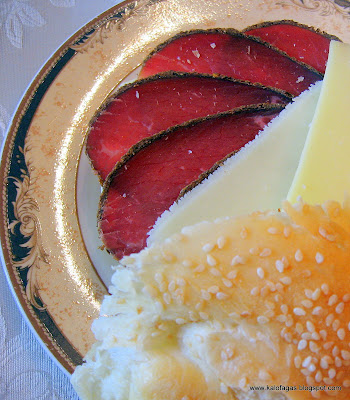 On many occasions I've referred to the Greek eating experience as being centered around many sample plates of foods that are shared over drinks, conversation among family and friends. Greek cuisine has alot of appetizers, usually simply prepared but the array is great and the diversity even more so. One facet of Greek appetizers or "the meze" is the use of delicatessen meats. I remember when I was young and my mom would prepare for an entire week to prepare mezedes for the onslaught of family and friends who would drop by our house on the occasion of my father's nameday, St. Nicholas. It's very common to see salami and other cold cuts on offer at a buffet table or as part of an array of appetizers like cheeses, bread, toursi (pickled vegetables) and the usual dips (like Tzatziki).
I've always liked deli meats be it Greek or non-Greek but today and in the future, I'm going to showcase some of Greece's deli and cured meats.
There's Kavourma from northern Greece, the Cretan delicacy of Apaki, Louza from the Cycladic Islands, Siglino from down south Mani way and today's feature, Pastourma.
From my readings, Pastourma comes from Armenian cuisine but it's widely enjoyed by Turks, some Arab countries and of course, Greece.
Pastourma made it's way to Greece through the migration of Greeks who once resided in Constantinople and Asia Minor. Some of the best Pastourma I had was when I visited Istanbul (Constantinople) a couple of years ago.
The Greeks of Asia Minor have left a permanent stamp on Greek cuisine and as many would agree, our cuisine is richer for it.
What's Pastourma? It's the grand-daddy of Pastrami. It used to be cured by frontier horsemen who would carry a type of Pastourma in their saddles during their long treks away from home. In essence, it's a beef jerky but now will get into the nitty-gritty.
Pastourma, it is said was once made of camel meat but that could be either urban legend or a fact of days of yore. Today's Pastourma is mostly made from different cuts of beef. For this recipe, I used an inside round cut of beef...lean, no silverskin and ideal size for some who wants to enjoy it with family and friends.
Pastourma takes about a month to salt cure and dry age to perfection. From my research, there are some quick-cure recipes out there but it appears the slow method garners the best results.
Pastourma is not for everybody. The crust is known as "tsimeni" or "trigonela" and it's a paste that contains garlic and spices, the predominant one being fenugreek.
Personally, I love the aroma, the taste of Pastourma. For those not in the know, fenugreek is a spice used heavily in the Orient it's from Methi leaves, which my Indian friends will attest to using in their dishes quite often.
Pastourma is best when it's sliced thinly, it has that texture of prosciutto or bresaola, very tender and buttery kind of experience. In it's rawest presentation, it's served thinly sliced on a plate with some bread and cheese and washed back with an Ouzo or Tsipouro aperitif. I've also found dry Greek reds to pair well with Pastourma.
http://2.bp.blogspot.com/_V8CJ9SigOho/SX_x6TnHw4I/AAAAAAAAGgk/u7TMgg0pHcI/s1600-h/IMG_1997.jpg" rel="nofollow">  Pastourma also makes for a wonderful omelet, which often is served as a dinner option for those late night Greek meals. The most famous use of Pastourma has to be Caesaria Pie, which contains a filling of pastourma slices, Kasseri chese and often tomato.
http://2.bp.blogspot.com/_V8CJ9SigOho/SX_x4OTYKaI/AAAAAAAAGgc/bDGtOTMtqgA/s1600-h/IMG_7959.jpg" rel="nofollow">  Pastourma can be found at Middle Eastern markets, some Greek food marts sell it, Armenian and Turkish patronized stores will also certainly carry it. If you're in a city or town that is nowhere near any of these stores, no worries....the home version is here.
http://4.bp.blogspot.com/_V8CJ9SigOho/SX_0CMsePxI/AAAAAAAAGhE/fzlSAfRjTgk/s1600-h/2007vacation+503.jpg" rel="nofollow">  Once again, my core belief in food is sharing and I've held no recipe back and nor will I ever. I present to you Pastourma, the home-cured version...enjoy! Pastourma (παστουρμά)
(recipe adapted from Mark Marcarian)
33 days preparation
1 piece of inside round beef (about 2 lbs)
approx. 1/4 cup sea salt (granulated)
Tsimeni http://2.bp.blogspot.com/_V8CJ9SigOho/SX_x6UkXdlI/AAAAAAAAGgs/FwJzJ2La2pw/s1600-h/IMG_1999.jpg" rel="nofollow -
3 Tbsp. of ground fenugreek
1/2 tsp. red pepper (cayenne)
1/2 tsp. of salt
1/2 tsp. black pepper
1/2 Tbsp. ground cumin
1/2 tsp. ground allspice
3-4 cloves of minced garlic
approx. 1 cup of water
cheesecloth
Ask your butcher for an inside round cut of beef, lean and no silverskin. Rinse and pat-dry your meat and place in a container that will fit in your fridge. Using an upholstery needle, thread some butcher's twine through one end of the meat and tie a knot so that you may later hang the meat for curing.
http://1.bp.blogspot.com/_V8CJ9SigOho/SX_0CzQAP-I/AAAAAAAAGhc/QEghG0BDhvg/s1600-h/IMG_1431.jpg" rel="nofollow"> 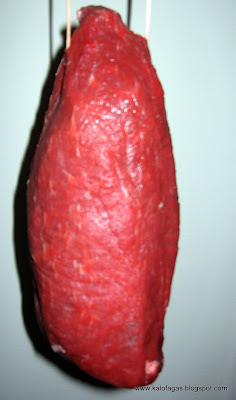
Cover the the entire area of meat with sea salt and place in your vessel. Cover with plastic wrap and use either a brick or 2-3 cans of tomatoes to weigh/press down on the meat. Place in the fridge for 3 days and turn once each day.
http://4.bp.blogspot.com/_V8CJ9SigOho/SX_0CgTsc1I/AAAAAAAAGhU/Q0_mQyyeVZg/s1600-h/IMG_1433.jpg" rel="nofollow"> 
Upon completion of day 3, rinse the meat of the salt in cold water and allow it to then soak in cold water for an hour. Allow the water to drain off the meat (30 minutes) and press between some cloth towels to remove any remaining moisture.
Wrap the meat with one layer of cheesecloth and hang in a cool, airy place to dry for 2 weeks. My Pastourma was hung to dry in a cool, dry cellar that was 15-18C and humidity of about 60-65%.
http://1.bp.blogspot.com/_V8CJ9SigOho/SX_0DW7KfYI/AAAAAAAAGhk/osRUR0X42WA/s1600-h/IMG_1565.jpg" rel="nofollow"> 
Check on your Pastourma from time to time, you might get a slight foul smell but that's okay...change the cheesecloth (I did 3 times).
After 2 weeks, remove the cheesecloth and rinse and pat dry.
http://2.bp.blogspot.com/_V8CJ9SigOho/SX_0Cdr30_I/AAAAAAAAGhM/KRc00O4OXCI/s1600-h/IMG_1762.jpg" rel="nofollow"> 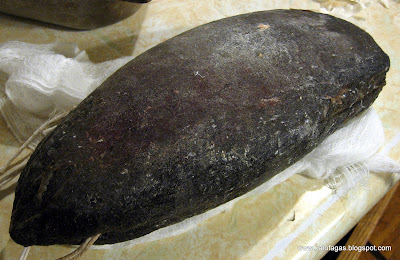
Now mix all the ingredients (except the water) for the Tsimeni in a large bowl. Slowly add the water a bit at a time while you mix the ingredients until a thick, gloopy paste has formed. You'll use anywhere between 1/2 to almost 1 cup of water (the Tsimeni should be thick so that it adheres to the meat).
Put on some gloves and slather the meat with your Tsimeni mixture.
http://1.bp.blogspot.com/_V8CJ9SigOho/SX_x7NpfGbI/AAAAAAAAGg8/4eIYAhFgbUU/s1600-h/IMG_1764.jpg" rel="nofollow"> 
Take your Tsimeni-coated meat back to where you hung the meat and allow to cure for another 2 weeks.
http://1.bp.blogspot.com/_V8CJ9SigOho/SX_x6hqVn9I/AAAAAAAAGg0/6irTXHvfAEg/s1600-h/IMG_1771.jpg" rel="nofollow"> 
After a total of approx. 33 days, your Pastourma is ready to be eaten. Cut the Pastourma in half and slice thinly against the grain from the inside towards the outer, tapering end of the meat. You may also refrigerate or freeze your Pastourma for future use. Wrap well in plastic wrap and thaw for 5 minutes to soften and go on and slice what you need before placing back in the freezer.
http://2.bp.blogspot.com/_V8CJ9SigOho/SX_x6UkXdlI/AAAAAAAAGgs/FwJzJ2La2pw/s1600-h/IMG_1999.jpg" rel="nofollow"> 
Serve thin slices at room temperature as part of an appetizer plate with some cheese, some bread and an aperitif like Ouzo or a dry Greek red wine. |
-------------
If you are a visitor and like what you see, please http://foodsoftheworld.activeboards.net/registration_rules.asp?FID=0" rel="nofollow - click here and join the discussions in our community!
|
Replies:
Posted By: Souvlaki
Date Posted: 20 March 2013 at 10:54
|
Wow what a nice story about pastourma....
I wonder why I did not read this post earlier, congrats.....I really liked it...
about the omelete if you do not like tsimeni you can peel it off, just fry a small peace of it with the oil until it melts (for a discrete taste) then cook the omelete with the meat as usual....that is the only way I can eat pastourma because the spices are too strong for me, and for many many people here in Greece.
|
Posted By: TasunkaWitko
Date Posted: 20 March 2013 at 11:33
|
Hello, Souvlaki!
I appreciate your input on this topic. I haven't yet been able to try it, but I have tried similar and related http://foodsoftheworld.activeboards.net/project-pastram_topic917.html" rel="nofollow - Romanian , http://foodsoftheworld.activeboards.net/bresaola-di-cervo_topic3263.html" rel="nofollow - Italian and http://foodsoftheworld.activeboards.net/dried-beef-aka-chipped-beef-from-venison_topic1603.html" rel="nofollow - American versions of pastourma; the spices and flavourings were a little different, but the method was basically the same. All were made from venison, rather than beef, but were otherwise made in as traditional a manner as possible - and all were very good!
I like bold flavours, so to me, the tsimeni would probably be the best part - of course I haven't tried it yet, so I cannot say for sure. I've noticed with my previoous charcuterie projects above that the thinnest possible slices make for the most enjoyable eating ~
Autumn is the best time in Montana to try projects such as this, but springtime might also be good - if I get an opportunity, I will see if I can make this.
Can you tell me, is this product ever smoked? Or is it traditionally un-smoked?
-------------
If you are a visitor and like what you see, please http://foodsoftheworld.activeboards.net/registration_rules.asp?FID=0" rel="nofollow - click here and join the discussions in our community!
|
Posted By: Souvlaki
Date Posted: 21 March 2013 at 01:26
|
From what I know pastourma is dried on air, sun-dried or smoked it depends on who produces it. Smoked one is good for pies and omelet.....and as a meze I would prefer non-smoked because it is lighter ...
|
Posted By: TasunkaWitko
Date Posted: 21 March 2013 at 08:54
Souvlaki - thank you for your local perspective on this traditional Greek charcuterie. 
I am indeed looking forward to giving it a try, I'm not sure when, but will let you know when I do. Perhaps I will smoke half and leave the other half un-smoked, then compare the two.
-------------
If you are a visitor and like what you see, please http://foodsoftheworld.activeboards.net/registration_rules.asp?FID=0" rel="nofollow - click here and join the discussions in our community!
|
Posted By: Margi Cintrano
Date Posted: 21 March 2013 at 09:33
|
Tas and Souvlaki,
This has been a very lovely and informative discussion on Greek Pastrama charcuterie.
Thank you and I am looking forward to Ron´s pictorial and future project ... and the Omelette idea sounds wonderful Tee ...
Kindest. Margi.
-------------
Volamos a Mediterraneo, un paraiso que conquista su gente u su cocina.
|
Posted By: HyeUp
Date Posted: 07 April 2013 at 11:41
Hi - I'm new to the forum and I like what I've seen.
As an Armenian, I know this as 'basturma'. The recipe you've posted looks pretty much as I made it myself (using beef) many years ago. I love the spice mix, and as stated, it's not for everyone. The fenugreek is the predominant flavor which something the average American palate is not familiar with.
As a kid, basturma pretty much convinced me that God must be Armenian. How else could anything so good be explained?
I found this forum while looking for a recipe for Buendnerfleish, the Swiss dried meat. I'm hoping to be well armed with various recipes before this year's hunting season!
Thanks for the fun site - now I'll go check out whatever else I can find.
-------------
I'll try almost anything twice.
|
Posted By: HyeUp
Date Posted: 07 April 2013 at 11:45
Just another comment on basturma/pastourma - the pictures show marbling and fat pockets in the meat; there should be as close to zero fat as possible when making this. That should mean it would work well for elk and venison.
-------------
I'll try almost anything twice.
|
Posted By: HistoricFoodie
Date Posted: 07 April 2013 at 13:21
Nice perspective, HyeUp.
Welcome to Foods of the World. It already sounds like you'll be a major asset to our little group.
Why don't you head up to the Members Lounge forum and tell us a little about yourself?
|
Posted By: gonefishin
Date Posted: 07 April 2013 at 15:52
Thanks for your insight HyeUp! Welcome to the forum.
Tas, as usual...great thread. I haven't tasted Pastourma, I'll keep my eyes open for it...thanks for sharing!
-------------
Enjoy The Food!
|
Posted By: TasunkaWitko
Date Posted: 08 April 2013 at 09:43
|
Hi, Ruth - I'm glad you found this; it is my next "venison charcuterie" project, and I plan on making good use of the fenugreek in order to make it as "authentic" as I can. The venison roasts are, as you know, great for things like this, because they are so lean, with no fat.
Dan - I wish I could take credit for the beautiful photography in this one, but I cannot - the source link is somewhere in the original post, and is very much worth checking out ~ 
-------------
If you are a visitor and like what you see, please http://foodsoftheworld.activeboards.net/registration_rules.asp?FID=0" rel="nofollow - click here and join the discussions in our community!
|
|