Färsrullader
Printed From: Foods of the World Forum
Category: Europe
Forum Name: Scandinavia
Forum Discription: Where people live to eat.
URL: http://foodsoftheworld.ActiveBoards.net/forum_posts.asp?TID=887
Printed Date: 26 March 2026 at 18:45
Topic: Färsrullader
Posted By: TasunkaWitko
Subject: Färsrullader
Date Posted: 29 October 2010 at 12:03
|
Färsrullader From Time/Life's Foods of the World - The Cooking of Scandinavia - 1968:
here's a shot of the goods for a double batch - this one uses very simple ingredients, as you can see:
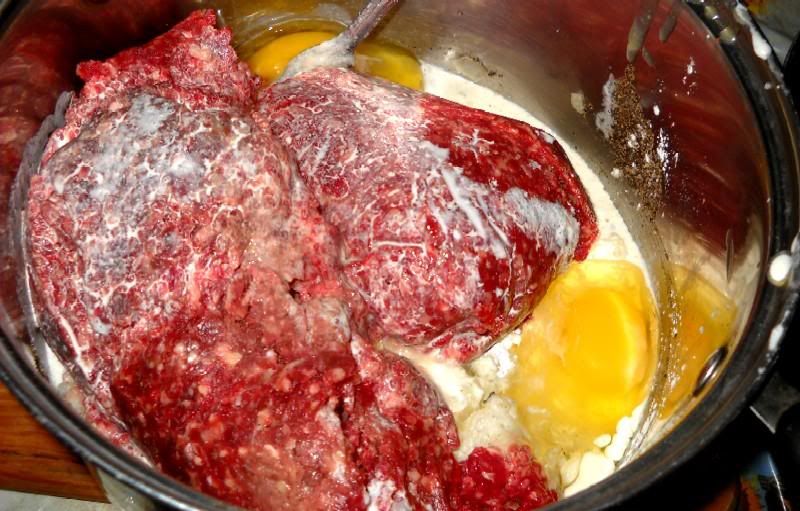
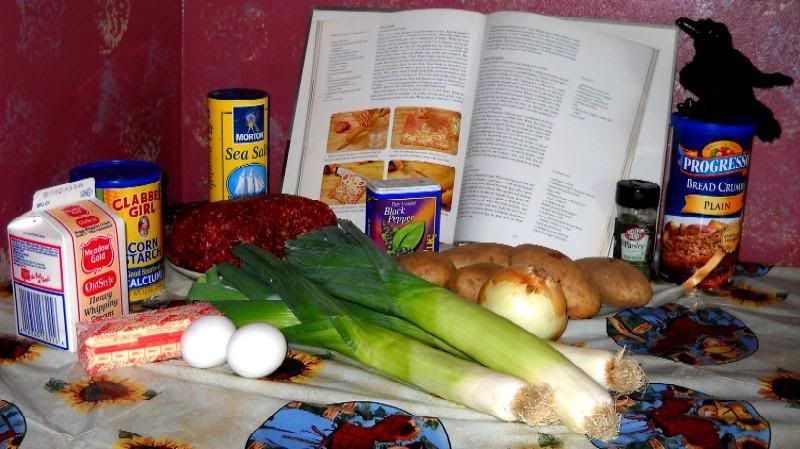 everything is available at any local grocery, except possibly the veal. rather than veal, which is evidently impossible to get these days even in montana, we used ground beef and there were no detrimental effects. the beef in this case was locally grown, slaughtered and processed; as you can see, it is quite lean and has very good colour.
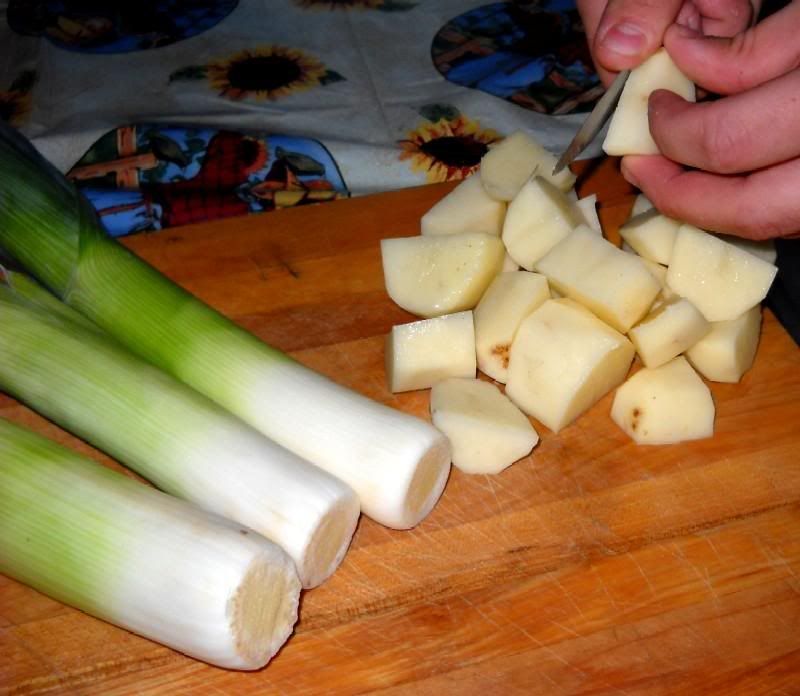
my #3 son billy began cutting the potaotes into sixths and quarters, depending on size:
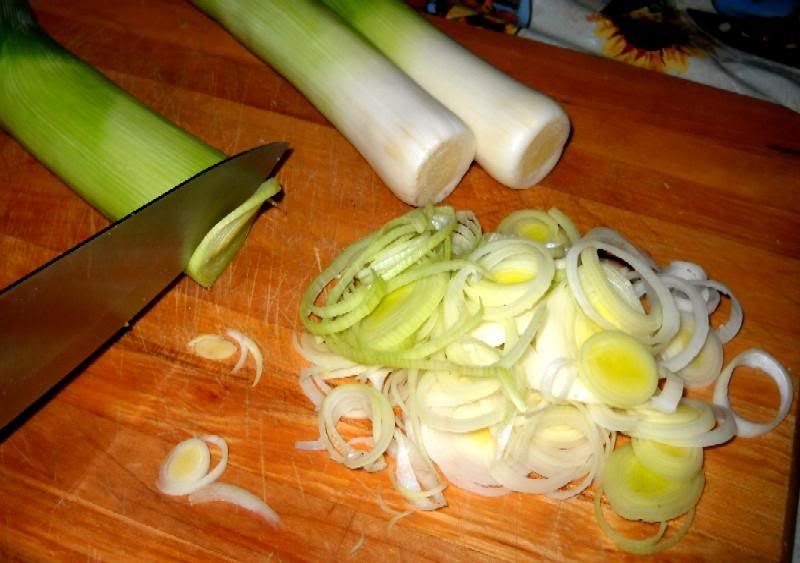
 and then i sliced the leeks thinly in preparation for their later placement in the ruladers:
 we boiled the potatoes on the stovetop, then drained then and began mashing them with a fork:
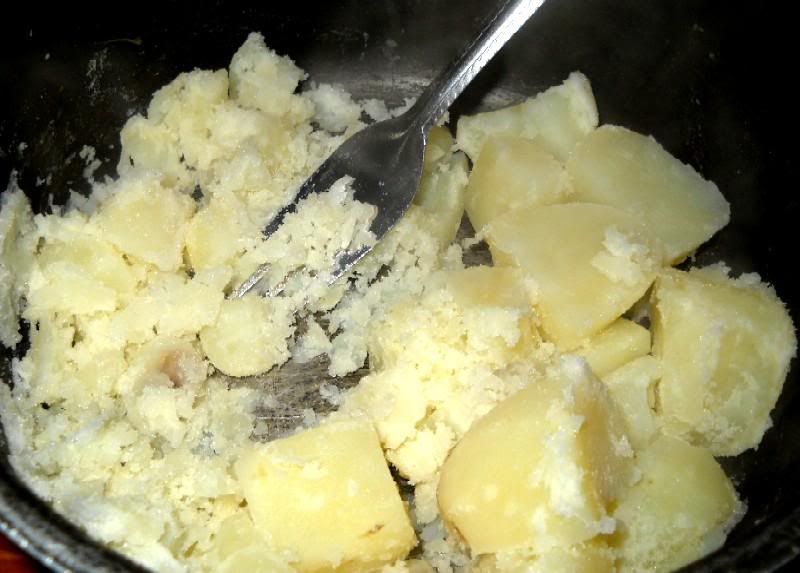 until they were this consistency:
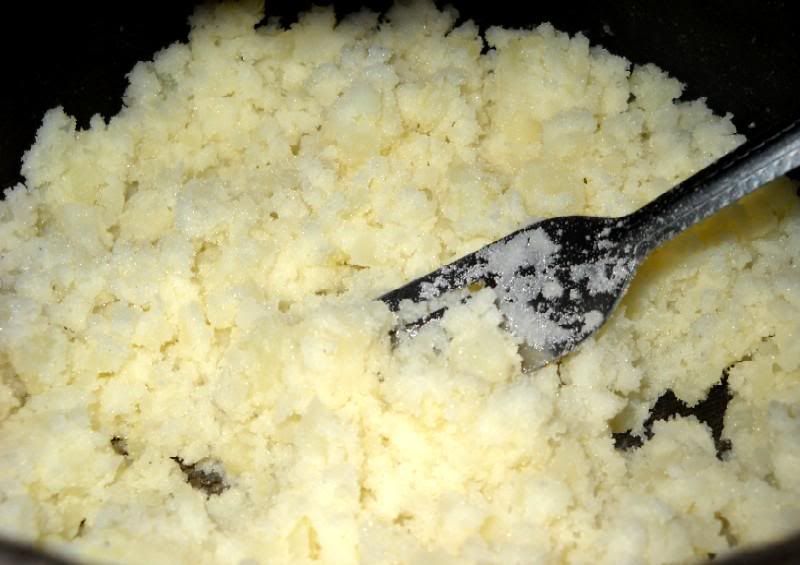 on a side note, i've always wanted to try making http://foodsoftheworld.activeboards.net/forum_posts.asp?TID=172&title=roll-out-the-lefse - lefse , but have held back because the instructions i have always seen call for running the boiled potatoes through a ricer. i've decided, after this experience, that the ricer must be for convenience only, because the fork method seems to do exactly the same job. with this in mind, i might give the "swedish tortilla" a try!
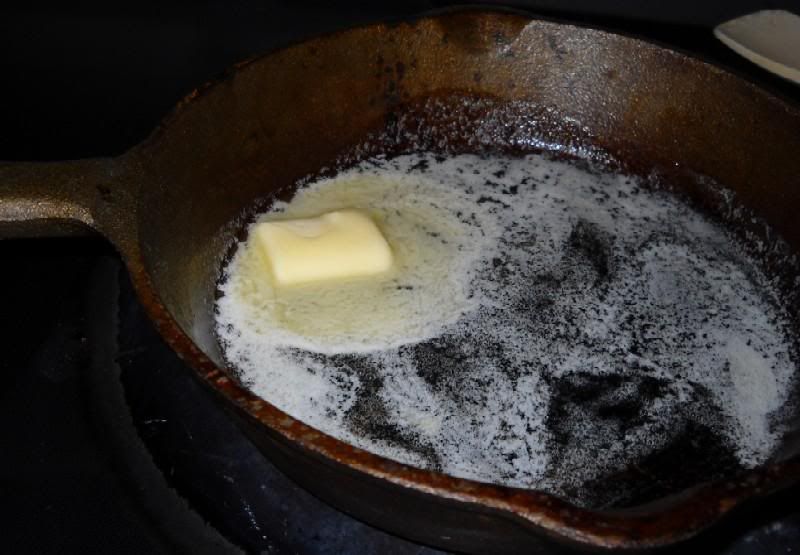
once the potatoes were fluffy in texture and ready, we melted some buttter in a small cast iron skillet:
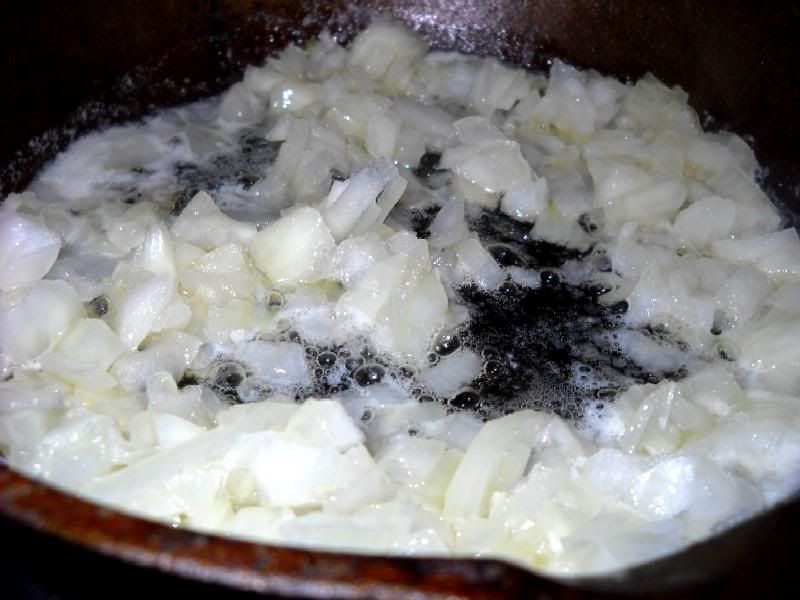
 and proceeded to saute the onions as directed:
 when they were ready, we added them to the fluffed potatoes in a large bowl:
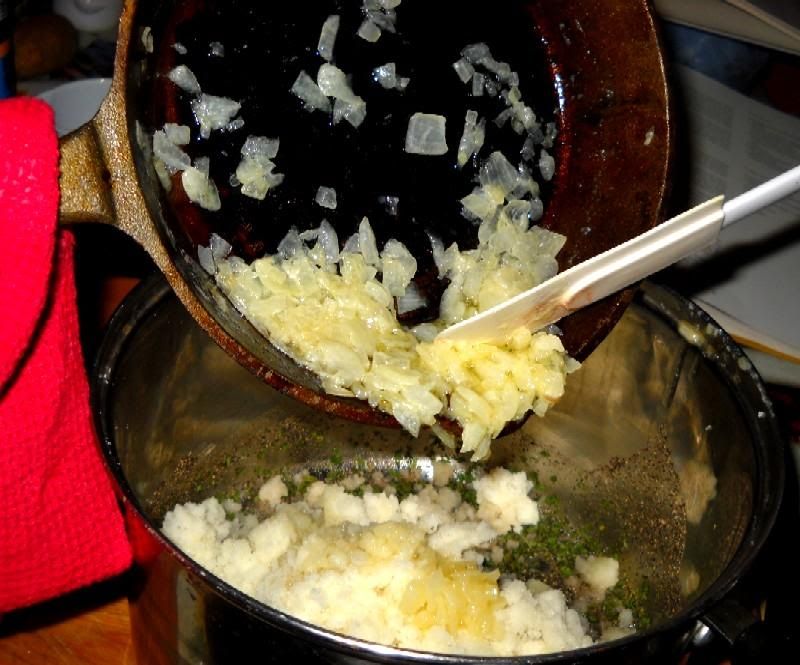 and then added the proscribed amounts of ground beef, bread crumbs, cream, water, salt, pepper, egg, parsley and cornstarch:
 we mixed it all together as thoroughly as possible:
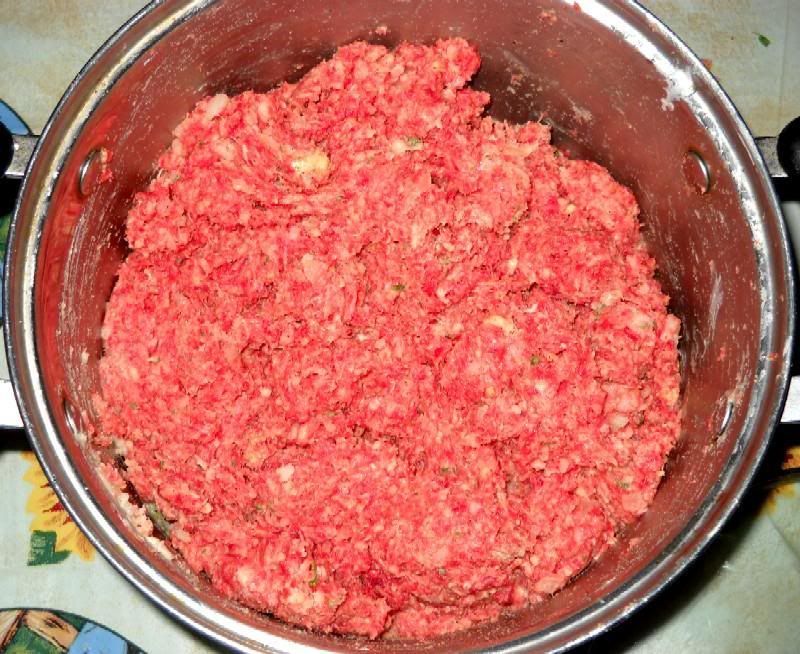 and then set it in the refrigerator to chill for about an hour.
meanwhile, i was working on another project ( http://foodsoftheworld.activeboards.net/potage-parmentier-and-vichyssoise_topic888.html - potage parmentier ) that same night for our first course, and took this opportunity to get it started.
when the meat had chilled thoroughly, we began the process of assembling the rullader. i decided rather than make a bunch of little tiny ones, i would make a dozen, each about the size of a burrito. to do this, i came up with an idea that hopefully would make the process easier. we covered our cutting board (which was just the right size) with foil, then sprayed it with olive oil and set half the meat mixture on it and flattened it out by hand as much as was practicable:
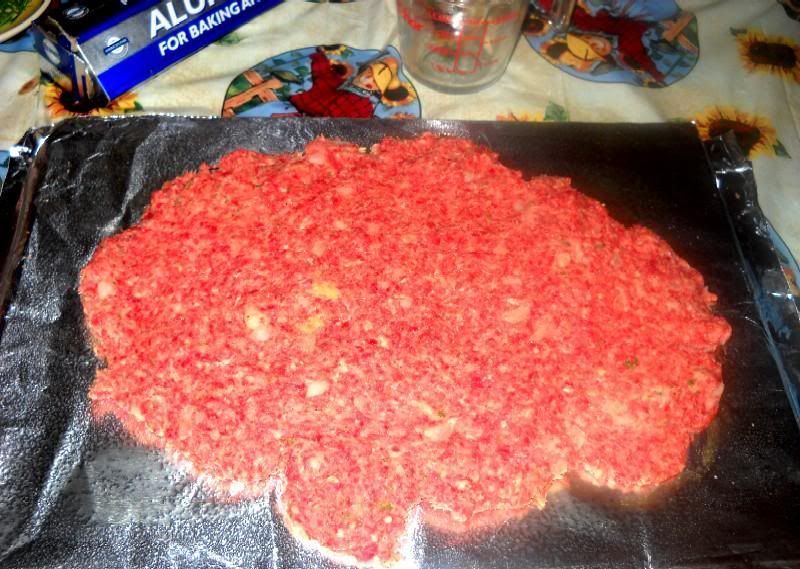 then rolled it out flat to the edges of the foil-covered cutting board:
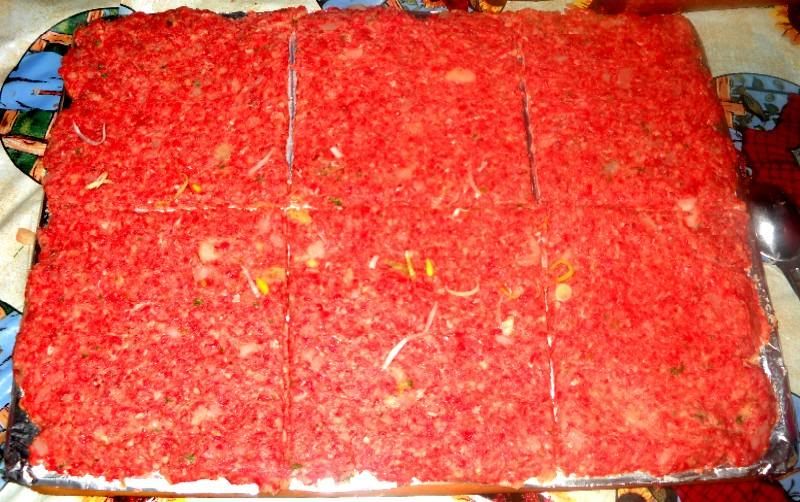
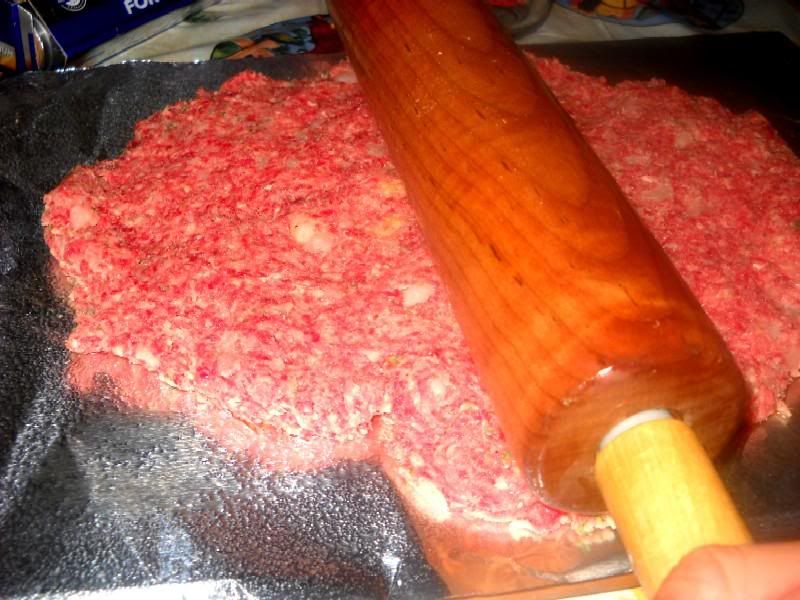 i started to put the sliced leeks on, then remembered i had to section the meat mixture, so i removed as many leeks as i could and then used a knife to cut the mixture into six sections:
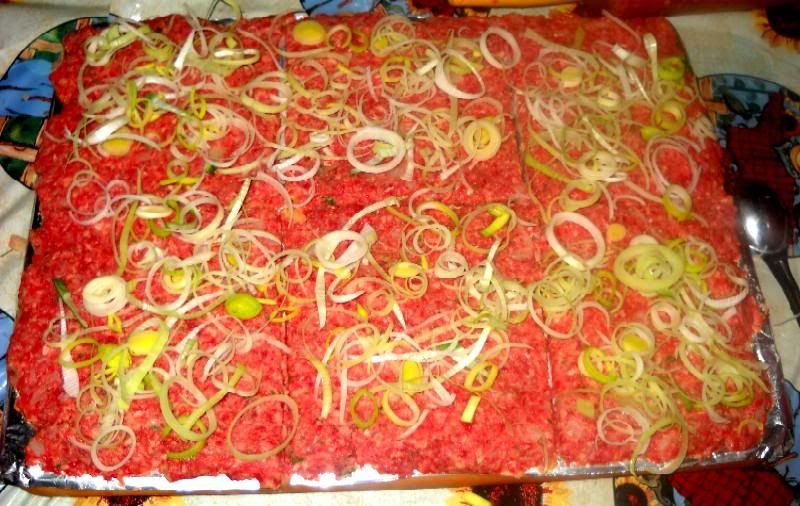
 i then tossed the leek slices back on, roughly in the sections but also overlapping a bit:
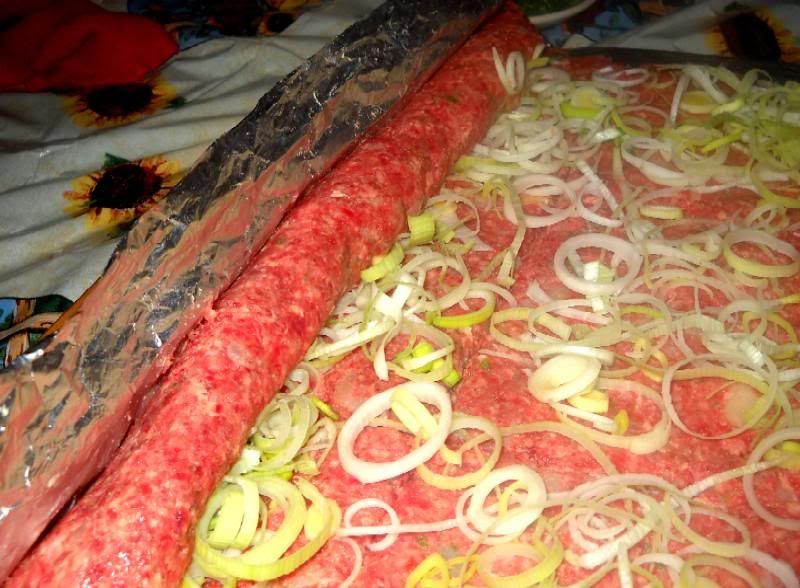
 now comes the tricky part, as anyone who has made a http://foodsoftheworld.activeboards.net/first-fattie-of-the-summer_topic635.html - fatty for barbecue can attest. we carefully lifted the foil on the "long" side in a rolling motion and rolled the sections as tightly as possible whilst pulling the foil forward until the long roulade reached the middle:
 when it reached that point, we stopped and reinforced the long cut we had made down the middle (which was now the divider between the "top" three and "bottom" three rolls), then pulled the foil back and reinforced the cuts for the "bottom" three individual rulladers as well.
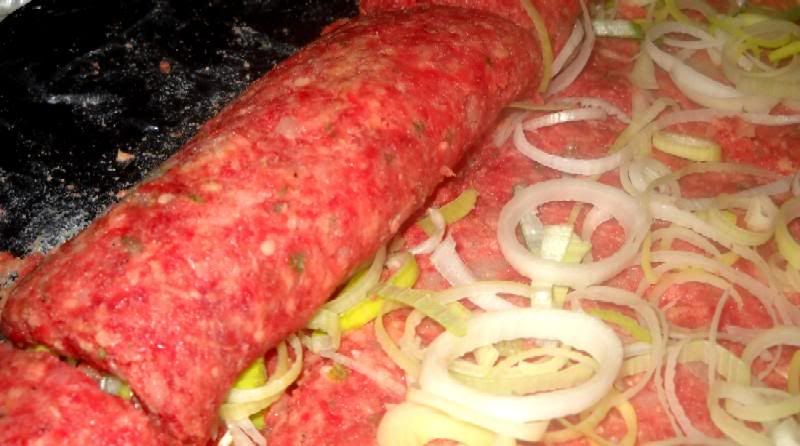 we then used a spatula to lift the first three rulladers off and set them on a baking sheet lined with foil that had been sprayed with olive oil:
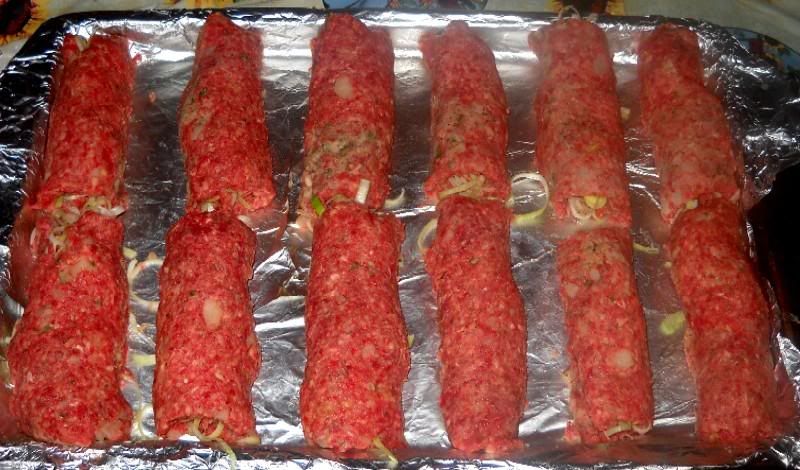
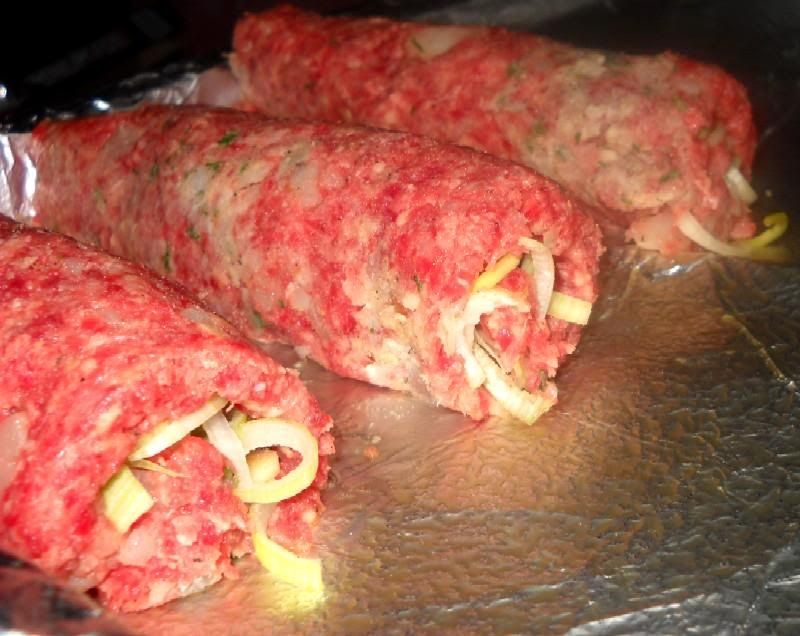 we repeated the procedure for the "other half" of the first batch, and then repeated the entire operation for the second half of the meat mixture, resulting in 12 rullader:
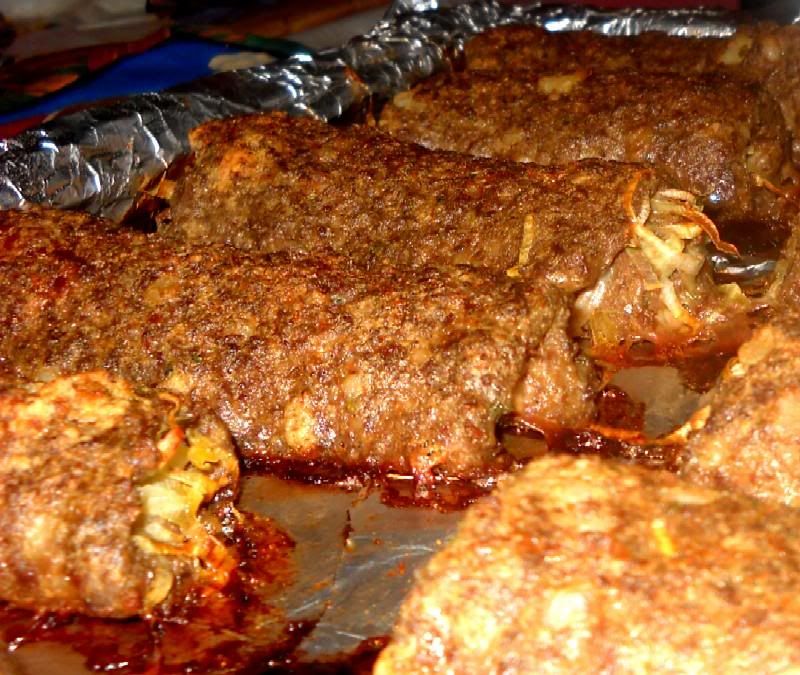
 at this point, i made another deviation from the recipe, which called for frying the rullader four-at-a-time in butter. instead of that, i decided to bake them in the oven, which would hopefully be less labour-intensive and time-cosuming; also a tiny bit healthier, i suppose. it was mostly a decision of convenience and it worked just fine, as far as i could tell. here's how they looked after maybe 45 minutes of baking at 350 degrees, if memory serves: 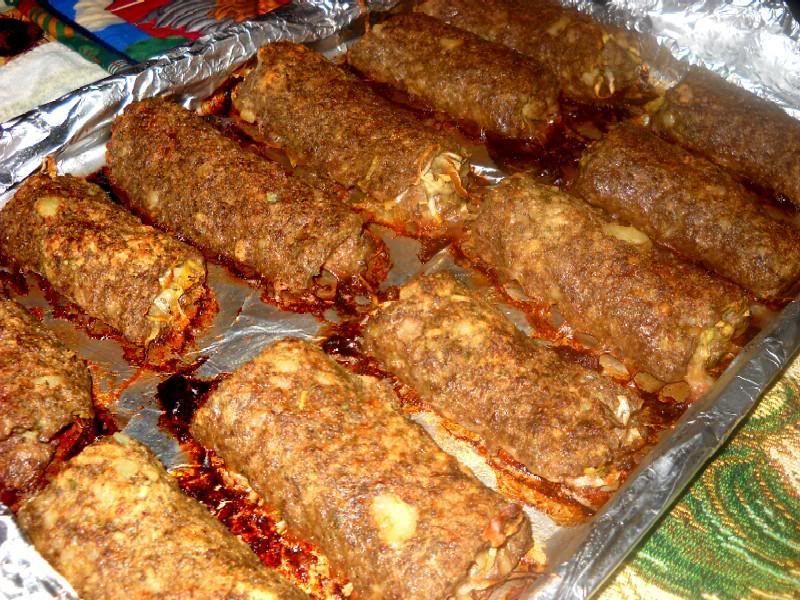 the smell while they were baking was incredible, and really brought out the best of the various ingredients, especially the leeks and onion. here's a closer shot of all that savory goodness:
 the baking worked out just fine but there weren't many "drippings" to use in the sauce; nevertheless, we scraped as much as we could off the foil and put everything in the small cast iron pan we had used for the onions, along with the butter and heavy cream (what was it i said earlier about being concerned about calories?):
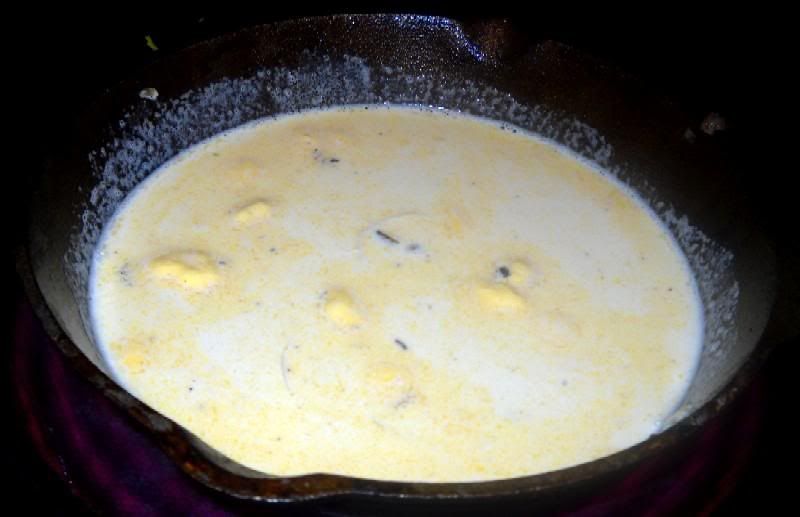 when the cream mixture started boiling:
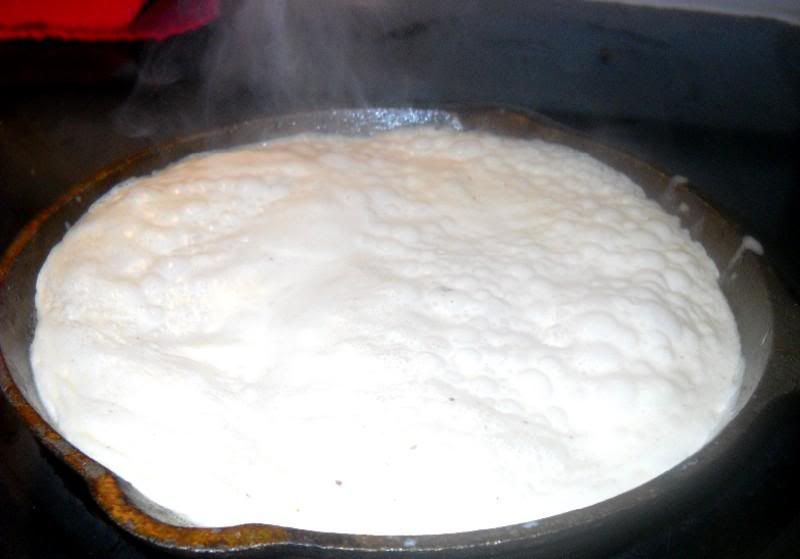 we reduced the heat to low and stirred it vigorously, keeping it off the sides and in the middle as much as possible. it seemed to continue to boil too much, and i was worried about everything scalding or separating, so i also moved the pan halfway off the burner. after a while it started to darken and for a skin on top:
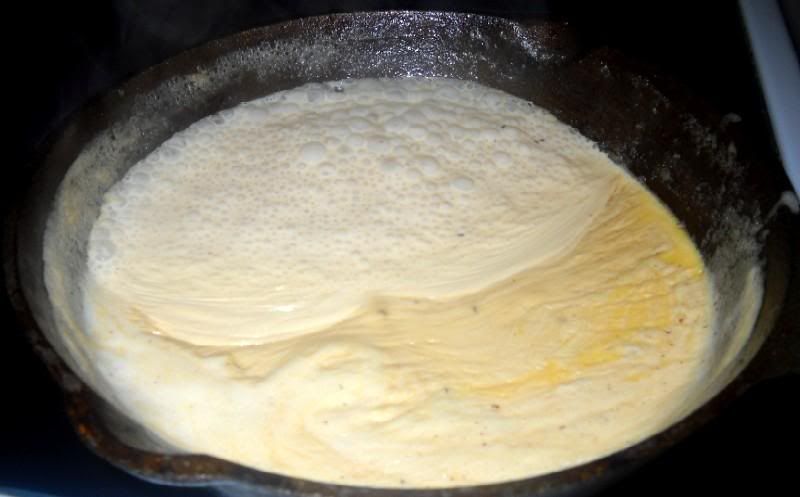 which i kept stirring back into the sauce as it continued to simmer. eventually it seemed to reach the consistency and colour that i thought it should and i plated two rullader per person on a small plate:
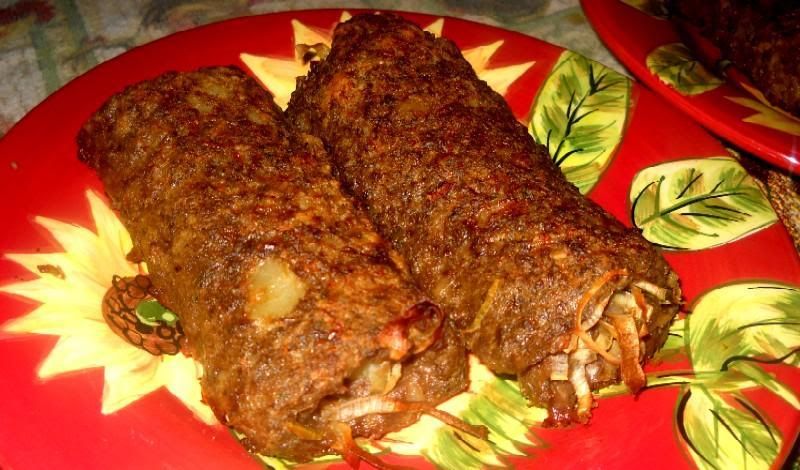 then drizzled the rich, creamy sauce over the tops:
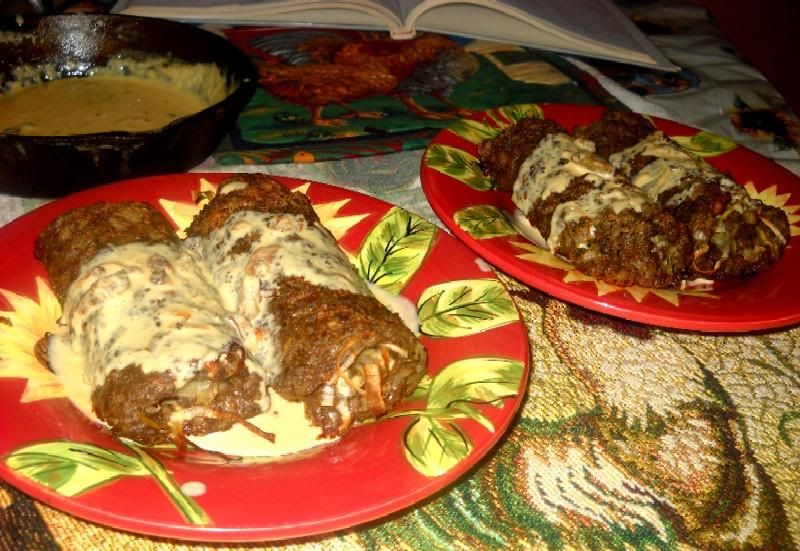 and served them to my famished family (and the neighbour kid who had lingered around just to try them). here's a close-up of how they looked, and i can say without a doubt that they tasted even better!
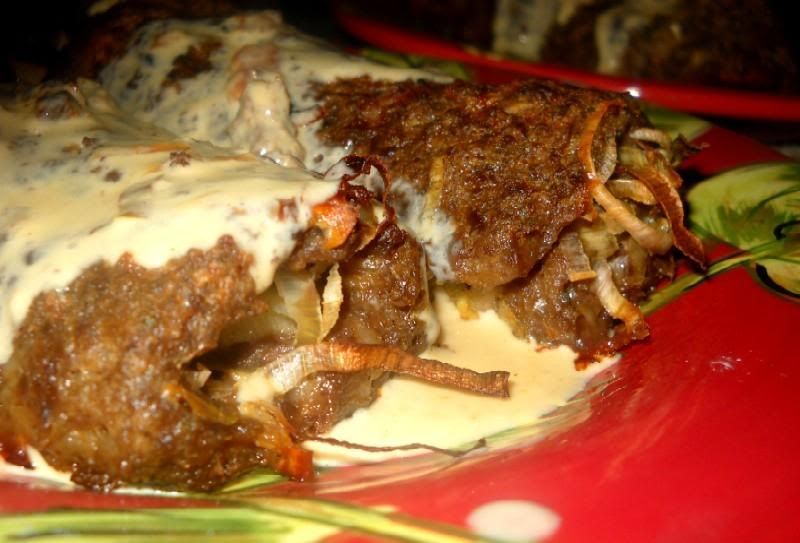 everyone seemed to like them and i can rest assured that this was a success all-around. for some reason, i read the recipe wrong and ended up using twice the amount of leeks that i should, but this posed no problems; similarly, the baking rather than frying of the rullader was no problem, either, and resulted in firm, savory envelopes of goodness without the danger of falling apart. frying them would have resulted in a flavour that would have been a bit richer, but this served well to speed the process along, i think. then agian, who kows, it may have taken the same amount of time. either way, it's all good!
this is definitely a do-again dish for us and one that touches a bit on my swedish heritage. perhaps my own ancestors enjoyed a similar version of this dish on a cold, winter evening and in preparing this dinner i was also paying respect to that part of my background. you don't have to be of swedish derivation to enjoy färsrullader, though - all you need is some simple ingredients and the willingness to give them a try!
------------- If you are a visitor and like what you see, please http://foodsoftheworld.activeboards.net/registration_rules.asp?FID=0" rel="nofollow - click here and join the discussions in our community! |
 Makes 16 Roulades (to serve 4 to 6):
Replies:
Posted By: Guests
Date Posted: 29 October 2010 at 18:51
Beautiful execution and a wonderful dish! Wow, this looks really tasty and big congrats to your helpers. Like you, I'd have done them baked instead of fried and no loss apparent from your end results. Definitely a great Scandinavian meal you all should be proud of as well as sharing here!  ------------- |
Posted By: jdonly1
Date Posted: 29 October 2010 at 19:09
| Might have to try that,looks good |
Posted By: kiwi
Date Posted: 29 October 2010 at 20:30
|
That looks awesome, I might try this one next time I start getting meat cravings. I imagine you could ad lib some interesting alterations in with the leaks as well. ta!
------------- kai time! |
Posted By: Hoser
Date Posted: 30 October 2010 at 03:22
|
Looks terrific Ron! I guess there are a lot of little tweaks you could make with this dish....it's definitely on my must do list. Great pics too....a nicely done tutorial. ------------- Go ahead...play with your food! |
Posted By: TasunkaWitko
Date Posted: 30 October 2010 at 09:05
|
thanks to all for the comments!
yep, this one would respond well to some improvisation, i think. the main thing is that it is relatively easy yet produces something that looks and tastes complex. if anyone gives this a try, post results! ------------- If you are a visitor and like what you see, please http://foodsoftheworld.activeboards.net/registration_rules.asp?FID=0" rel="nofollow - click here and join the discussions in our community! |
Posted By: Christine in P.A.
Date Posted: 04 February 2016 at 22:19
|
Thank you so very much for posting this! Although it is 5 1/2 years after you posted it, I just found it. I made these last night, and they are utterly wonderful. But I had trouble keeping them from falling apart when I browned them in a skillet. After I was done, I was worried that perhaps they were not done all the way through, so I put them in a flat dish and baked them 20 minutes at 350. Your way is so very much better! I will do it that way instead, baking them and skipping the skillet browning part. You are a culinary genius in my book! One thing I probably will do, however, is brush on a little melted butter before I bake them, then use the drippings to make the gravy more flavorful. I made two little changes to the sauce recipe, though, when I made it last night. I sauteed a little more thinly sliced leek in the pan used to brown the rolls, then added 1/4 c. of heavy cream and 1/4 c. of half and half. I also added a few gratings of fresh nutmeg, which I had seen previously in several Swedish meatball recipes. The sauce and the rolls turned out delicious. One question of you: When I rolled out the meat mixture, I didn't have enough to make a 16" x 16" square, so I chose to make a 12" x 12" square, and so my yield was only 9 rolls, not 16. Did you manage to get the full 16? If so, how? By the way, to accompany this, I made buckwheat kasha, using the recipe in the 1972 edition of the Joy of Cooking (the turquoise cover edition). I added a 1/2 cup of minced onion that I sauteed first in a little bit of butter before adding the buckwheat groats and proceeding with the recipe. It was a wonderful accompaniment. Again, thank you so much for your great step-by-step photos and detailed explanation.
|
Posted By: TasunkaWitko
Date Posted: 07 February 2016 at 12:07
Hello, Christine, and please allow me to extend a very hearty welcome to this forum! I'm looking forward to seeing your contributions, and am very hnoured that you gave this wonderful recipe a try. It is one of my favourites!  I apologise for my tardy reply, but I was engaged in several work and family commitments that kept me away. When I made this, I ended up with 12 färsrulladers, but this was from a double batch because we had 6 people in the house and I wanted to have two of them per serving that were about the size of a burrito. A person could get a few more, with appropriate adjustments in the sizes of the final product. As to how I did it, I pressed it down on a sheet of foil on a hard surface (one batch at a time), and rolled it out; I'm not too sure how thick it was; maybe 1/4 of an inch. I then cut down through the mixture just to the surface of the foil, placed the leeks, then rolled the mixture up as tightly as I could, pulling the foil off the meat as I rolled it up, re-cutting the rolls and lifting them off as each roll came to it's own edge. The thorough mixing of the egg, potato and meat seemed to hold together well enough. The pictures above documented the process, but it seems to be one of those things a person has to try a couple of times in order to get the hang of it. Yes, I decided early on that baking them would probably be the best way to go, especially since it was my first time making them! Its a technique that I had used before when making meatballs, so I figured it was worth a try. The end result worked very well; they cooked perfectly and retained their shape. The brushing of the melted butter is an excellent idea that I will try in the future, for sure! ------------- If you are a visitor and like what you see, please http://foodsoftheworld.activeboards.net/registration_rules.asp?FID=0" rel="nofollow - click here and join the discussions in our community! |