|
Thank you, from the Foods of the World Forums! |
Bacalao al Pil-Pil |
Post Reply 
|
Page 12> |
| Author | ||||||
TasunkaWitko 
Admin Group 

Joined: 25 January 2010 Location: Chinook, MT Status: Offline Points: 9389 |
 Post Options Post Options
 Thanks(0) Thanks(0)
 Quote Reply Quote Reply
 Topic: Bacalao al Pil-Pil Topic: Bacalao al Pil-PilPosted: 15 March 2013 at 12:31 |
|||||
|
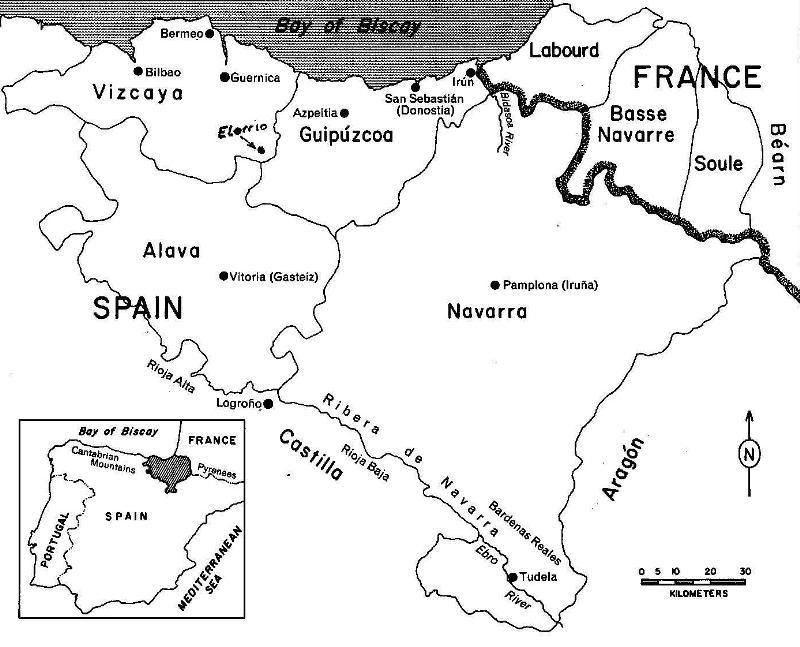
Bacalao al Pil-Pil When I first started collecting books of the Time/Life Foods of the World series, I immediately gravitated to the volume on Spain and Portugal and began reading it eagerly. I found the chapter on Basque cooking particularly interesting, with fascinating photos that drew me right in; it seemed that here was an area and a culture that was truly unique, and that uniqueness contributed to the cuisine. I found it fascinating that certain concepts would be so integral, not only to the land and the people, but to the food as well. From Time/Life's Foods of the World - The Cooking of Spain and Portugal, 1969:
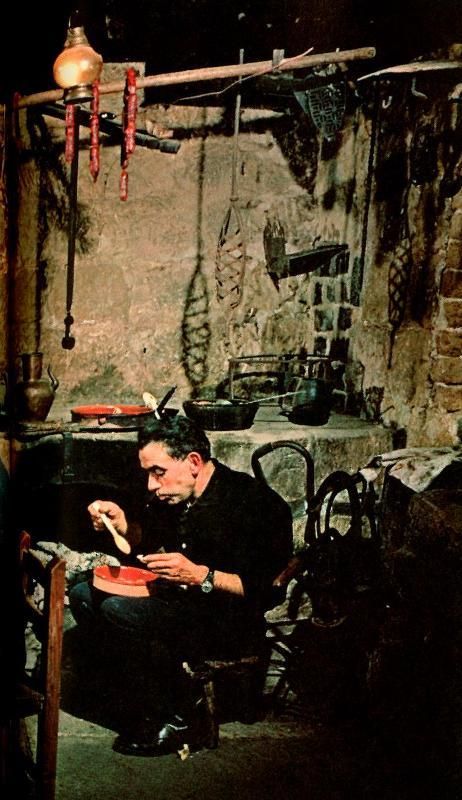
As I continued reading, I was introduced to several facets of the Basque culture that contributed to the well-deserved reputation for excellence that Basque cooks enjoy:
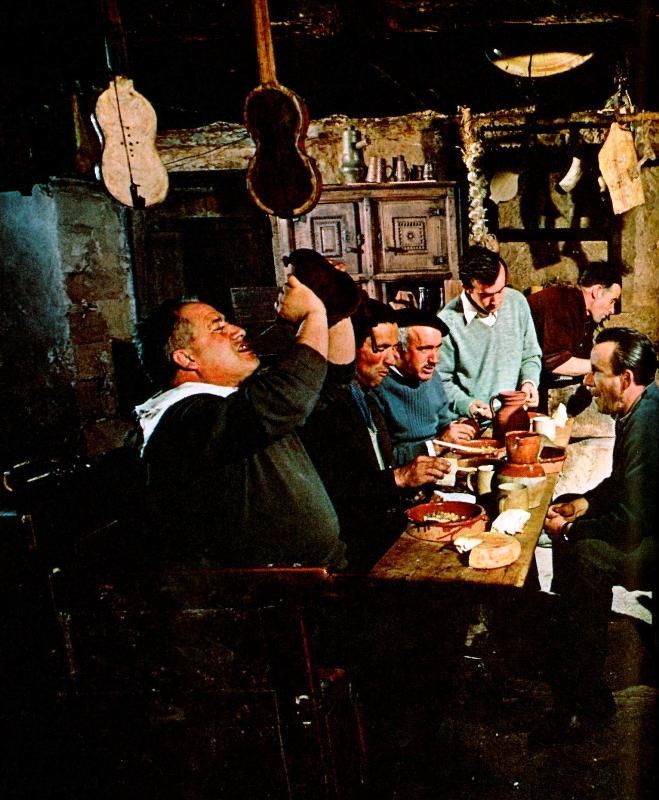
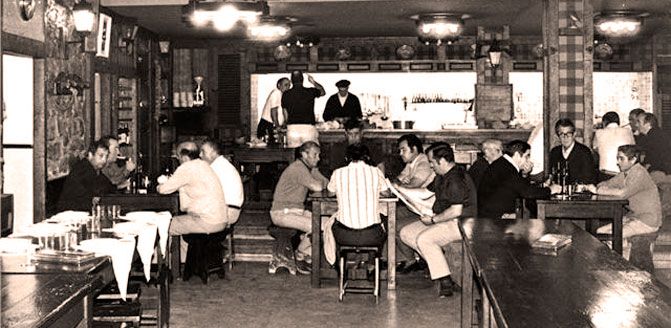
This idea of men getting together for the sole purpose of cooking and enjoying the bounty of the Basque table fascinated me, and it was natural to put myself in the position of a visitor to Basque country:
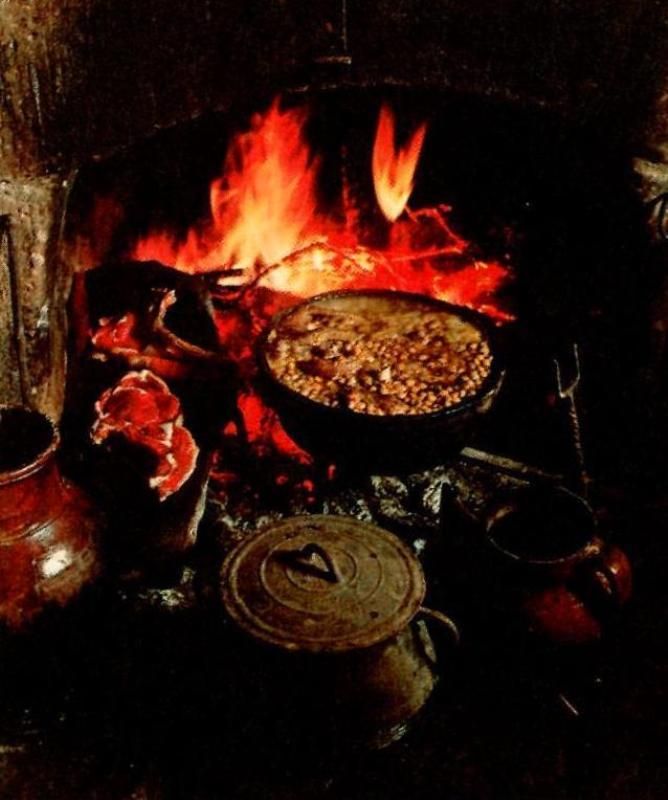
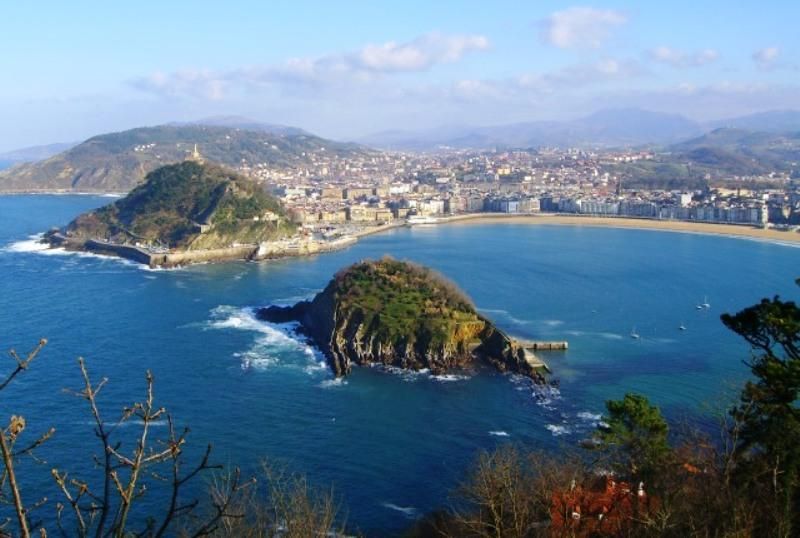
No study of Basque cuisine would be complete without broaching the subject of seafood, which is so integral to Basque cooking that it would be hard to imagine the cuisine without it. The proximity to the Bay of Biscay and the Atlantic assures that there will always be an abundant bounty from the ocean, ready to be brought to its highest elevation by skilled cooks with a built-in instinct for excellence and innovation:
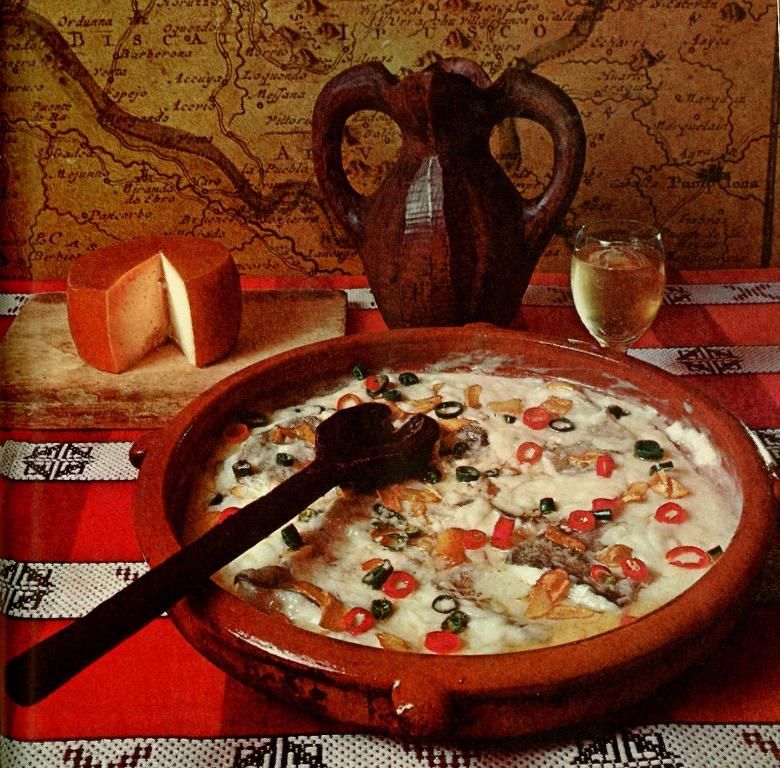
One of the quintessential seafood dishes on Basque culture is Bacalao al Pil-Pil, which is salt cod cooked in simple and humble fashion with very little frivolity; this dish is the essence of Basque cooking in that the main ingredient is not only the star, but also the instrument of its own embellishment. This concept brings us back to the opening comments regarding pure ingredients, sauces, gravies. Time/Life elaborates:
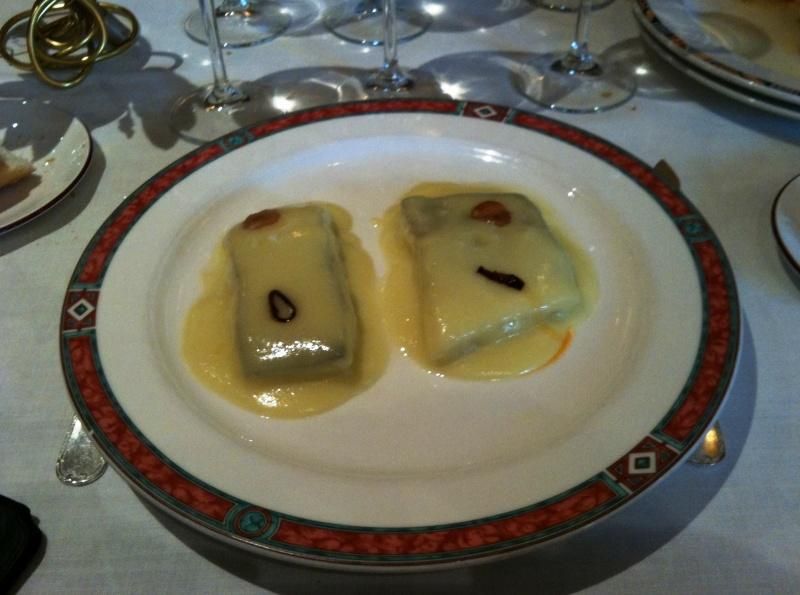
The careful dance that results in the pil-pil sauce involves gentle heat and motion, emulsifying the natural juices of the cod into the garlic-infused oil that it is cooked in and creating a new ingredient that enhances and highlights its components. To me, it is an example of the fundamental truth that simple ingredients prepared simply will create their own elegance. Interestingly, When I was researching this project, I found that the Guria restaurant in Bilbao, which prepared the bacalao al pil-pil pictured above, is still in existence. With a little bit of digging, I discovered that this quintessential Basque dish is still on their menu, and even found a modern photo showing their preparation of it:
Note how the tablecloth design in the old photo is very similar to the rim of the plate in the new photo; it seems that in Basque country, the past and the present are always interwoven into a timeless tapestry. My reading indicates that the dish that we've come to know as bacalao al pil-pil is not quite as it was originally made, although it is very close. According to at least two sources (Kurlansky and Busca Isusi), the original bacalao al pil-pil was prepared in the same tradition that eels were prepared, with gentle, sizzling cooking in olive oil, seasoned with garlic and perhaps a sliced pepper; however, the juices from the fish were not blended with the olive oil into a sauce - it was simply served, the same way that the eels are. It seems this method for cooking cod traces back to around the same time as a Basque uprising known as the Third Carlist War, circa 1830, when an abundance of salt cod procured through a clerical error necessitated innovative methods in cooking it. Eventually, it was discovered that the juices of the cooking cod, when subjected to gentle motion, would emulsify with the oil it was cooking in, resulting in a unique and delicious preparation.
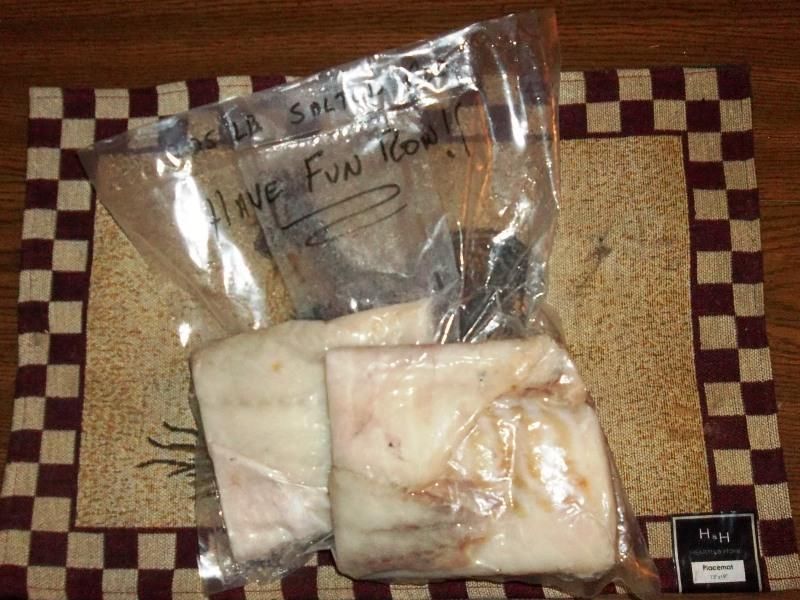
When I made this dish for the first time, things did not go entirely as planned. Due to an execution error, the pil-pil sauce did not formulate the way it was supposed to, and in modern, technical terms, I failed in my goal. Having said that, what I ended up preparing was actually very close to the original way that bacalao al pil-pil was prepared, so I am calling it a "successful failure." The important thing, to me, is that the dish tasted excellent, and I had no complaints at all where flavour was concerned; indeed, the Beautiful Mrs. Tas, who is by no means a lover of fish, really enjoyed this dish, and in spite of the almost-prohibitive cost, she is looking forward to the next time I make it. I hope that my next attempt will allow me to achieve the goal of integrating the sauce the way it is intended to be. In any case, here is a record of my first attempt at bacalao al pil-pil.… The primary ingredient, of course, is salt cod. Living where I do, this is extremely difficult to procure; luckily I had the very good fortune to meet a most excellent friend a few years ago - you know him here as "Hoser," but I like to call him "Dave!" Anyway, since Dave lives near a bustling and thriving Portuguese community on the East Coast, he is able to come across a few things that are not easy to get around here, and he graciously sent a supply of salt cod to me:
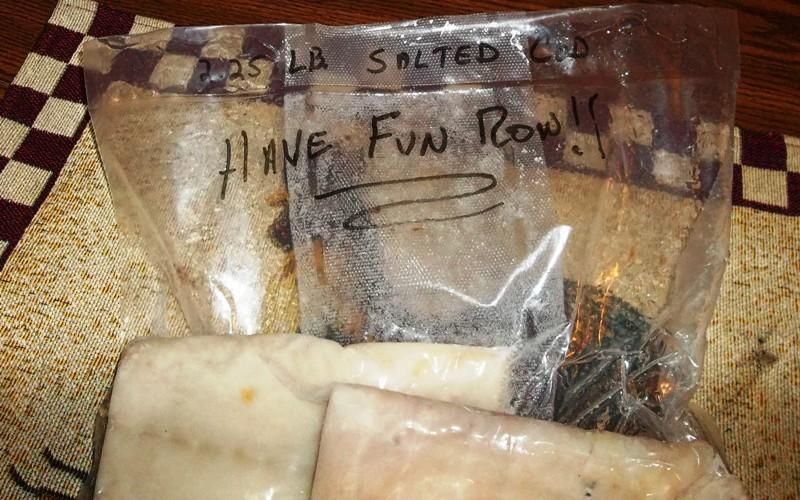
This salt cod came from A J Seabra, a chain of Portuguese supermarkets based in New Jersey, and was some really fine-quality stuff; it smelled fresh and ultimately had a wonderful flavour that seemed to be more than the sum of its components - a truly special treat that I will always remember fondly. Dave also penned some advice:
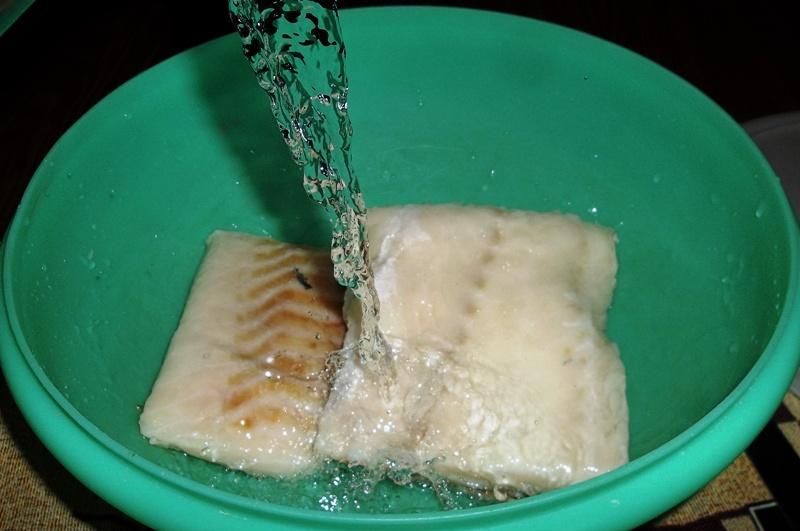
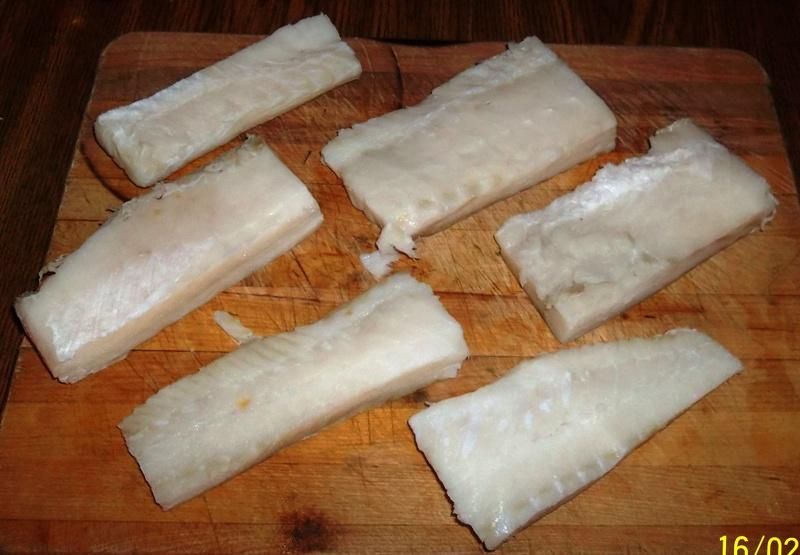
This admonition set a perfect tone for this project, and I must say that I had a great time with it ~ Thank you, Dave! Salt cod is made by packing the cod fillets in sea salt, which preserves the fish via partial dehydration, creating a dry, salty environment where food-borne pathogens cannot grow. This is a very, very old method for preserving cod and other fish, and during the days before refrigeration, it allowed the humble codfish to create a huge amount of commerce as it fed much of the known world. Salt cod is not so common in these days of flash-frozen packaging, but it is still sought out as the preferred way to prepare many dishes, including this one. In order to use salt cod in a dish, the excess salt must be soaked out. This has a secondary effect of "re-hydrating" the fillets, causing them to expand back to their original size, as well. There's nothing complicated about this process, simply submerge the fillets in an appropriate amount of fresh water:
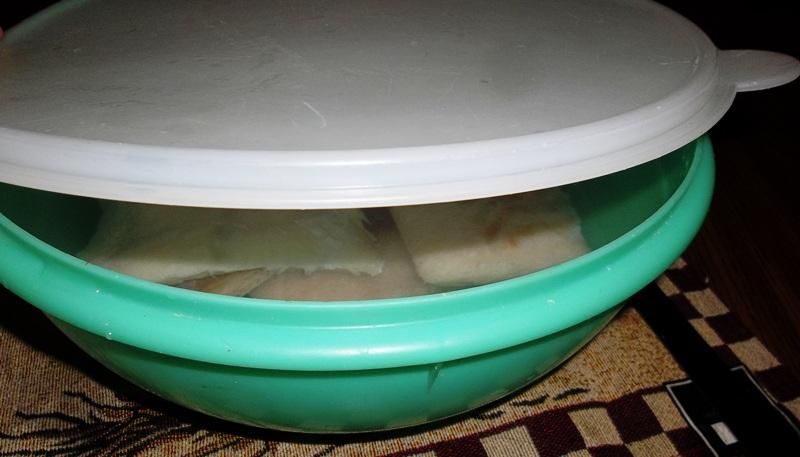
Once this was done, I covered the bowl:
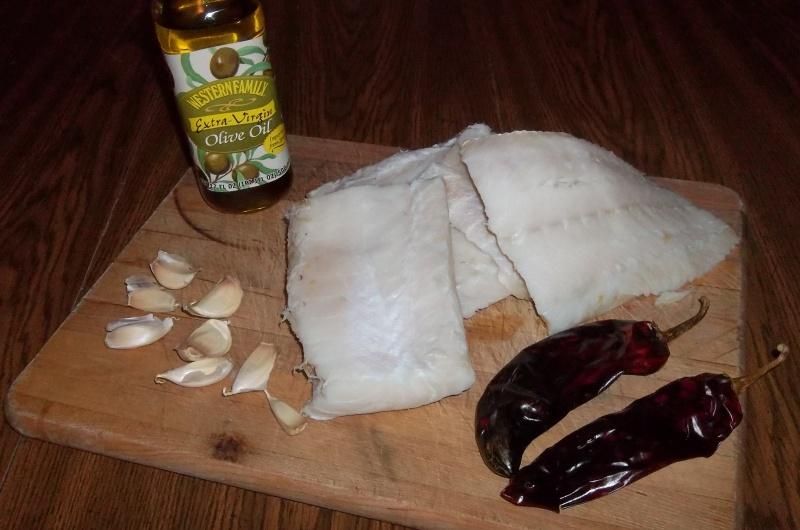
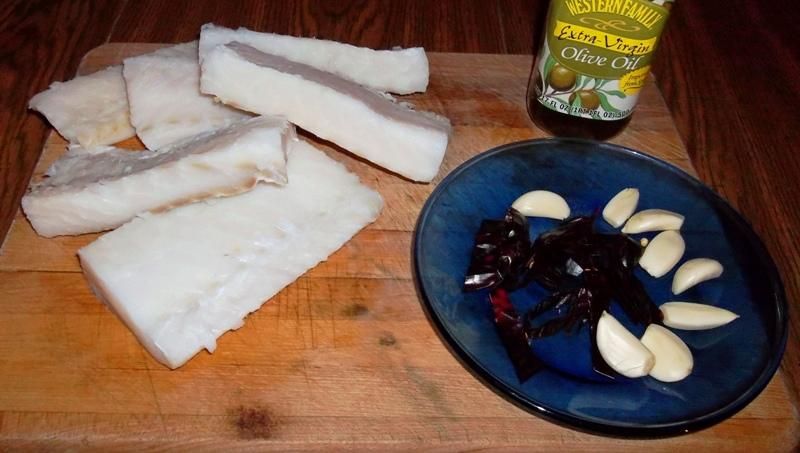
And placed it in the refrigerator. Over the course of the next 48 hours, I changed the water every 8 hours or so, until the water was no longer salty and I was ready to begin this dish. One of the main things I love about this dish is how it is so quintessentially Basque in nature: it is simple, with few ingredients that are utilised to their maximum potential. Here's all you need:
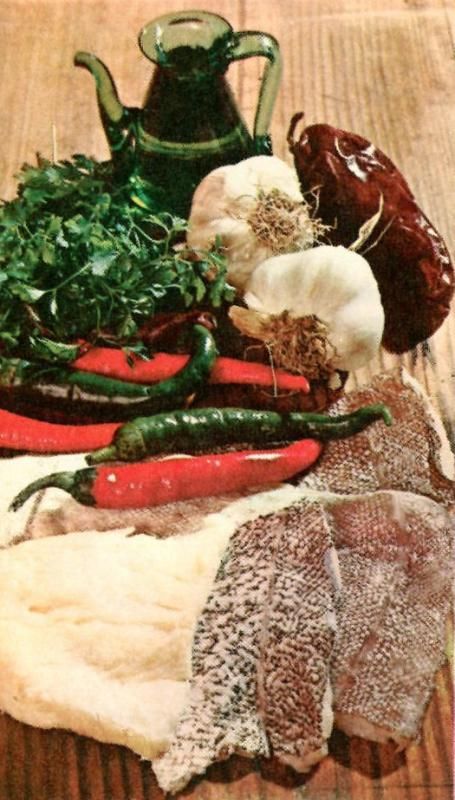
Olive oil, garlic cloves, the de-salinated cod fillets and a couple of dried, red chiles. A note about the olive oil: For this project, and nearly all of my Iberian projects, I like to use this simple, store-brand olive oil, which is imported from Spain:
 It is definitely nothing fancy, and it is not even close to premium quality; however, I have found it to be flavourful with a good aroma, so I like to use it.
A note about the chiles: Watching the video, I noticed that a long, triangular, dried red pepper is used, cut into strips, sautéed in olive oil to infuse some flavour, and then employed as a garnish for the finished dish. The chiles used in the video are evidently traditional dried guindillas or espelette peppers, which are of course unavailable here and, even if available, would probably be too hot for the Beautiful Mrs. Tas - because of this, I set about looking for an acceptable substitute that would be more suited for our available resources and her preferences, without changing the dish too much. Based on what I was able to learn, and considering the availability of what I could find, I ultimately selected dried New Mexico chiles; they are dark red (the right colour), they are relatively mild, they are the right shape and - most importantly - they are available! They turned out to be a very good, flavourful choice, and I recommend them to anyone looking for a good substitute.
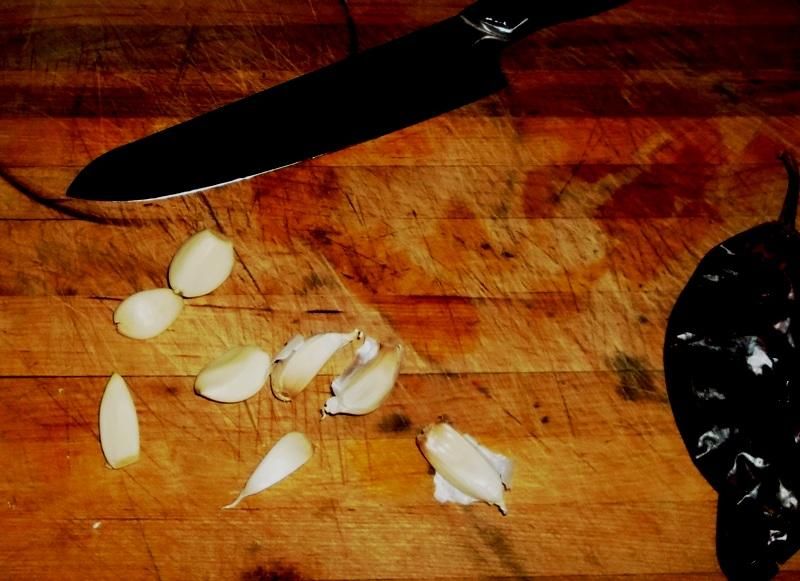
In any case, let's get started! First, I gently crushed and peeled the garlic cloves:
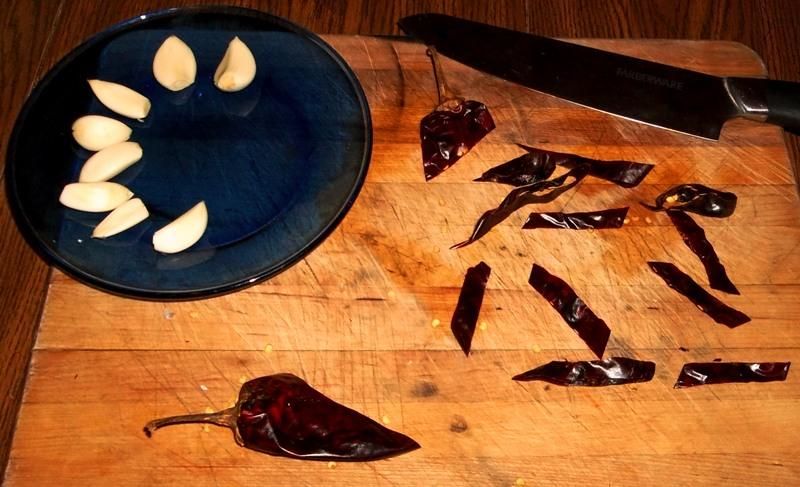
Sometimes, the garlic cloves are sliced longitudinally into "chips," but I elected to keep them whole this time, for simplicity's sake. Next, I sliced the chiles into strips:
Then, I trimmed the cod fillets into uniform portions:
There were a few trimmings, bits and pieces that I reserved, intending to use them for other projects or perhaps a as a base for some fish stock. Here we are with the few but oh so essential ingredients, ready to begin cooking:
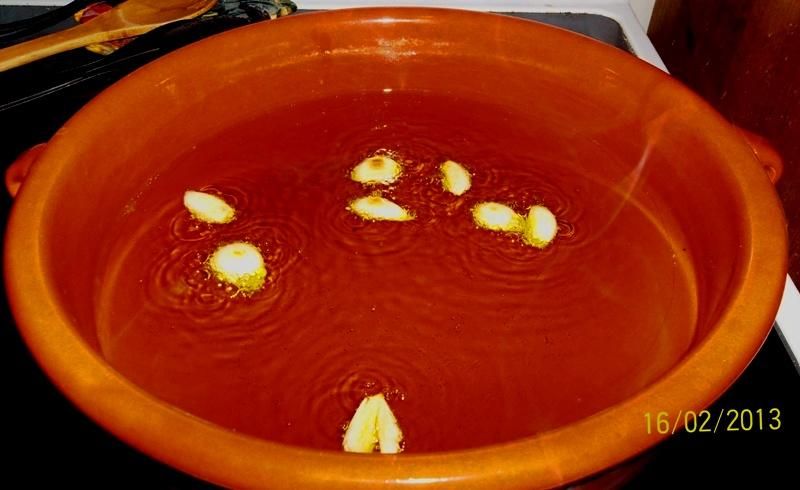
The only other ingredient that one might choose to employ would be parsley, as a garnish and for colour; however, in my town, there is no finding fresh parsley on a weekend, so I went without. Aside from those few ingredients, there are of course some cookware and utensils that come in handy when making this dish; first and foremost is a glased, terra cotta cazuela:
This dish can surely be prepared most adequately with a stainless steel or other appropriate sauté pan; however, I figured that if I was going to do this, I might as well jump in and do it right, so I purchased a 12.8-inch (32.5-cm) cazuela from La Tienda: It was definitely a good purchase, and I am looking forward to using it for many Iberian and other projects.
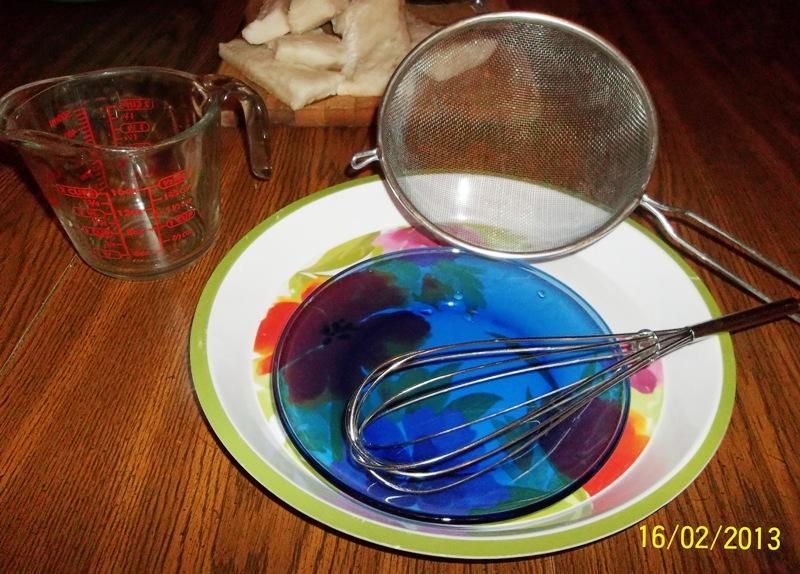
In addition, there are a few other things that might prove helpful:
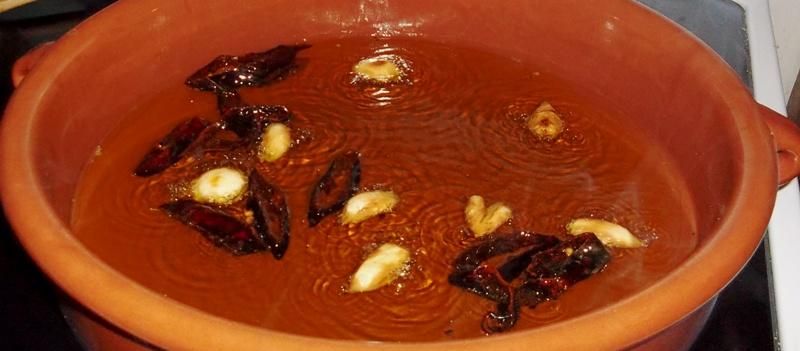
A plate to hold the garlic and dried chile strips once they are sautéed, a deep, wide platter to hold the cooked cod fillets and collect their juices, a small sieve, to begin the process of emulsifying the pil-pil sauce, and a wire whisk to use once the sauce enters a state where it is fairly stable. To begin, I heated the olive oil to a medium and dropped in the garlic cloves, in order to infuse the garlic flavour into the oil and take on a slight toasted colour:
When the garlic cloves just started to take on colour, I dropped in the strips of dried chiles for just a few moments, to also flavour the oil:
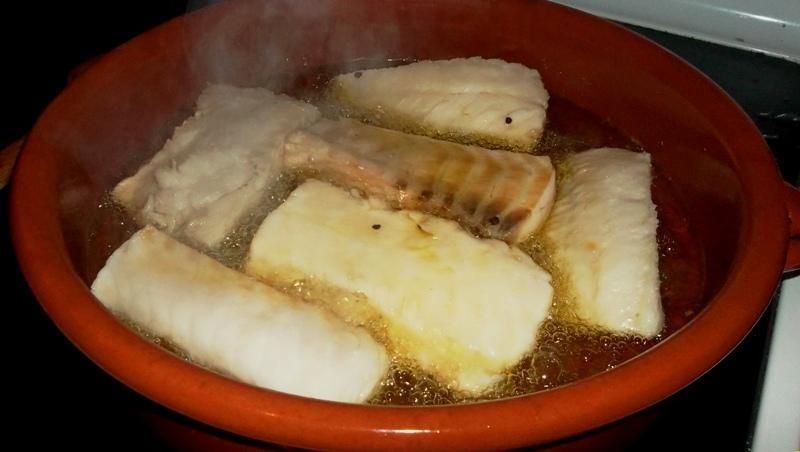
At this point, I also reduced the heat to low - or, at least I thought I did. After removing the garlic cloves and strips of dried chiles, I waited a few minutes for the temperature of the oil to drop, then added the cod fillets:
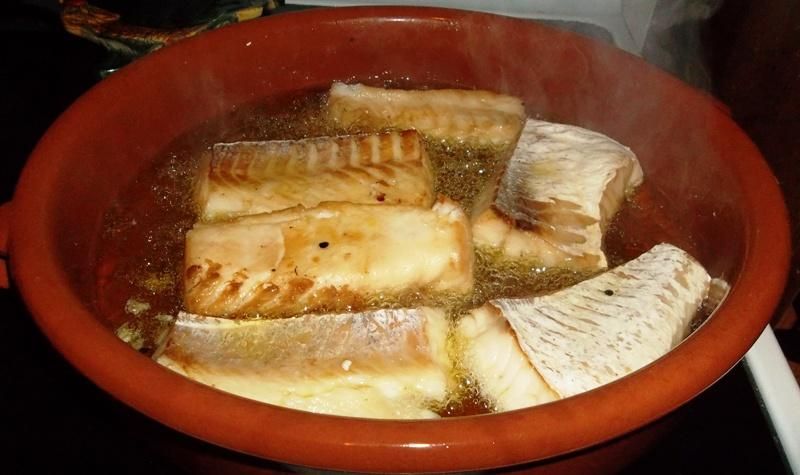
In Karlos's video, he does not seem very concerned about crowding the pan, so I put all of the fillets in, relying on the cazuela's outstanding heat retention properties to keep the oil from cooling too much. After 4 minutes, I turned the fillets:
It was here that I noticed that the heat still seemed a little high, but since the knob on the stove indicated the lowest setting, I didn't think too much of it and assumed that the oil would continue cooling. What I didn't know at the time is that somehow the heat setting had not been reduced at all, and I was still cooking at full-on medium, which is much too hot for this dish at this stage. When the cod fillets had cooked another 3 or 4 minutes on the second side, I removed them to the platter so that they could rest:
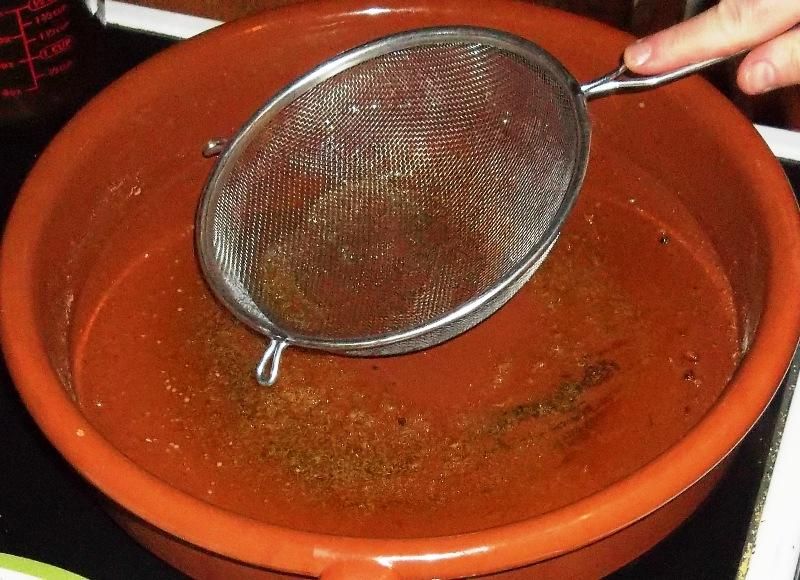
It is during this time that they should release their serum or juices, which will later be emulsified into the oil to form the pil-pil sauce; however, due to the high heat, most of the juices had been forced out into the cazuela and were cooked to the point where they were unable to be emulsified. It was at this point that I noticed my error, and immediately turned the knob of the stove to off so that the cazuela could cool down and hopefully salvage the project, but unfortunately the damage had been done. Being the persistent person that I am, I tried to form the sauce anyway, turning the stove back on to the lowest setting (which worked fine this time) and whisking back and forth with the sieve:
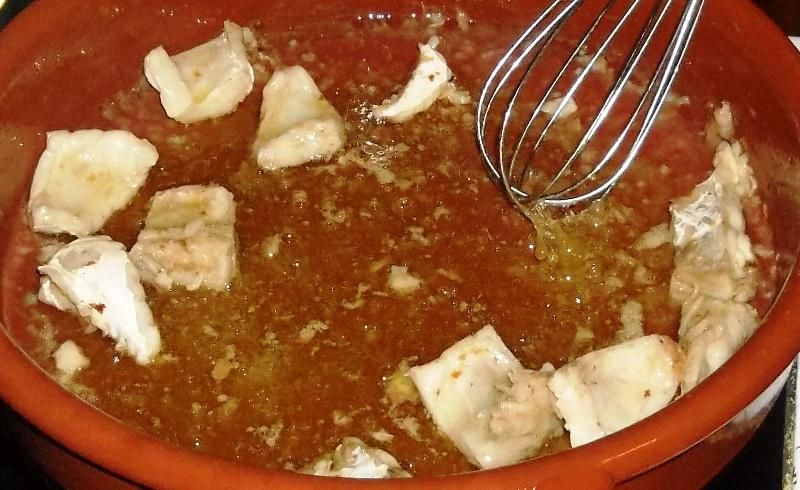
This had very little to no effect, as you can see, because the essential juices were cooked. I added the juices that had drained off the fish into the platter, but it wasn't enough to kick-start the process. In my desperation, I added the few pieces of salt cod that resulted when I trimmed the fillets, hoping that they would release enough serum to form the sauce:
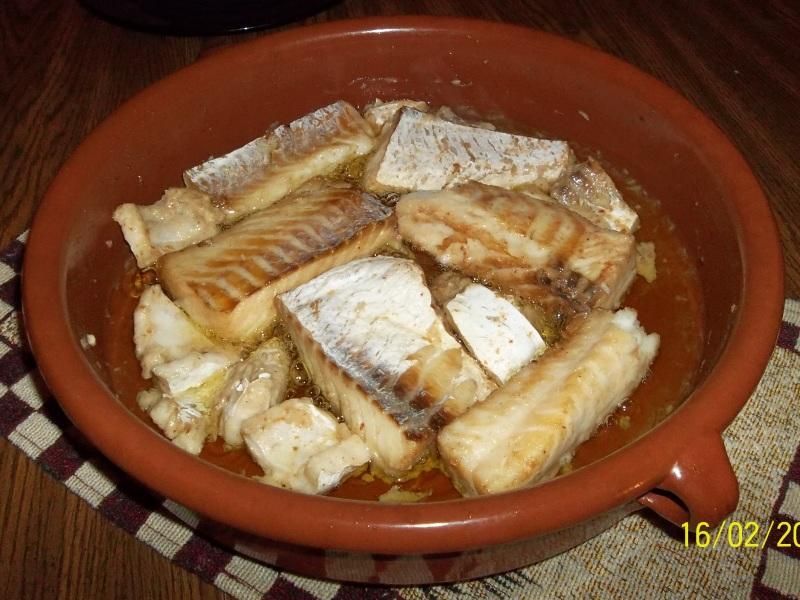
As you can see, it kept looking as though the process would start, but it never was able to sustain itself and form the sauce in the way that modern preparations do. Be that as it may, I did have an excellent meal here, cooked very much in the way that the original bacalao al pil-pil had been prepared, so I returned the cod fillets to the cazuela in order to heat up a bit:
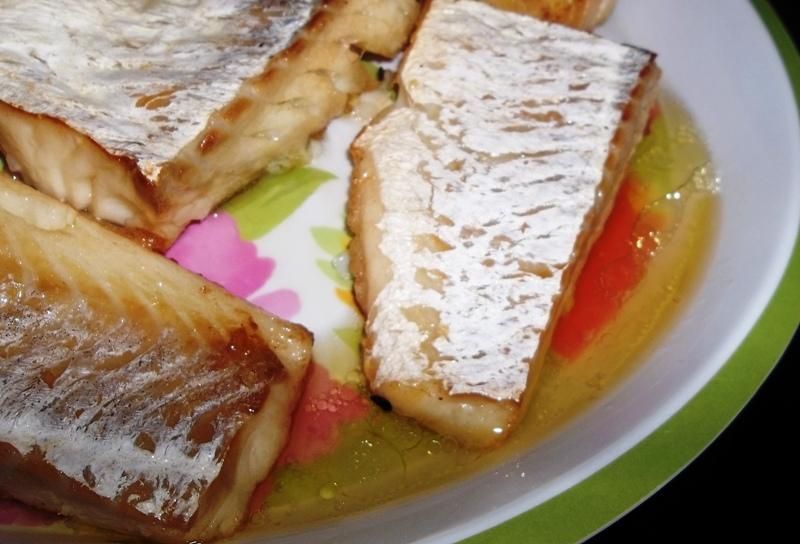
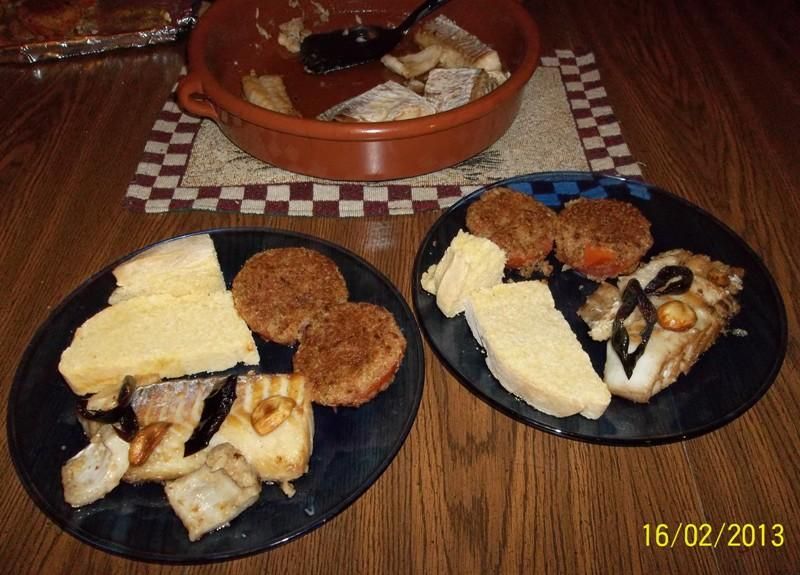
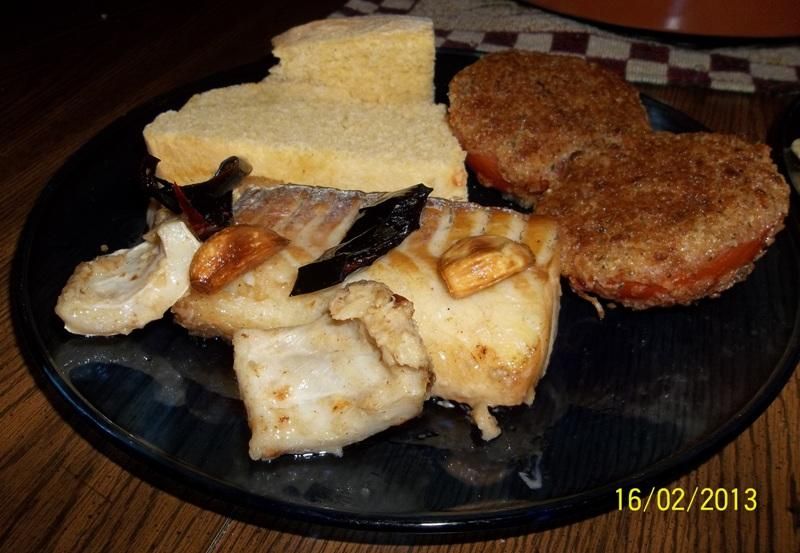
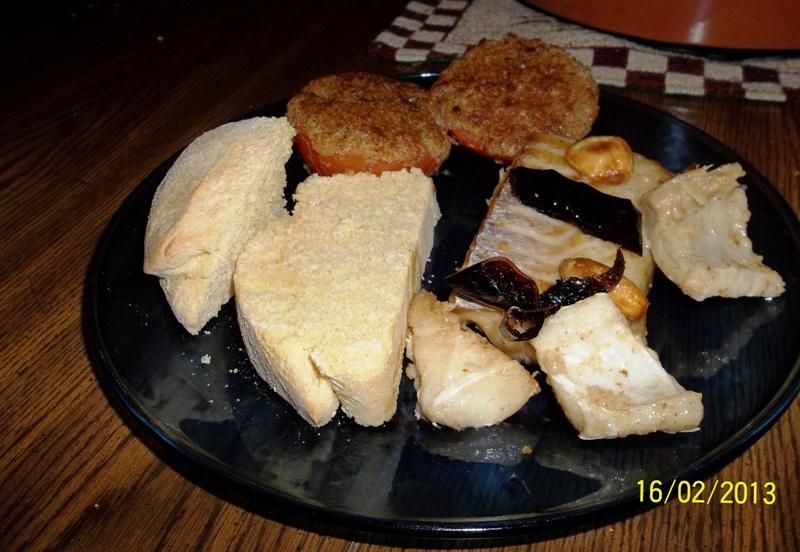
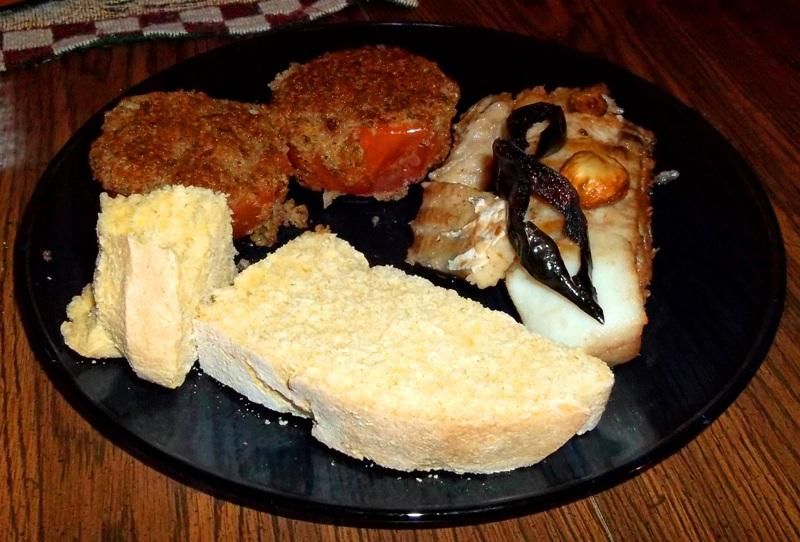
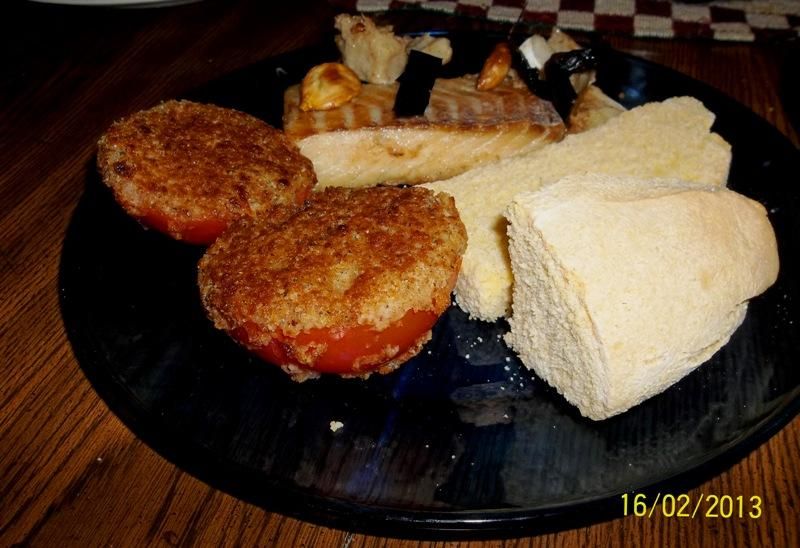
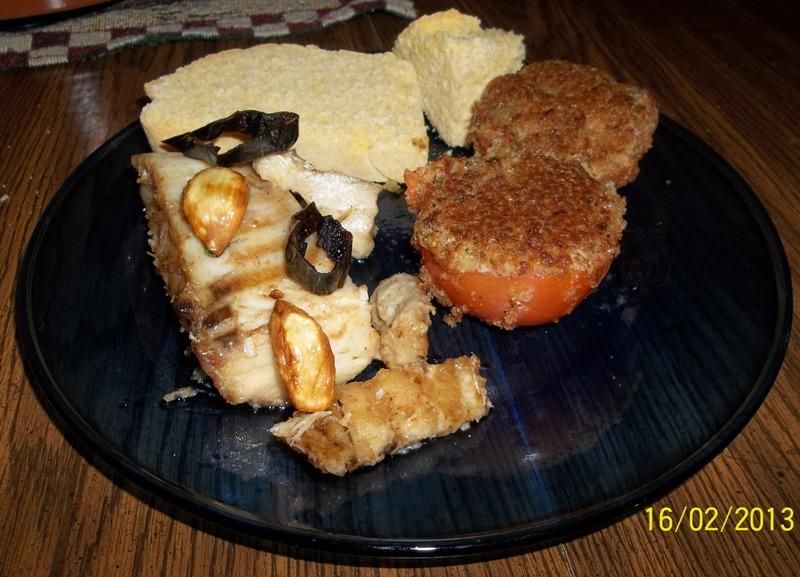
And then served my meal:
Aside from the lack of emulsified pil-pil sauce, the dish was quite a success, and tasted excellent.
I had never had salt cod in any form before this, and was impressed with the way it picked up the flavours of the other ingredients: the olive oil, the toasted garlic and the fruity, slightly-spicy chiles.
There was just a hint of salt flavour, to provide a nice, savory base, and the fish was firm and flaky in texture - probably just slightly over-cooked, but nonetheless delicious. When choosing a bread to bake for this meal, I wanted something that would be Iberian in nature; something that would be plausible in Basque country and go well with a fish meal. Finally, I wanted to pay tribute to my friend Dave, and the Portuguese market where his gift came from. It wasn't long before I found the perfect choice, Portuguese cornbread:
Corn is an important crop in Basque country, and fresh-baked breads are a fixture at nearly any meal. The cornbread was absolutely a great choice for this dish, and was enjoyed by all. Here's a link to a step-by-step pictorial on Portuguese cornbread, if you are interested: For a side dish, I chose to try an idea that I got from Chris: broiled tomatoes topped with a butter-and-herb bread crumb mixture and a hint of Parmesan cheese:
These were delightfully simple to make and bursting with wonderful flavours; the only real problem is that I used store-bought bread crumbs that seemed, to me, to be excessively fine and dry. In the future, I will make my own bread crumbs, which will hopefully provide a better texture. Having said that, the flavours of this simple tomato side dish were wonderful, and perfectly at home on a Basque plate, I think. You can read more about my preparation of these tomatoes here, if you'd like: Over-all, this was an outstanding meal, in spite of a couple of minor execution errors, and provided a wonderful introduction to the Basque traditions of cooking seafood. I will - most definitely - be preparing this again, as soon as I can get my hands on some more salt cod.
Thanks for taking the time to read this - I hope you enjoyed the experience as much as I did. If anyone wants to try this, please feel free to ask any questions, and I will get some answers for you. As you can see from reading this report, one primary rule must be to keep your heat low; trust your cookware to do the cooking for you, and pay careful attention to procedure and detail. If you do this, there is no reason why you can't enjoy success on your first attempt; however, even if it doesn't work out as you plan, chances are that you will still end up with a wonderful and delicious Basque meal. Ron |
||||||
|
If you are a visitor and like what you see, please click here and join the discussions in our community!
|
||||||
 |
||||||
| Sponsored Links | ||||||
|
||||||
|
Margi Cintrano
Master Chef

Joined: 03 February 2012 Location: Spain Status: Offline Points: 6362 |
Post Options
Thanks(0)
Quote Reply
Posted: 15 March 2013 at 13:09 |
|||||
|
Tas, Firstly, I wish to thank you for an absolutely incredible legacy on the Basque culinary history and their penchant for gastronomy. The details, the information content, the photos, the challenge of research in English in itself and the truly enjoyable sheer reading pleasure ...
Then, though the emulsifiation process of the Omega 3 in the salt cod, and the Evoo, did not emulsify into the Pil Pil Sauce; the dish looks splendid and I am sure it tantalized the tastebuds none the less.
The baked tomatoes and the bread also added the color needed to a monochromatic off white and beigey ivory yellowish dish ...
The cobalt glass dishes, are lovely and I can see, how much this dish was enjoyed, even if not perfect ... This is a relatively new cuisine for you, and The Basque inheritance of culinary knowledge is challenging ... And a specialty here in Iberia.
Chef José Andrés has a video in English; MADE IN SPAIN SERIES; which I believe shall produce the objective; the Pil Pil forms without direct fire / flame. José takes 2 towels ( or oven mits ) and removes the cazuela from the flame; and in clockwise motion, he rotates in a circular motion, the cazuela, once the Cod is sautéed lightly; and continues in a circular movement, at a steady pace for 20 minutes and never going rapidly nor the use of a whisk employed; just the moving of the cazuela in steady clockwise movements --- this enables the omega 3 of the salt cod to emulsify and gel into a thick pil pil ...
www.josemadeinspain.com/episodes ( in English )
www.petitchef.es ( José Andrés´ Bacalao al pil pil )
So, with this in mind; I would handle the preparation of this recipe a bit different ...
The feature on an editorial level and the research is truly phenomenal and I truly have enjoyed your editorial, the outstanding stamp, of your writing and the efforts taken to attempt such a masterful dish to begin with.
Kindest regards.
Margaux Cintrano.
gourmet choices.
|
||||||
|
Volamos a Mediterraneo, un paraiso que conquista su gente u su cocina.
|
||||||
|
||||||
|
HistoricFoodie
Admin Group
Joined: 21 February 2012 Location: Kentucky Status: Offline Points: 4945 |
Post Options
Thanks(0)
Quote Reply
Posted: 15 March 2013 at 13:15 |
|||||
|
About time you got around to posting this, Ron. We've been waiting with semi-bated breath.

Seriously; a realy great job. I'd say this is the best pictorial/tutorial you've posted so far. Makes me axious to try making a pil pil my own self.
|
||||||
|
||||||
|
gonefishin
Master Chef

Joined: 20 September 2012 Status: Offline Points: 1778 |
Post Options
Thanks(0)
Quote Reply
Posted: 15 March 2013 at 13:34 |
|||||
|
Hi Tas!
This is an incredible article, from start to finish...nicely done (as usual). Thanks for taking the time to frame everything so beautifully. Your dish does look wonderful, I'm sure it was a feast for the belly as much as it is for the eyes. I am not sure what she is saying, but this video illustrates what I noticed when making the pil pil and how to take it far enough. The substance that extruded from the salt cod was plentiful when I used the skin on salt cod. I noticed a fair amount in this woman's video, she also points to it several times. It is around the 3:00 mark...you can see it floating, as well as accumulating under the oil on the bottom. Margi, have you used the tip and roll method you described? I was making this motion the entire time I was making mine, and though I could see it mixing...it didn't become an emulsification until I used the strainer to aerate (as in the video), then you reincorporate the oil that you set aside slowly...I don't think I can stress that enough. But I do get the feeling that the motion may have been directly connected to the gel (?) formation (or extraction?) Which bring me to another interesting point to note when I was making the dish, I didn't set aside nearly enough time. I was making it at work, and I was way way off course for time. But, when you've cooked fish before, and you see the white stuff oozing to the surface at times...that is what you want to capture in the olive oil. Great great write up...the way you research your information, and the style in which you write...with your cooking methods and photography skills...amazing. I always look forward to the next tutorial you do! Thanks for sharing! Dan |
||||||
|
Enjoy The Food!
|
||||||
|
||||||
|
TasunkaWitko
Admin Group
Joined: 25 January 2010 Location: Chinook, MT Status: Offline Points: 9389 |
Post Options
Thanks(0)
Quote Reply
Posted: 15 March 2013 at 14:19 |
|||||
|
To all - many, many thanks for the kind words -
this project is one I've been hooked on trying for a long time. It was originally inspired when I went to a garage sale a few years ago and found 4 books that were part of a series by Time/Life called "Foods of the World;" one of them was the volume on Spain and Portugal, so I picked it up. They have 24 or 26 Volumes in all, covering the world pretty well. I eventually got all of the books through ebay and cheapbooks.com and other sources.
The Spain book was the first one I read, and when I came across those photos of those guys sitting around the table eating, and THEN that photo of the finished dish (in the restaurant with the wine and cheese and the map in the background) I was hooked and wanted to try this. I forgot about it for a couple of years, because I can't get salt cod around here, but the topic came up again in some discussions here, and Dave offered to send me some ~ I'm glad he did!
Anyway, I gotta say, I love doing these pictorial projects. For me, it's not enough to simply make a recipe, especially when it is something so fundamentally traditional to a region, country or culture. I want to LEARN about it, and I want to pick up some background - so I find out as much as I can, and try to keep it all in mind when I am preparing and eating the dish. It definitely adds to the experience, and makes it more than simply cooking out of a cookbook. I love doing these pictorial projects. For me, it's not enough to simply make a recipe, especially when it is something so fundamentally traditional to a region, country or culture. I want to LEARN about it, and I want to pick up some background - so I find out as much as I can, and try to keep it all in mind when I am preparing and eating the dish. It definitely adds to the experience, and makes it more than simply cooking out of a cookbook.
|
||||||
|
If you are a visitor and like what you see, please click here and join the discussions in our community!
|
||||||
|
||||||
|
Rod Franklin
Chef 

Joined: 17 February 2010 Location: USA Status: Offline Points: 921 |
Post Options
Thanks(0)
Quote Reply
Posted: 15 March 2013 at 14:34 |
|||||

|
||||||
|
Hungry
|
||||||
|
||||||
|
Margi Cintrano
Master Chef
Joined: 03 February 2012 Location: Spain Status: Offline Points: 6362 |
Post Options
Thanks(0)
Quote Reply
Posted: 15 March 2013 at 14:38 |
|||||
|
Dan and Tas,
Alot has to do with:
1) the salt cod must be fully thawed; and soaked 48 hours for 3 days and dry --- patted and the time permitted to let dry
2) the Evoo, of course, the best you can afford from Spain
3) QUINTESSENTIAL: the circular motion: NOTHING rushed with this recipe AND 20 minutes of
total dedication to this clockwise movement and the timing is quintessential --- the fish should be not over cooked --- and similar to a steak; it must be just cooked on the exterior ... ( see Made In Spain - José Andres´ Recipe and Video in the Basque Country in English ) ...
I believe, from the photos, This might of been the problem --- Ron´s fish looks delectable however, it is too well done for Pil Pil ... should not be cooked through ... the simmering in your clockwise motion for 20 mins. cooks the fish !!!
The salt cod was cooked too well done --- and thus, not enough Omega Emulsification gel ...
If you are able to watch Chef José Andrés, it is very clear how he rotates clockwise only, never answering a cell phone or doing anything but THIS DISH ... and he does this without halting for a second; for 20 minutes; NO STOVE ... the Omega 3 in cod, is as great as Salmon; thus, this emulsifying Omega is the key --- it combines with the Evoo and very very slowly it creates an emulsified substance and thus, it takes a little while, and shall fill the bottom of the clay earthenware cazuela ... Then, you shall see, it is ready --- serve immediately.
Look at my 1st message above to Tas; where I provide the links for José ´s Made in Spain recipe and another link ...
I had made this dish a couple of times during Christmas ( 2011 and 2010), and though I like it; we personally prefer fresh cod; and prefer BACALAO EN TOMATE RIOJANO WHICH EMPLOYS FRESH COD ...
It is more Mediterranean - on the Italian side ... And Pil Pil is more of an Atlantic Dish ...
I had not made it during the holiday season 2012 - 2013 ...
It is a dish, I prefer to have at a Basque Restaurant ... as you must be very very focused on the preparation ... And requires an extensive amount of studying the video, prior to preparation ...
There are NO mishaps --- it is not something one can make amends ! Ron had done a wonderful feature and I am sure, his cod was wonderful; however, there was something that went amiss, creating the emulsifier ...
I hope this assists ... It is not an easy dish to prepare --- whatsoever. I had learnt to make it, from a chef friend --- who grew up in the Basque Country however, is restaurateur now, in Málaga .... He used to have restaurant in Madrid.
Margi.
|
||||||
|
Volamos a Mediterraneo, un paraiso que conquista su gente u su cocina.
|
||||||
|
||||||
|
TasunkaWitko
Admin Group
Joined: 25 January 2010 Location: Chinook, MT Status: Offline Points: 9389 |
Post Options
Thanks(0)
Quote Reply
Posted: 15 March 2013 at 14:47 |
|||||
|
Margi -
Thanks for the kind words and the additional information. I finally got to see José Andrés on a cooking show the other night, and was very impressed with him and his commitment to beautiful, quality Spanish cuisine - he is truly a master, so I shall consult his video.
Ron
|
||||||
|
If you are a visitor and like what you see, please click here and join the discussions in our community!
|
||||||
|
||||||
|
Margi Cintrano
Master Chef
Joined: 03 February 2012 Location: Spain Status: Offline Points: 6362 |
Post Options
Thanks(0)
Quote Reply
Posted: 15 March 2013 at 14:59 |
|||||
|
Ron,
Though your fish looks wonderful; it is too golden for Pil Pil ... Notice the whiteness of the fish in the historical photo, and in José Andrés Video, Made In Spain in English ... The fish cannot produce the emulsifyer if it is golden; must be only slightly pale goldish white on the 2 exterior sides, and rare rare in middle so that when u hold the cazuela with oven mits or 2 towels; and clockwise rotate the dish for 20 minutes at least; the emulsifyer or OMEGA 3 and the EVOO shall emulsify into the pil pil sauce ---
I hope that you can watch José ´s video in English ... and then, you shall understand ...
Margi.
|
||||||
|
Volamos a Mediterraneo, un paraiso que conquista su gente u su cocina.
|
||||||
|
||||||
|
gonefishin
Master Chef
Joined: 20 September 2012 Status: Offline Points: 1778 |
Post Options
Thanks(0)
Quote Reply
Posted: 15 March 2013 at 15:05 |
|||||
|
Tas, I also love that Hoser got the whole process really going by sending the salt cod...way to go Hoser!
|
||||||
|
Enjoy The Food!
|
||||||
|
||||||
|
Margi Cintrano
Master Chef
Joined: 03 February 2012 Location: Spain Status: Offline Points: 6362 |
Post Options
Thanks(0)
Quote Reply
Posted: 15 March 2013 at 15:49 |
|||||
|
Tas, After watching several videos ( you tube ), I have noticed, that the temperature of the Evoo plays a quintessential role; and your´s might of been too high.
Another interesting point, is that in several of the videos and on blogs of Basque Chefs, and other Iberian Chefs; they strain the cod flakes from the Evoo prior to creating the pil pil ...
There are so many factors ...
However, you and Melissa truly enjoyed the dish as prepared; and in order to prepare it in the future; I would definitely follow José Andrés´ method --- it is how I had done it the couple of times I prepared it, once in 2010 and once in 2011 ...
I still believe, your cod was a bit too well done for Pil Pil ... as stated above ... as one can see the definite difference in the color; your´s is gorgeous golden and in Pil Pil it remains quite snowy white ... Thus, the Omega emulsifyer is reduced ...
Kindest regards.
Margi.
|
||||||
|
Volamos a Mediterraneo, un paraiso que conquista su gente u su cocina.
|
||||||
|
||||||
|
Rod Franklin
Chef
Joined: 17 February 2010 Location: USA Status: Offline Points: 921 |
Post Options
Thanks(0)
Quote Reply
Posted: 15 March 2013 at 16:23 |
|||||
|
I've never made this, nor have I seen it before seeing it here at FOTW. After watching the video and another one I found on the tubes I think I'm getting the idea.
If I had to guess, and I will even though no one is asking me, because this is the internet  , it looks like the fish needs to be warmed over very low heat for a while. The motions appear to be made to wash the exuded stuff, which I am guessing is collagen, from the fish and into the oil. I say it's barely cooked based on the video where it shows that translucency and softness in the fish instead of a more firm and opaque texture, which would indicate a higher heat being used. The video also seems to show that the clear oil is separated into another container. Then the remaining oil and stuff from the fish is whipped with the small strainer as some of the reserved clear oil is added back to the emulsion. , it looks like the fish needs to be warmed over very low heat for a while. The motions appear to be made to wash the exuded stuff, which I am guessing is collagen, from the fish and into the oil. I say it's barely cooked based on the video where it shows that translucency and softness in the fish instead of a more firm and opaque texture, which would indicate a higher heat being used. The video also seems to show that the clear oil is separated into another container. Then the remaining oil and stuff from the fish is whipped with the small strainer as some of the reserved clear oil is added back to the emulsion. To guess what happened to Tas, he operated at too high a temperature and cooked and coagulated the collagen rendering it unable to form an emulsion with the oil. In the past I've worked with hide glue of various types and the absolute maximum temperature that could be used to melt the glue was 140F, after that the collagen cooked and was ruined. I've known folks who've made hide glue from fish skins and even better, fish swim bladders. So, to fix this problem, work at temps below 140F and allow the collagen to render out slowly while washing it away into the surrounding oil with gentle agitation. Remove the fish, let the oil settle and separate somewhat. Draw off as much cleared oil as you can and whip the rest with the strainer, adding some of the removed clear oil back, a little at a time till the sauce is as you want it. That's what I see. |
||||||
|
Hungry
|
||||||
|
||||||
|
MarkR
Chef

Joined: 03 February 2011 Location: St. Pete FL Status: Offline Points: 625 |
Post Options
Thanks(0)
Quote Reply
Posted: 15 March 2013 at 16:25 |
|||||
If I can only rotate it in a counter-clockwise motion... will it still work?  On edit, the key is to remove the cazuela and let the residual heat finish the cooking. Otherwise you will overcook the cod and stop the emulsifying process! My observation only! |
||||||
|
Mark R
|
||||||
|
||||||
|
Margi Cintrano
Master Chef
Joined: 03 February 2012 Location: Spain Status: Offline Points: 6362 |
Post Options
Thanks(0)
Quote Reply
Posted: 15 March 2013 at 16:33 |
|||||
|
Mark,
If you choose counter clockwise rotation; then, have fun with your arms for 20 minutes ...  Margi. |
||||||
|
Volamos a Mediterraneo, un paraiso que conquista su gente u su cocina.
|
||||||
|
||||||
|
TasunkaWitko
Admin Group
Joined: 25 January 2010 Location: Chinook, MT Status: Offline Points: 9389 |
Post Options
Thanks(0)
Quote Reply
Posted: 15 March 2013 at 16:41 |
|||||
|
I had a nice, comprehensive reply typed out, but lost it, so here is the condensed version:
Dan - that's what I love about this forum and its members; everyone is willing to help each other out and that makes for a great crew here ~  Margi - If you read my opening post, you'll see that I diagnosed the problem right away (way too much heat from the stove cooked out the majority of the juices). Unfortunately, I didn't know this at the time because of the faulty stove dial and by the time I realised it, it was too late. The problem has since been corrected and will not happen again - I'll see about trying Jose's method. Rod - yep, the lower temps are indeed essential; I think if you were to give this a hot, you'd have it down. As it was, if my stove would have worked the way it is supposed to, I think this would have been a home run out of the park, but a triple play isn't too bad for a first attempt at a major-league dish such as this ~  Something to keep in mind is that the original dish as it was developed in the 1830s was not the same as the dish that is cooked today; in fact, the main difference was that there was no emulsified sauce, just salt cod cooked in garlic and chile-infused olive oil. So from an historical point of view, I still made the "proto" or "paleo" version of bacalao al pil-pil; however, I'm looking forward to taking it to the next level by mastering the modern, emulsified pil-pil sauce. |
||||||
|
If you are a visitor and like what you see, please click here and join the discussions in our community!
|
||||||
|
||||||
|
Margi Cintrano
Master Chef
Joined: 03 February 2012 Location: Spain Status: Offline Points: 6362 |
Post Options
Thanks(0)
Quote Reply
Posted: 15 March 2013 at 16:57 |
|||||
|
Tas, After watching Chef José Andrés in the Basque Country, I realised that Chef Karlos Arguiñano, though marvelous and extremely entertaining is a T.V. Chef preparing regional Iberian dishes, for a wide range of viewers who watch his fanstastic programme and prepare lunch. He is a wonderful professor, coach and showman ... However, José is an artist and a gourmet Chef with 12 successful restaurants under his belt ... And he has the key to this dish from the Michelin Gents, Subijana, Irizar and Arzak ... He holds the cazuela and rotates it clockwise for 20 minutes to create the Pil Pil ... He truly is a genius, artist and accomplished Chef in regional Iberian cuisines. He has studied under all the Basque Gastronomes and Adriá ...
I highly recommend that you watch his video ... and do a practice test with the salmon, which contains the same amount of Omega 3 as Cod does ...
Sorry, the thread has grown so much, it is a bit difficult to remember all the details --- I recall you stating the high temperature --- error.
Margi.
|
||||||
|
Volamos a Mediterraneo, un paraiso que conquista su gente u su cocina.
|
||||||
|
||||||
|
Hoser
Admin Group

Joined: 06 February 2010 Location: Cumberland, RI Status: Offline Points: 3454 |
Post Options
Thanks(0)
Quote Reply
Posted: 16 March 2013 at 00:23 |
|||||
|
Another awesome post Ron....sure do appreciate the fact that you documented it all for us too.
I can't say much more that hasn't already been said above, so I'll just sit here and look at all the purdy pictures.
|
||||||
|
Go ahead...play with your food!
|
||||||
|
||||||
|
africanmeat
Chef

Joined: 20 January 2012 Location: south africa Status: Offline Points: 910 |
Post Options
Thanks(1)
Quote Reply
Posted: 16 March 2013 at 04:47 |
|||||
|
This is a great post Ron
 |
||||||
|
Ahron
|
||||||
|
||||||
|
TasunkaWitko
Admin Group
Joined: 25 January 2010 Location: Chinook, MT Status: Offline Points: 9389 |
Post Options
Thanks(0)
Quote Reply
Posted: 03 January 2015 at 21:07 |
|||||
|
The Beautiful Mrs. Tas and I put this on our menu for the week, using some salt cod that I picked up in Great Falls just after Christmas (12.00$ for one pound, packaged in a wooden box). Beginning Thursday evening, I soaked the bacalao in cold water (in the refrigerator), changing the water periodically; tonight, I prepared bacalao al pil pil for the second time.
My execution this time was a little better than before; but it wasn't yet quite perfect. I'll begin my tale in the middle of the process, after the preliminary work: Learning my lesson from last time, I kept the heat under my cazuela on LOW for the entire time of the cooking, and dropped it to the absolute lowest setting when I attempted the pil pil sauce. This allowed the cod to be cooked much better than last time, and kept the "juices" from cooking before they could be worked into the sauce. Also, I occasionally "swished" the cazuela around in a gentle circular motion throughout the cooking of the cod, with the idea of helping the emulsion. Once the cod was cooked, I set it aside and used a rubberised whisk to finish the process. Whatever I did, it worked to some extent; I was able to emulsify the juices I had into the oil; unfortunately, it still didn't quite work. The big problem, I think, was that the the cod had no skin and therefore was lacking enough "stuff" to produce the juices necessary to thicken the emulsion. What I ended up with was a thin sauce that was well emulsified, but still not what I wanted. In an act of desperation, I added a generous tablespoon of pimentón de la Vera to the "sauce" - this had the effect of turning the emulsion a beautiful brick-red...it also thickened it to a nice consistency. Not quite traditional, but a colourful alternative with a nice kick!  After adding the bacalao back to the sauce in order to re-heat, I tossed in the "chips" of sliced garlic and New Mexico chile (the best alternative at hand) that I had earlier (simmered? sautéed? steeped?) in the olive oil as it was heating before cooking the cod. Once the entire concoction was heated throughout, I served it with oven-fried potatoes and peas. Results were not what I had intended, but the meal was still pretty good! The cod probably could have soaked anothe half-day or so, because it was just a bit too salty, but it was well-cooked and flaked beautifully. The "sauce," while not "correct," was still pretty good, with an earthy, smoky warmth provided by the pimentón. The potatoes made a great companion, crispy golden-brown outside and fluffy inside; the peas brought some fresh taste and bright colour to the party. All-in-all, another one of my famous "successful failures."
|
||||||
|
If you are a visitor and like what you see, please click here and join the discussions in our community!
|
||||||
|
||||||
|
Margi Cintrano
Master Chef
Joined: 03 February 2012 Location: Spain Status: Offline Points: 6362 |
Post Options
Thanks(0)
Quote Reply
Posted: 09 January 2015 at 18:26 |
|||||
|
|
||||||
|
Volamos a Mediterraneo, un paraiso que conquista su gente u su cocina.
|
||||||
|
||||||
|
Post Reply
|
Page 12> |
 Tweet
Tweet
|
| Forum Jump | Forum Permissions You cannot post new topics in this forum You cannot reply to topics in this forum You cannot delete your posts in this forum You cannot edit your posts in this forum You cannot create polls in this forum You cannot vote in polls in this forum |


 Topic Options
 The cooking of northeastern Spain is almost as concerned with sauces as that of the Levante is concerned with rice - though at first glance the visitor may not realise this, for the kitchens of [the Basque region] do not recognise the distinction others make between the two terms, sauce and gravy. For most cooks, gravy is the liquid juices of the food, while a sauce is more or less an additive, usually served separately. But here, the two are one and the same: juices and separate ingredients are nearly always cooked together with the food itself until they are indistinguishably mixed. And if the key term in the dining rooms of this culinary zone is sauce, which refers to the final product, the magic word in the kitchens is blend - the process by which the product is achieved....