|
Thank you, from the Foods of the World Forums! |
Bogrács Gulyás |
Post Reply 
|
| Author | |||
TasunkaWitko 
Admin Group 

Joined: 25 January 2010 Location: Chinook, MT Status: Offline Points: 9389 |
 Post Options Post Options
 Thanks(0) Thanks(0)
 Quote Reply Quote Reply
 Topic: Bogrács Gulyás Topic: Bogrács GulyásPosted: 28 February 2012 at 23:31 |
||
|
Bogrács Gulyás My friends, everything you have been told is a lie.
That hamburger-macaroni-tomato concoction that the lunch lady gave you wasn't "real" goulash - nor was the similar mess served at the church potluck supper; or the reddish, brownish, yellowish looking stuff plopped on your plate by your Aunt Doris on the days when you were dragged along by your parents for a Sunday visit. It was all a fabrication; a bastardised, Americanised myth propagated by culprits such as Betty Crocker, Margaret Fulton and a fellow named Campbell.... Or was it? Andy (Boilermaker) covered the history of gulyás (also known throughout the world as gulasch, goulash, guláš and a few other similar names) very well in his post: My post will take a look at the question, "What makes goulash...gulyás? Wikipedia gives us a baseline, citing the Hungarian origins of the dish:
From there, some history of the dish is discussed, followed by an enumeration of the regional varieties in central, eastern and southern Europe, including the countries mentioned above. Basically, this regional distribution corresponds with the borders of the Austro-Hungarian Empire, plus or minus a few kingdoms or principalities. All versions are basically similar, with a few differences based on local tastes, customs or availability of ingredients. And just what are the ingredients? Well, when it comes to meat, beef, veal, pork, lamb, mutton, venison and wild boar are mentioned; sometimes smoked, sometimes in the form of a sausage. Sometimes browned or seared, and sometimes not. The thing that most of the meats have in common are that they come from the tough, flavorful cuts of the animal. Onions are the next most-prominent ingredient, cooked in fat, most typically lard, in order to bring out all the good flavours. There's also a starch involved, which could be potatoes, dumplings, noodles, kasha, pasta or, in some cases rice. Various vegetables can also be added, including, sometimes, peppers and/or tomatoes, neither of which should ever take over the dish, if used. Carrots, celery, parsnips, mushrooms, beans and even sauerkraut, to name just a few, can also be found in various forms of gulyás. And the spices - there can be so many! Aside from the usual salt and pepper, the one spice that all forms of gulyás have in common is paprika, which is featured prominently and forms a major flavour profile of the dish; one can also find find garlic, caraway seed, herbs such as bay leaf, marjoram or thyme, as well as many others. Beyond that, wine, vinegar, beer or even lemon juice can be added to some versions, for a little extra piquant depth. One Hungarian variety even features sour cream. This ingredients list is hardly exhaustive, and to the casual reader, it would seem that the possibilities are endless and that gulyás/goulash could be made from just about anything; indeed, the Czech word, guláš, is a slang term for "mishmash." Moving across the pond from there, Wiki gives us some interesting information:
So, looking at it from that viewpoint, maybe that stuff you remember as a kid was indeed goulash! But getting back to Hungary, and traditional Hungarian gulyás, here is a fairly typical recipe for that was customarily cooked by cattle drovers in an iron kettle over an open fire, hence the name Bogrács Gulyás (kettle gulyás). From Time/Life's Foods of the World - The Cooking of Vienna's Empire, 1968:
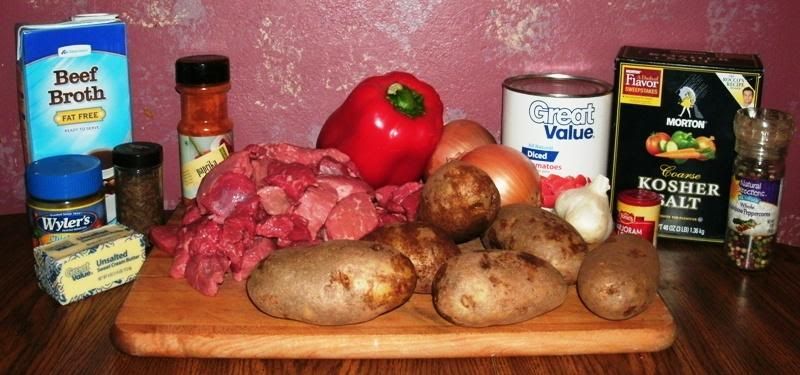
So let's get started! First, as always, is a shot of the goods as according to the recipe above:
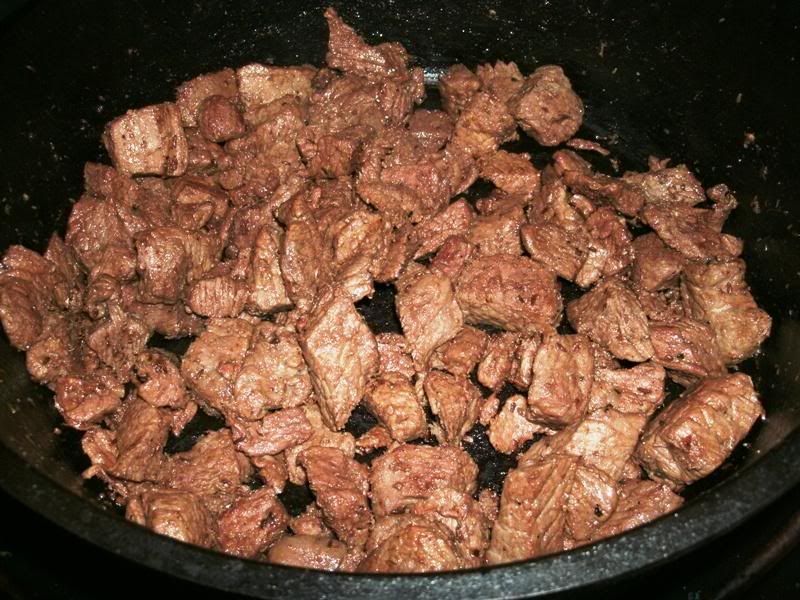
I had considered omiting the caraway seeds, due to the fact that the beautiful Mrs. Tas does not like them; however, the proscribed amount is very small, so I ultimately decided to use them in order to get into the traditional spirit of things. I did, however, hold fast to my "no green peppers" policy, substituting a good-sized red one. For the beef, I used just over 4 pounds of cheap, flavourful "stew meat," so the photo above represents what is essentially a double recipe. One of the age-old controversies when making gulyás is whether or not to sear the meat during preparation. If the meat is in fact seared, it is generally accepted that it should not be dredged in flour, since thickening gulyás with a roux or flour simply isn't done, at least in most cases. For this preparation, I decided to sear the beef in my cast iron Dutch oven, and set about doing so:
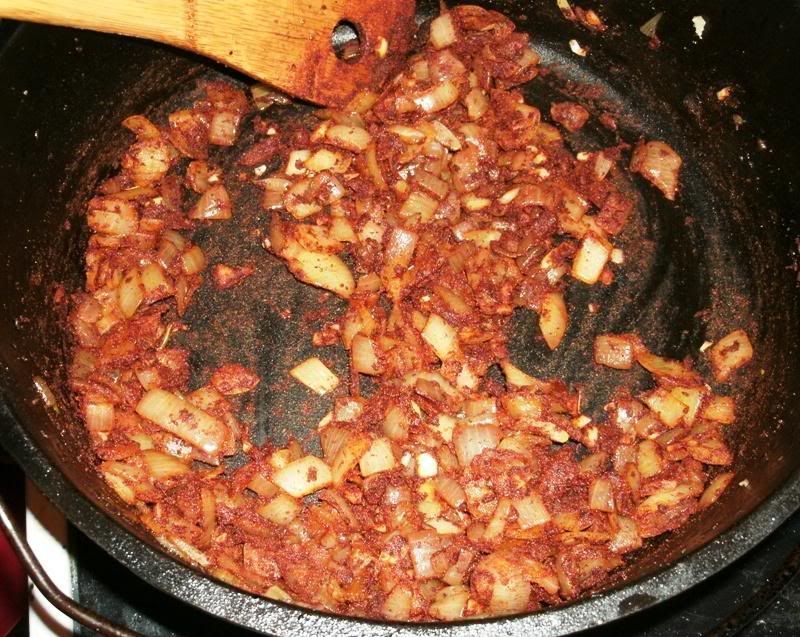
More on the effects of that action later. Traditionally, lard is used when making gulyás; however, since I had none on hand, I used a little butter for this step. After the beef was seared, I added an additional tablespoon of butter and cooked the chopped onions over medium heat for a few minutes, until they just started to turn brown and carmelise. Then I removed the Dutch oven from the heat and added the garlic and paprika to the onions, stirring them as the rich, red spice released its oils and darkened:
I then added the beef back to the Dutch oven, along with the broth, caraway seeds, salt and pepper:
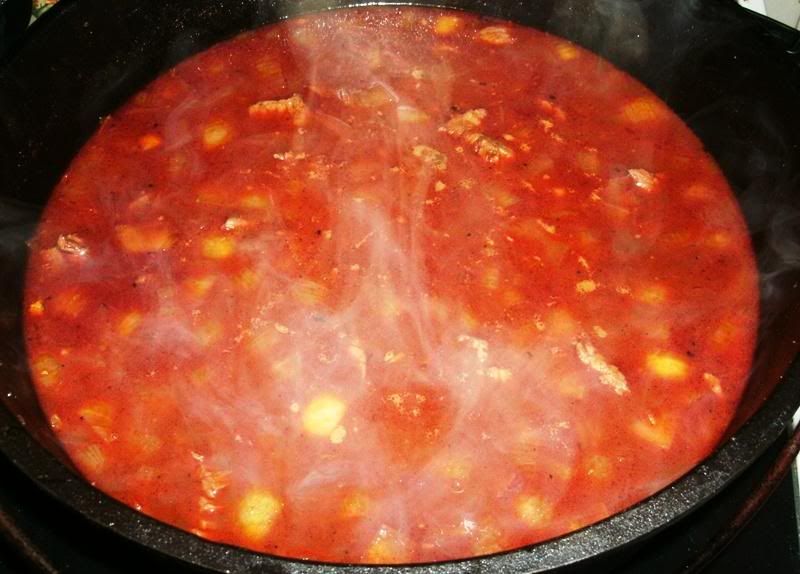
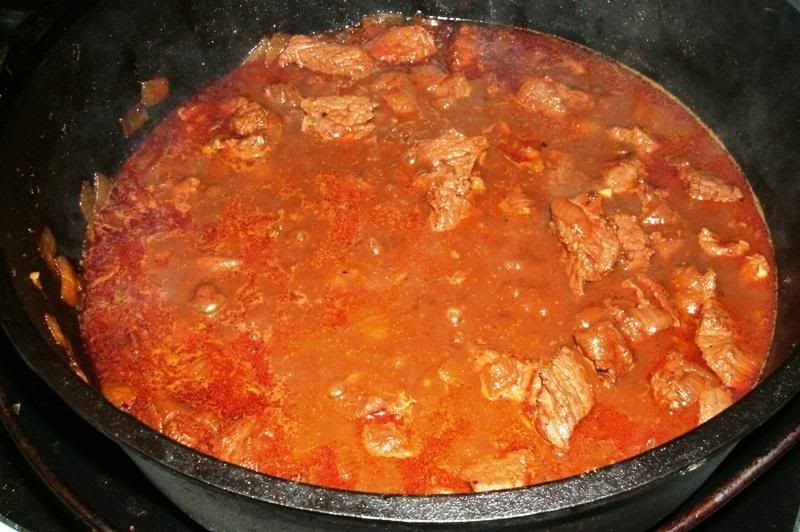
I brought this to a boil, then reduced the heat and simmered gently, keeping the lid only partially on so that some evaporation could take place and allow the gulyás to thicken up just a bit. After an hour, here's what I saw:
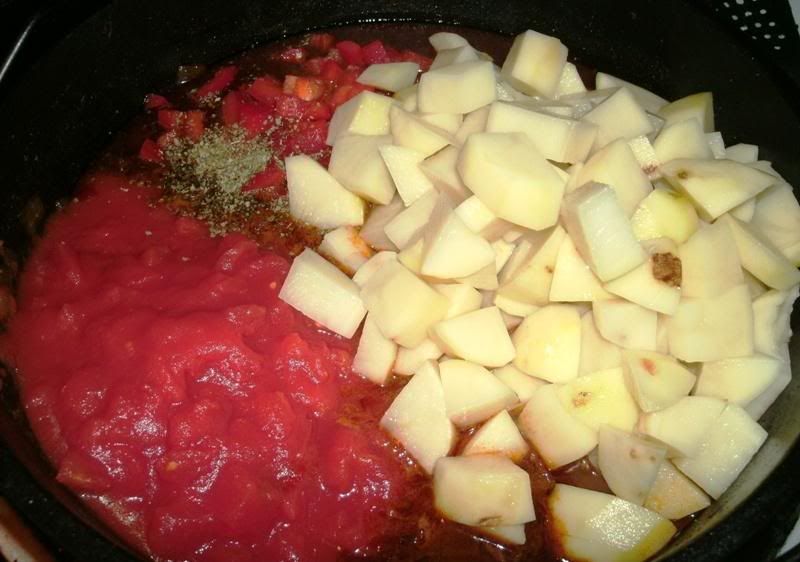
Next, I added the potatoes, tomatoes, chopped red pepper and marjoram:
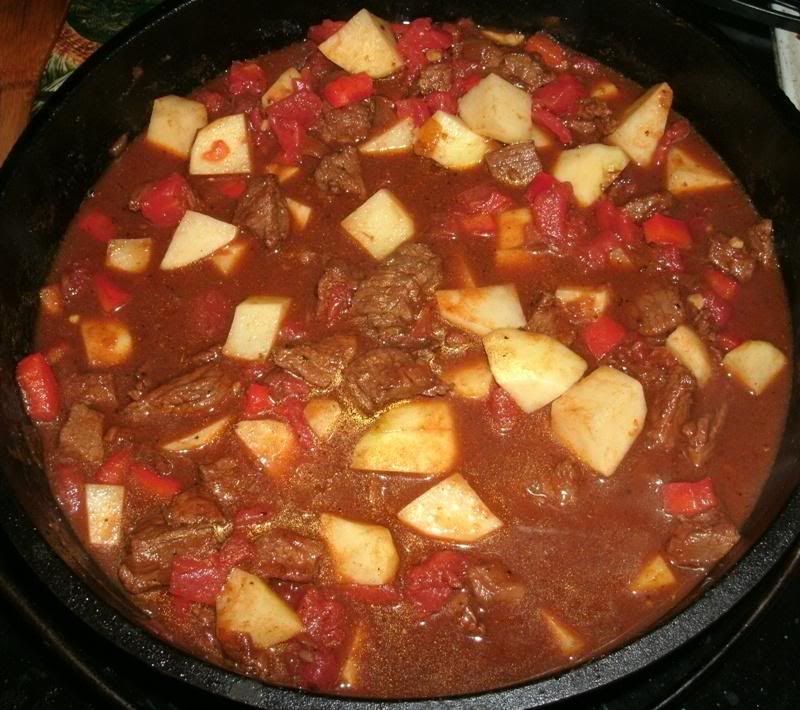
The recipe advised parboiling the potatoes first, but I elected not to do this; as far as I can tell, the finished meal did not suffer from it. The gulyás was really starting to look good:
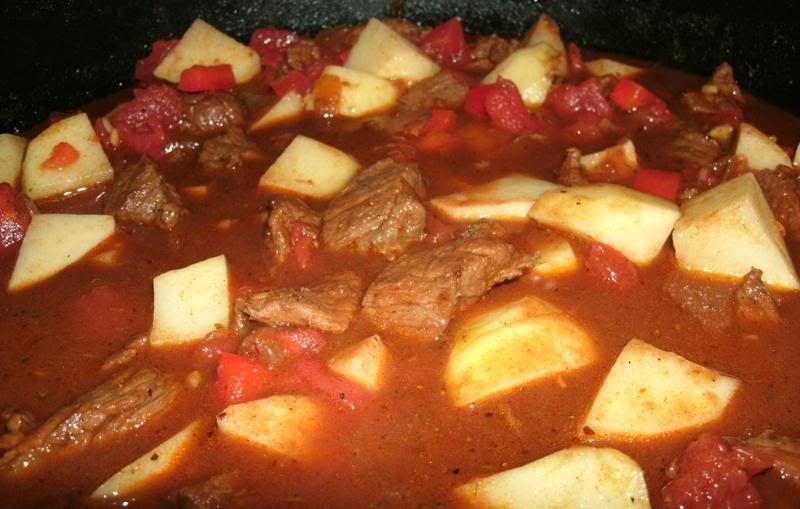
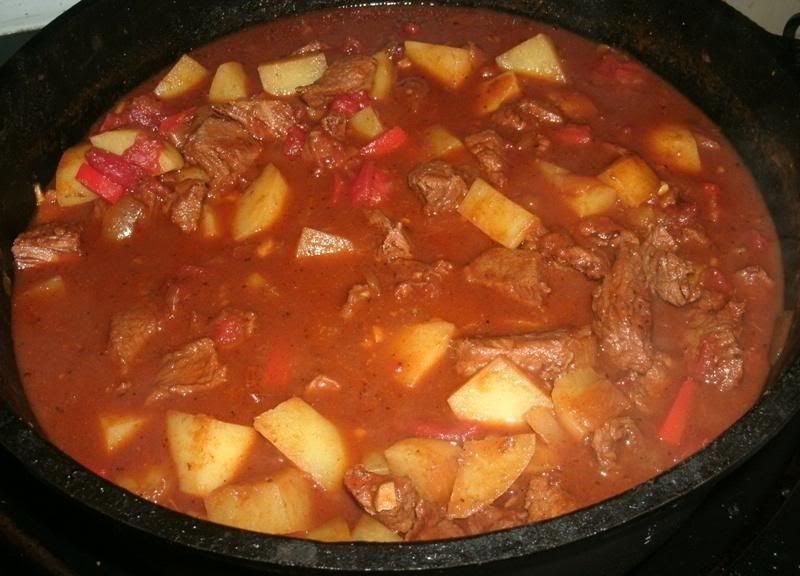
I had expected the gulyás to be much more reddish than it was; it appears that searing the beef beforehand results in a darker end product, due of course to the browning of the meat:
I then simmered the gulyás for another 45 minutes or so, partially covered, to cook the potatoes throughout and allow the beef to become fork-tender. During this time, the modest reduction brought on by evaporation allowed the gulyás to thicken and become even richer. But it wasn't much longer before the wonderful aroma and the delicious-looking gulyás could be ignored no more:
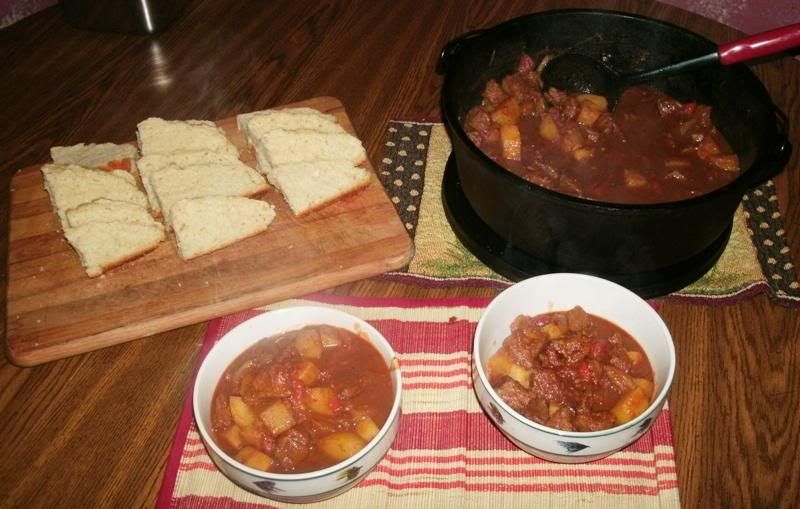
The gulyás was done, there was no reason to wait, so I served it along with some really nice beer bread that I baked earlier that day:
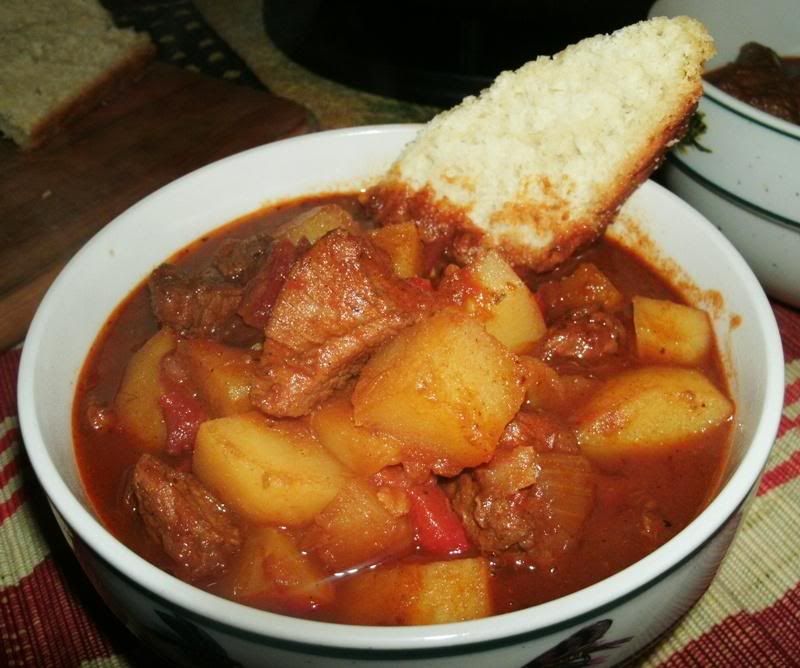
One taste was enough to convince me that this was NOT the goulash that was served by the lunch lady. This was rich, savory, satisfying gulyás, and trust me when I say that there is a difference:
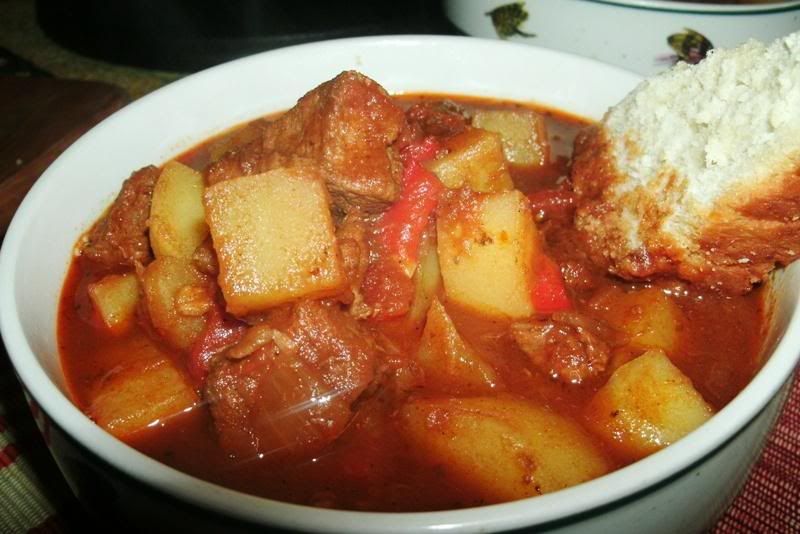
The tender chunks of potato carried the humble, yet noble flavours straight into orbit, accented just slightly by the tomatoes, marjoram, and even the hint of caraway and peppers that I had been so worried about. Interlaced through it all, the warm, dark paprika wrapped itself around me, taking me across the ocean to the verdant Hungarian plains. It wasn't at all difficult to imagine myself enjoying this humble, timeless meal under the stars as the cattle settled down for the evening, lowing their soft lullabyes to their calves.
My friends, this stuff is the real deal, and I can assure you, it will be a hit in your home. If you like beef, onions and tradition, you're going to love this. |
|||
|
If you are a visitor and like what you see, please click here and join the discussions in our community!
|
|||
 |
|||
| Sponsored Links | |||
|
|||
|
The Farmer's Wife
Scullery Servant 

Joined: 19 October 2011 Location: MT Status: Offline Points: 16 |
Post Options
Thanks(0)
Quote Reply
Posted: 29 February 2012 at 01:22 |
||
|
"taking me across the ocean to the verdant Hungarian plains. It wasn't at
all difficult to imagine myself enjoying this humble, timeless meal
under the stars as the cattle settled down for the evening, lowing their
soft lullabyes to their calves."
Beautifully written! I enjoyed the history lesson, very interesting. I shall be headed to the freezer in the morning, to find a large roast I can chop up and use for this recipe. Looks simple and scrumptious! |
|||
|
|||
|
Hoser
Admin Group

Joined: 06 February 2010 Location: Cumberland, RI Status: Offline Points: 3454 |
Post Options
Thanks(0)
Quote Reply
Posted: 29 February 2012 at 02:59 |
||
|
You've got me drooling all over myself here Ron...what a delicious, belly warming meal that must have been. There is something about a stew that just soothes the soul as far as I'm concerned.

|
|||
|
Go ahead...play with your food!
|
|||
|
|||
|
HistoricFoodie
Admin Group
Joined: 21 February 2012 Location: Kentucky Status: Offline Points: 4945 |
Post Options
Thanks(0)
Quote Reply
Posted: 29 February 2012 at 06:15 |
||
|
Good job, Ron. If Friend Wife (who is Hungarian) sees those pics I'm in big trouble. My whole menu plan will go out the window.
Anyone making this for the first time, please take especial note of the paprika quantity. That is not a typo!
This is not an American recipe, calling for a teaspoon of the stuff. The basic secret of Hungarian stews, be they gulyas, paprikash, or whatever, is that paprika is the base flavor. Note, too, that the recipe specifies "sweet Hungarian." If possible, follow that exactly. Spanish paprika has a totally different flavor profile.
|
|||
|
|||
|
Boilermaker
Chef 

Joined: 23 July 2010 Location: Marietta, GA Status: Offline Points: 685 |
Post Options
Thanks(0)
Quote Reply
Posted: 01 March 2012 at 20:49 |
||
|
Ron,
This is simply outstanding. One one of the keys to Hungarian cooking is the frying of the onions and you nailed it here, my friend. Burn them and the dish is ruined, undercook them and the dish lacks the sweetness and layered flavors that properly carmelized onions add, the Hungarians are all about the color of the onions and you got it absolutely right. Your cooking vessel is also 100% correct, beautiful. I can just picture a Magyar shepherd cooking gulyas in that pot over an open fire. Well done! I hope you enjoyed this old world dish as much as I do. |
|||
|
|||
|
TasunkaWitko
Admin Group
Joined: 25 January 2010 Location: Chinook, MT Status: Offline Points: 9389 |
Post Options
Thanks(0)
Quote Reply
Posted: 23 March 2012 at 10:34 |
||
|
say, i forgot to reply to this. first, thanks to all for the great comments; this is one absolutely amazing dish that is easy and full of flavour. since posting, i've made it twice again, once with green peppers (yikes!) i must say, i like it better with a red or with no peppers, but no worries, it is still good no matter what.
TFW - thanks for the compliments on the writing, i try but don't always succeed ~ did you give this a try? if so, how was it?
dave - we're heading almost out of stew season, so if you're going to give this a go, now's the time!
brook - you might as well make it for her now, because you know she's thinking about it! and yes, you are 100% right about the paprika. when cooking hungarian, my pimentón amuhado is defintiely not used.
andy, this stuff, as i said before, was outstanding and just right - i not only enjoyed it, i loved it, especially considering the cold, grey day when i made it. my only regret is that i waited so long to try it. i agree about the onions - they are definitely a key and contribute to the special flavour that can only be found here, with the slight sweetness and richer depth from the carmelisation.
|
|||
|
If you are a visitor and like what you see, please click here and join the discussions in our community!
|
|||
|
|||
|
Post Reply
|
|
 Tweet
Tweet
|
| Forum Jump | Forum Permissions You cannot post new topics in this forum You cannot reply to topics in this forum You cannot delete your posts in this forum You cannot edit your posts in this forum You cannot create polls in this forum You cannot vote in polls in this forum |


 Topic Options
 [Gulyás] is a soup or stew of meat...and vegetables (especially potato), seasoned with paprika and other spices. Originating in Hungary, goulash is also a popular meal in Austria, Bosnia & Herzegovina, Croatia, Czech Republic, Germany, Poland, Romania, Scandinavia, Serbia, Slovakia, Slovenia and some regions of Italy. It is one of Hungary's national dishes.